


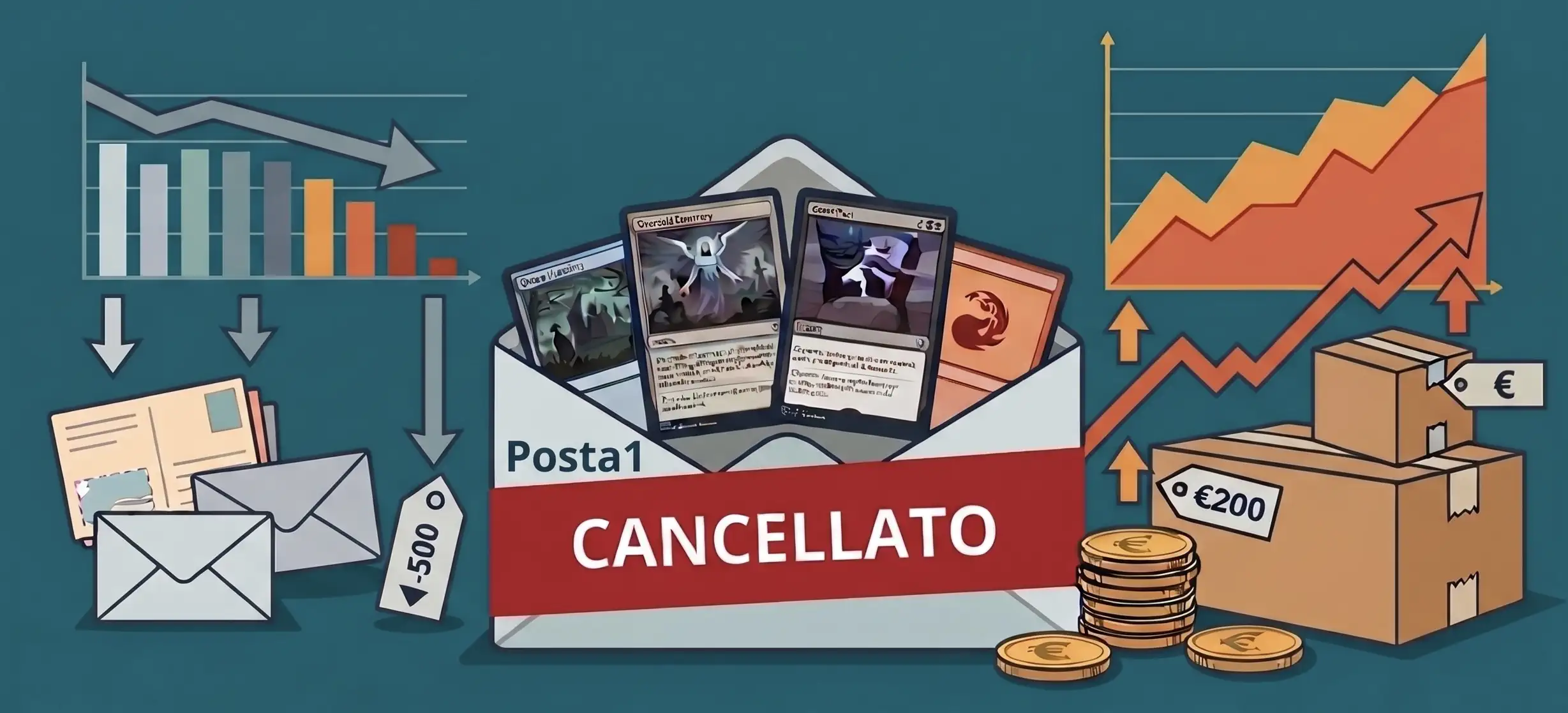
The End of Economic Shipping Will Impact the Card Market
From May 1, 2026, Poste Italiane will remove Posta1 and other priority mail services from the scope of the Universal Service. Specifically, services such as Posta1, Posta1Pro, Posta1online, and Postapriority Internazionale will no longer be available as universal products from that date. The communication was published directly by Poste Italiane on the page dedicated to the variation of the Universal Postal Service.
For many sectors, this might seem like a technical modification. For the collectible card market, however, it risks being a very concrete change. Posta1 was important for cardsIn the card market, especially for cards of low-to-medium value, shipping cost is a fundamental part of the purchase.
A card costing a few euros is only worthwhile if shipping remains cheap. Posta1, despite its limitations, was one of the most used tools for shipping small, light, and low-value items. It was a fast, simple, and relatively low-cost solution.
Its elimination changes the balance: if the minimum available shipping becomes more expensive, even cheap cards become less convenient to buy individually.
Impact on Sellers
For sellers, especially private individuals and small sellers, the main problem will be keeping low-value orders competitive.
Until now, it was possible to sell a single cheap card with shipping proportional to the item's value. With the end of Posta1, the minimum shipping cost is likely to increase, making many micro-sales less sustainable.
This could lead to three effects:
- less convenience in selling single cheap cards;
- greater push towards multiple orders or larger carts;
- increase in the final price perceived by the buyer, even when the card price remains unchanged.
It's not necessarily the price of the cards that increases, but the overall cost to receive them.
Impact on Buyers
For buyers, the change will be immediately visible at checkout.
A card costing 2 or 3 euros might no longer be convenient if the minimum shipping costs almost as much as, or more than, the card itself. This can reduce impulse purchases and make small-amount transactions less attractive.
The market might therefore shift towards more considered purchases: fewer single orders, more aggregated orders, more attention to the relationship between card value and delivery cost.
A Problem Especially for Low-Value Cards
High-value cards will be less impacted. Buyers of a 100-euro card are already more willing to pay for tracked, secure, and more expensive shipping.
The real problem, however, concerns commons, uncommons, cheap rares, low-priced staples, and generally all those cards that only make sense if the logistical cost remains low.
In this segment, even an increase of a few euros in shipping can completely change the convenience of the order.
What Could Change in the Market
The end of Posta1 could accelerate some existing dynamics:
- increase in multiple orders;
- greater importance of aggregated carts and the use of services like CardTrader Zero;
- reduction in single sales of very cheap cards;
- greater weight of platforms that can optimize logistics and consolidation;
- possible pressure on sellers to offer more efficient alternatives.
In other words, the market might become less favorable to direct shipping of very small orders and more oriented towards models where multiple cards are bought and shipped together.