

Modern Metagame: Relief after the Grief?
As we all know, on August 26, Nadu, Winged Wisdom and Grief left Modern, finally opening up the format and providing a much-needed breath of fresh air to a format that had been practically monolithic until then.
Indeed, before the Modern Horizons 3 Pro Tour won by Simon Nielsen, hopes for a diverse meta dominated by new cards like Nadu, Winged Wisdom, Necrodominance, Ocelot Pride, Psychic Frog, Phlage, Titan of Fire’s Fury, and so on, were high, but reality is usually much colder and harsher.
Bant Nadu not only won the PT, but definitively dominated the format, establishing itself as an undisputed Tier 0, with a remarkable 0 matchups below a 50% win rate according to online and paper statistics.
So, the ban of Nadu, Winged Wisdom was fairly predictable. The ban of Grief was a bit more unexpected (and slightly delayed), as many anticipated it for Legacy but it surprisingly also arrived in Modern.
Well, with this, the format is fixed, many different cards that were “soft-banned” due to Nadu's presence are now playable again, many decks return from the depths, the sun shines, the meta becomes varied, there are no more rules, and every deck can do well. Wizards has managed to fix the unfixable, Modern is saved!
But did it really happen that way?


Since we'll be discussing the metagame, I'll try to use some data gathered from around the web. Below are the power rankings for the format's Tier 1 decks in July (first table) and August (second table) 2024, courtesy of QuietSpeculation.com (excellent meta analyses, highly recommended if you're comfortable with both English and math). As you can see, July's meta was primarily a product of the Pro Tour, with Necrodominance's excellent position being a prime example. In August, however, we can see that effectively only well-established strategies continued to perform well: Bant Nadu was obviously untouchable, but behind it, the two versions of Energy, Boros and Mardu, had already asserted themselves, just waiting for the right moment to steal the crown as the format's undisputed Tier 1.
Having outlined how the format generally presented itself before our Egyptian bird had its wings clipped, let's move on to analyze the winners and losers of this ban list.
Losers
Necrodominance
Starting with the fact that I personally think Necrodominance is a deck that is both difficult to build and to pilot correctly, the ban of Grief removes a truly powerful weapon from the arsenal of all Scam-like decks, which are definitively dead after this announcement. Necrodominance is a complex deck, and many of the versions circulating in the format were built by abusing various discard spells, to which Grief itself was added as additional disruption, all supported by the card advantage generated by the namesake enchantment. Today, this strategy has become suboptimal, and lists are being updated and divided according to different schools of thought. What is certain is that the format, having generally adopted a more aggressive nature, does not favor the presence of this deck in the top tiers.
Jeskai Control
Considered the Nadu killer deck, thanks in part to Javier Dominguez's impressive performance at PT MH3, Jeskai Control received a total restyling thanks to MH3: the Energy package consisting of Tune the Narrative, Galvanic Discharge, and Wrath of the Skies provided greater flexibility, the strongest removal in the format, and the most undercosted sweeper in history. Completing this new facelift for the archetype is a wincon that doubles as removal and a tempo play in Phlage, Titan of Fire’s Fury, which also mitigates The One Ring's drawback by recovering precious life points. But the truth is always a bit more bitter, and Jeskai Control actually didn't have as positive a matchup against Nadu as was claimed, nor does it currently have a range of clearly favorable or at least playable matchups. With the format taking a more aggressive turn, with threats that are always in tandem and never single, and a manabase that calling "shaky" seems like a compliment, Jeskai Control often loses to itself, with suboptimal interactions between mana and cards in hand, or to threats that are difficult to resolve, such as The One Ring itself. However, Jeskai Control is a deck beloved by those who play it, who will decide to play this archetype regardless of the meta and other trivialities.
Winners
Boros/Mardu Energy
The King is dead, long live the King! With the forced retirement of Nadu, Winged Wisdom
from the tables, the top step of the podium is aggressively stormed by the new versions of Boros and Mardu Energy, practically a deck formed almost exclusively by Modern Horizons 3 cards. Guide of Souls, Ocelot Pride, Phlage, Titan of Fire’s Fury, Amped Raptor, Static Prison, Galvanic Discharge, all new additions to the format with a very high efficiency rate, and an absurd snowball potential make this deck solid, aggressive, but also capable of managing long games, transforming into midrange, control, or pure aggro depending on the situation. The Mardu version incorporates black to try to gain an advantage over its Boros cousin: on one side we have Orcish Bowmasters, Chthonian Nightmare, and Ob Nixilis, the Adversary, while on the other side we have Blood Moon to manage greedy manabases. If you check the August metagame according to QuietSpeculation, you can clearly see that by combining the various Energy (and Bombardment) versions, they were already largely more played than Bant Nadu, cementing Boros Energy as the new undisputed Tier 1 of the format.
Goryo’s Vengeance
While on paper the ban of Grief should have hurt Goryo, the reality is that it removed suboptimal cards that led to very strange games, where the Goryo player would execute the Grief and Ephemerate combo, only to accomplish nothing and lose the advantage generated in the very first turns of the game. Also thanks to the presence of Psychic Frog, Goryo today is much more stable and flexible in its Plan A, but is also capable of playing a Plan B more oriented towards tempo/control, where Psychic Frog plays a pivotal role as both a discard outlet and a difficult-to-manage threat. The new lists double the consistency of this Plan B with the addition of Emperor of Bones, another MH3 card that went under the radar but has been re-evaluated in the new Modern. Goryo therefore stands as a deck with very few dead cards, with a strategy capable of closing games as early as turn 3, and also capable of playing long attrition games thanks to an almost transformative sideboard.
Amulet Titan
“Amulet has remained tier 0 or 1 through metas with KCI, Hogaak, Eldrazi, Oko, Mox Opal, Treasure Cruise/Dig Through Time, Faithless looting/Golgari Grave Troll Dredge, and to this day. The deck is always the most broken thing in modern and just avoids bans by being hard to play.” This is the copypasta that all Amulet players know, also because it's all true. Amulet in the Nadu era was simply unplayable, because Nadu was a pretty bad matchup, and there was no point in playing a creature-based combo that wasn't Nadu itself. With Nadu out of the picture, Amulet has returned to being a real contender in the format, having a good matchup against traditional midrange strategies like Boros Energy. Furthermore, the cabal of Amulet players has managed to innovate the lists even further, making a leap in quality and adding a new level of additional complexity within a deck that was already not exactly the epitome of easy-to-pilot decks. In fact, thanks to the printing of Shifting Woodlands, infinite damage has been unlocked thanks to Aftermath Analyst and Lotus Field, in a loop that is as resilient as it is tedious to perform online.
Dimir Frogtide
Psychic Frog is one of the cards that benefited most from the Nadu ban. Widely anticipated during spoiler season as an incredibly pushed creature and moral heir to Psychoatog, the new Frog completely revolutionized UR Murktide, forcing it to adapt to a blue-black version. Psychic Frog quickly proved to be a difficult-to-manage threat, capable of generating card advantage, applying pressure, and closing games fairly quickly, also aided by various permission effects in pure blue-based tempo style. Dimir Frogtide has therefore greatly benefited from the meta shift as the deck has finally become playable. That said, blue-based Tempo style always has several flaws and this iteration is no exception: the deck is incredibly efficient at playing on the stack, but does not manage the board with the same efficiency.
Ruby Storm
Ruby Storm was another highly anticipated deck at PT MH3, where a spectacular debut was expected, but instead the deck registered a meager 33% overall win rate despite a presence of almost 10% of the total field. A resounding defeat for the deck. However, Ruby Storm was and remains truly explosive and capable of consistently winning in the first two/three turns of the game. With very few countermeasures to the Storm plan main-decked by most decks in the format, Ruby Storm starts 1-0 in most matches, only to then have to deal with post-side hate like any true full combo deck. Ruby Storm is one of those Dredge-style decks: if no one has a dedicated sideboard plan, the deck practically sails through tournaments, given the speed, redundancy, and resilience of the refined lists over the months. But like any pure combo, it struggles to deal with more than one piece of hate at a time, which makes it a deck to respect, but still containable.
Light at the end of the tunnel (?)
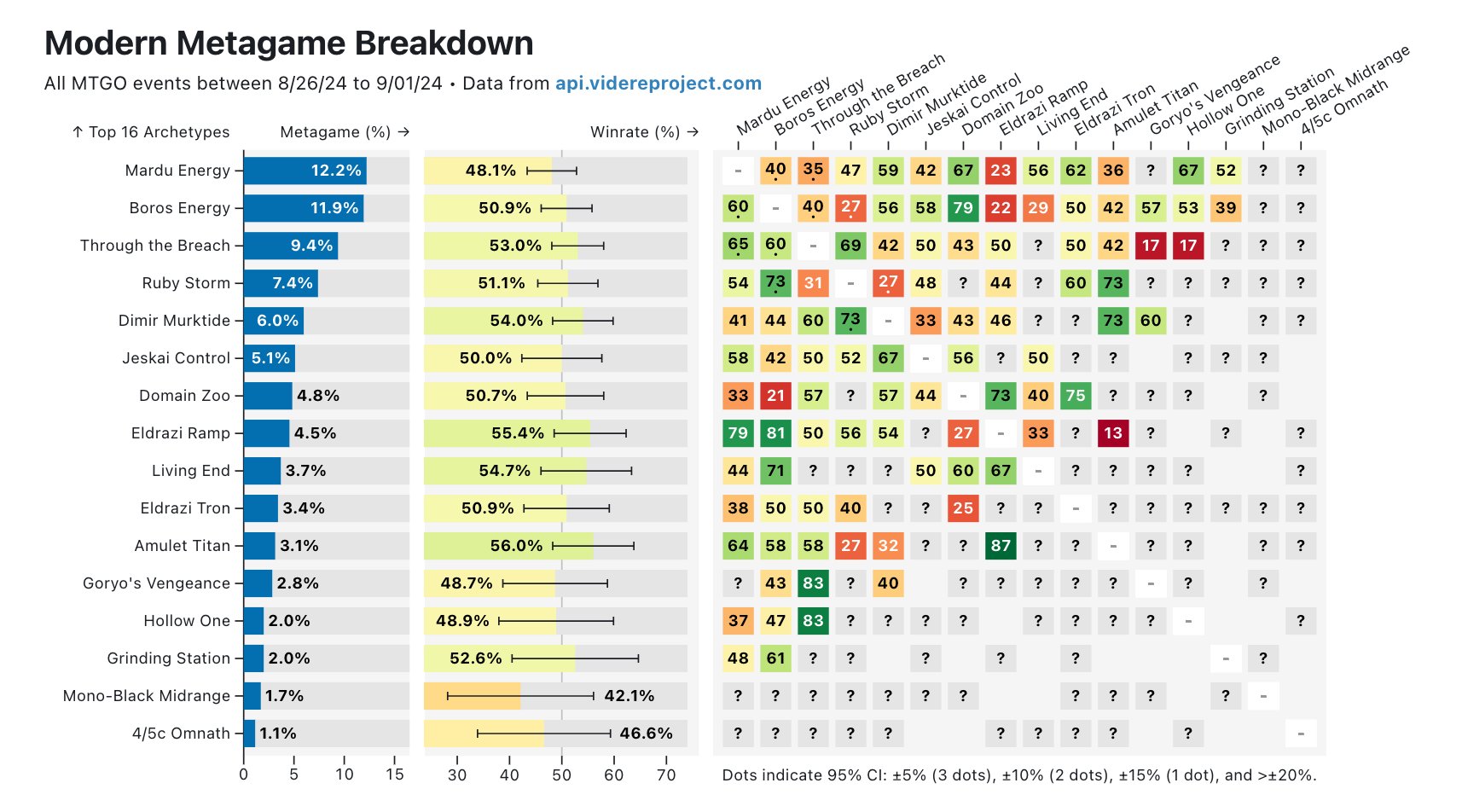
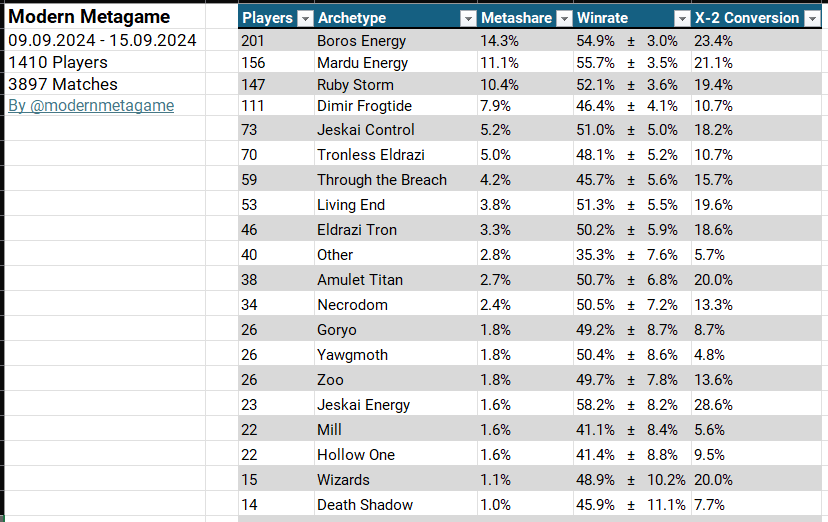
So, how does Modern look after the ban of Nadu, Winged Wisdom and Grief? As you can see from the reported charts and tables (courtesy of @TheQonfused, @AnaelYahi, and @modernmetagame, whom I invite you to follow on Twitter), the format is not as varied as one might have expected or imagined. Summing up the Energy variants, we have a good 20% of the format dominated by Guide of Souls, Ocelot Pride, and Ajani, Nacatl Pariah, followed at a clear distance by Ruby Storm, Eldrazi variants, Frogtide, Jeskai, and then the rest of the format. The situation has improved compared to Nadu's unchallenged dominance, but this does not mean that the format is "healthy," quite the opposite. Modern after the advent of MH3 remains somewhat uninteresting and unvaried to play, despite there being many "playable" decks; the truly competitive ones can be counted on one hand. If we want to exacerbate the point, even though Boros Energy is an interactive deck by design, given its midrange nature, many games seem completely non-interactive, with very few choices and defined by explosive starts that are difficult to respond to efficiently. And this applies to most of the decks listed above: Ruby Storm closing on turn two, FrogTide resolving a Frog on turn two and protecting it with infinite counterspells while continuing to draw cards, Eldrazi capitalizing on mana advantage through Kozilek’s Command, Sowing Mycospawn, Ugin’s Labyrinth and Eldrazi Temple, Amulet starting with Urza’s Saga
Amulet of Vigor
turn one, Goryo surveiling Atraxa, Grand Unifier to reanimate it on turn two, and so on. On paper, the format seems open, interesting, and geared towards close, interactive games where choices impact the game in both the short and long term, but the sad reality is that we live in a format where most decks look at each other and play their own game, without caring about who they are facing. And there are truly only 4 or 5 genuinely playable decks. To give you an idea, at the Nordic Masters in Malmö, between Day 1 and Day 2, I played 14 rounds, 3 of which were against Dimir FrogTide, 4 against Boros/Mardu Energy, and 4 against Eldrazi Breach. Not exactly a varied format, to be honest.
Tierlist
Inspired by my friend Marchino (@isthattruehero), I'm adding a Tierlist at the end of this format overview with the primary goal of providing a visual representation of the meta, but especially to elicit comments from people who feel offended by the ranking given to their pet deck.

- Tier 1: Boros Energy, Mardu Energy, Eldrazi Breach, Eldrazi Ramp
- Tier 1.5: Ruby Storm, Amulet Titan, Goryo’s Vengeance, Dimir FrogTide
- Tier 2: Jeskai Control, Living End, Twiddle Storm
- Tier 3: Merfolk, Rhinos, Domain Aggro, Hardened Scales, Necrodominance
- Off-Meta: HammerTime, Mill, 4c Omnath, Affinity, Creativity, Temur Breach, Yawgmoth
I wanted to differentiate between Tier 1, Tier 1.5, and Tier 2 because, in my opinion, the decks in Tier 1.5 are much closer in power level to the 4 (actually 2) decks in Tier 1 than those listed in Tier 2, and I didn't feel comfortable lumping them all under one umbrella.
The Nadu ban didn't save Modern; it transformed it into something different but still similar. Modern Horizons 3 brought a general reset of the format, but also a new archetype that has established itself as the new Gold Standard. The format is playable, but not necessarily fun, varied, or interesting. The Modern RCQ season will last for another couple of months, so let's brace ourselves and prepare to face cats, frogs, machine guns, and interdimensional monsters.
Until next time, Jimmy, follow me on twitter for weekly banter, bad decklists and not really humble opinions.