


The week of March 23rd to 29th is a quiet one, allowing time for reflection. We'll start with an in-depth look at the *Banned and Restricted Announcement* from the beginning of the week, then move on to alternative new decks that could make an impact in the format, and conclude with the usual bi-weekly update on format prices.
1| Banlist Update: No Changes
The week begins with a Banned and Restricted Announcement from Wizards of the Coast. For Standard, there are no changes. The article, written by Jadine Klomparens (senior game designer on the Magic: The Gathering Play Design team), states that Standard is considered a diverse and healthy format. Apparently, there are no indisputably dominant decks, and new strategies are constantly emerging, shuffling the meta and win rates. Jadine continues by writing that the overall picture of Standard remains the same as post-Pro Tour Lorwyn Eclipsed, as the Teenage Mutant Ninja Turtles edition has not caused a major upheaval.
Green bases fluctuate around Badgermole Cub, and the rest of the meta tries to counter the cub. A few other combo and aggro decks complete the meta, aiming to beat it with speed or power. Within this scenario, however, something has changed in the order of operations. Previously, cub decks were paired with Nature’s Rhythm to force Craterhoof Behemoth onto the battlefield, which effectively constituted a combo kill. Now, cub decks are almost always mono  strategies based on the Landfall mechanic. This different approach overperforms against threats, frequently including the Icetill Explorer and Mightform Harmonizer package.
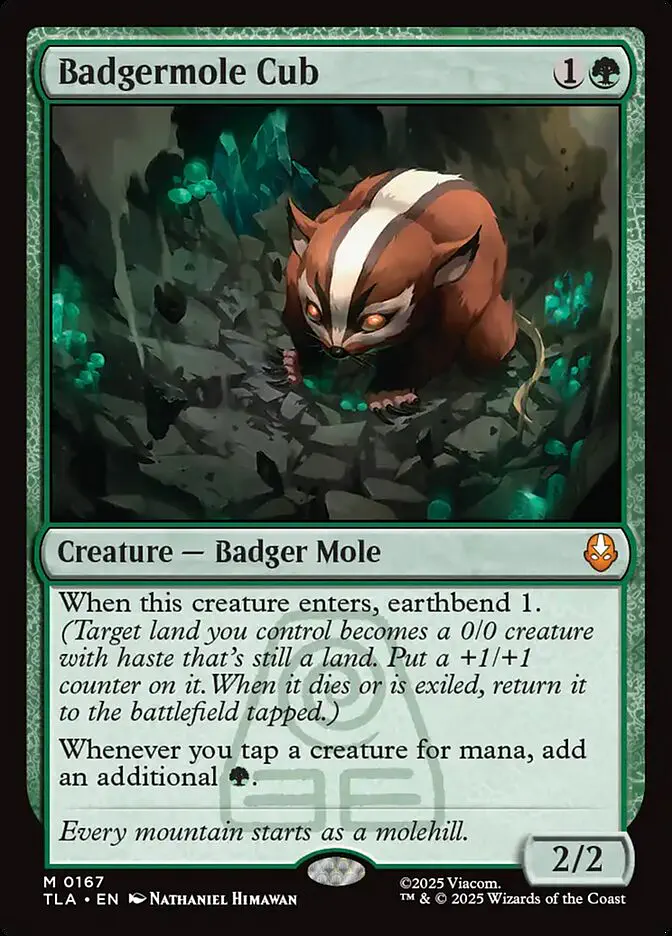
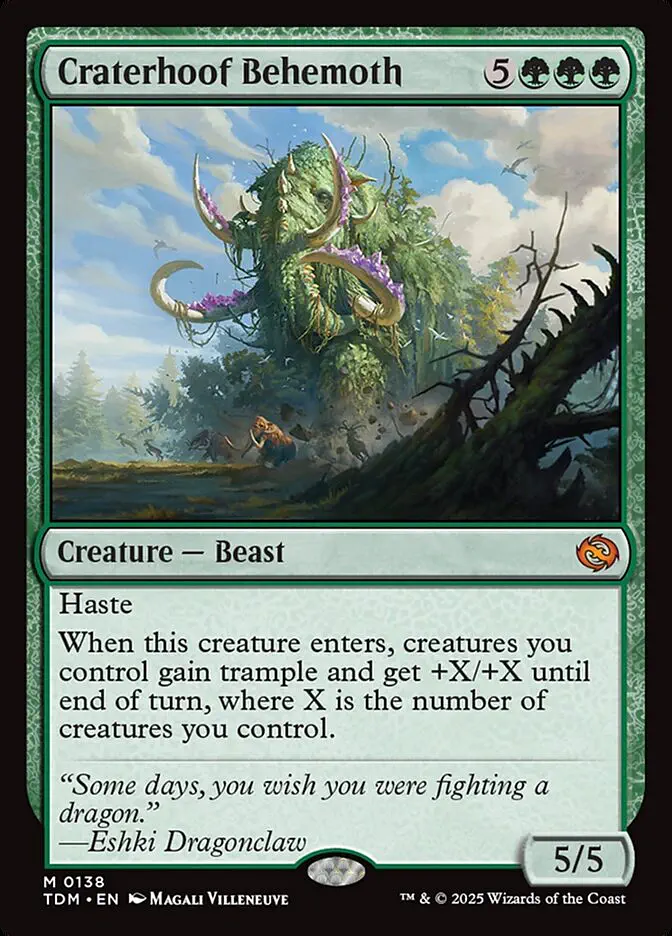
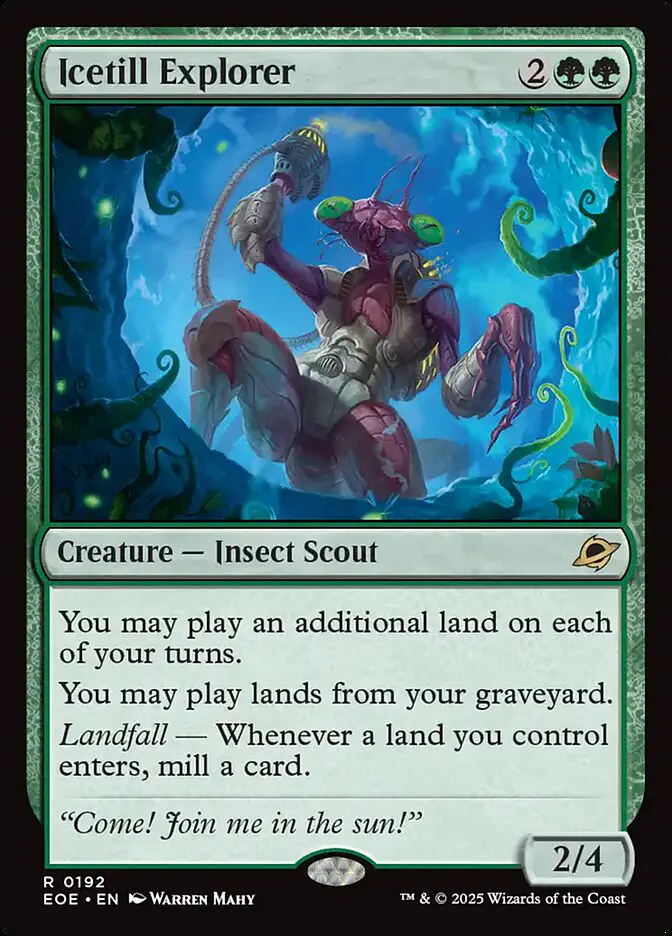
*A side note from me*: even if less flashy than Rhythm-Behemoth, Mightform Harmonizer warped together with any other repeated landfall effect also seems like a kind of combo to me. However, I understand that it is not in a technical sense, and also that the landfall interactions that must be inserted between Harmonizer and the attacking creature that is boosted make the whole thing much more nuanced and acceptable.
Jadine concludes her article with a very important observation. Although it's clear to everyone that current Standard is beautiful, fun, diverse, healthy, and popular, the Play Design team recognizes that the speed of the format is higher than it should be. Some decks exert too much pressure in the early stages of the game. They are aware of this critical issue and are working to resolve it with future editions.
After the March 23, 2026 article, a further explanation of the Banlist Update was provided during the WeeklyMTG live stream on March 24, 2026. In the latter, the connection between the card Badgermole Cub and the gradual acceleration of the format seems more explicit. Cub is under observation: it was not banned now, but it could face the axe in the future. In short, Cub is not broken, but it is concerning. Not strong enough to be banned immediately, but dominant enough to impose a survival test on the format.
After this negative shadow, we move on to the other side of the coin: it is remembered how Cub also does something positive for the format, which is to make green bases competitive. However, it is one of the Play Design team's priorities to find ways to achieve the same result without the side effects caused by Cub.
2| Golgari First Dimension
Some archaeological research into unfashionable color pairings led me to rediscover two possible futures for  . The first is a very synergistic combo version that, with a bit of refinement, has the potential to become relevant. I'm using Sebastian Vearncombe's brew from the ANZ Super Series Cycle 11 Regional Championships in Sydney as an icon.

The deck incorporates Mutagen Man, Living Ooze to ensure that the Mutagen Tokens generated by the deck sacrifice themselves without taxing mana. This effect enters positive spirals when interacting with cards like Michelangelo, Weirdness to 11, which brings a Hardened Scales effect to the format.
Mutagen Man also works well with Phoenix Fleet Airship. The latter not only copies itself thanks to the sacrifice of Mutagen Tokens, but each copy retains the ability to copy itself, going from one to two, from two to four, and from four to eight. Essentially, if it's not removed quickly, that airship will dig our opponents' graves.
Returning to Michelangelo, Weirdness to 11, this fine gentleman also positively influences the board effect generated by Ouroboroid. A good addition is also The Fire Nation Drill, a card I've always found interesting. In this deck, our creatures will become very large very quickly, but not always evasive. They might encounter indestructible blockers. This creates classic situations where you're not afraid to block, a bad situation for an aggro deck that needs to deal damage.
Since assigned damage remains on a creature until the end of the turn (this is a less technical explanation, the judges reading this will forgive me, but here the need for concise, constant updates is paramount and nothing else), then resolving Drill's activated ability before the Ending Phase can destroy even those blocking creatures.
3| Golgari Second Dimension
Here we have a Reanimator version that is not suboptimal compared to previous ones that relied on Superior Spider-Man. Those suffered too much from an unequal comparison with  Excruciator.
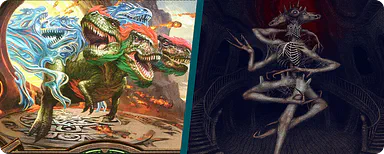
In this version, piloted by Paul Gabat at the MTG SEA Championship Final 2025-26 Round 2 (Southeast Asian RC), we find many good ideas borrowed from other decks. In this new home, however, they regain their color. The list, in truth, considers more than one game plan.
The reanimator line consists of sending powerful resources (like Valgavoth, Terror Eater or Summon: Behemoth) to the graveyard using cards like Bitter Triumph or Overlord of the Balemurk, and then reanimating them onto the battlefield with Zuko’s Conviction. However, this game strategy seems secondary to me. The deck's name is misleading.
The main line relies on the triggered ability of Kona, Rescue Beastie, tapped with the help of Evendo, Waking Haven or Susur Secundi, Void Altar. This allows you to put an impactful resource, such as Vaultborn Tyrant or Ghalta, Stampede Tyrant, from your hand onto the battlefield.
My aversion to "station lands" is well-known; I consider them poor cards because I don't believe their abilities justify the time sacrifice of having to play them tapped. In particular, Evendo, Waking Haven truly has a rather useless ability in the format compared to its activation timing (yes, you understood correctly: mimicking Gaea’s Cradle is not enough to be the belle of the ball). However, it seems this is one of the most advantageous ways to ensure you can tap Kona immediately without being forced to attack with her.
I offer a suggestion for improvement: perhaps integrating one or more copies of Lumbering Worldwagon into the list could make the deck even more performant. To assist its described game plans, the deck also considers a toolbox option kindly offered by the card Archdruid's Charm.
4| Format Prices
Update on the Standard MOLE Index for format prices. The distribution of the field, compared across multiple meta-tracking databases, yielded an analysis sample of 10 decks (Excruciator, monoLandfall,  Lessons, Midrange, Prowess, Spellementals,
  MOMO, Momo White, Rhythm, 4c Elementals).
The contraction of observed points indicates a concentration of positions towards certain archetypes, increasing their popularity at the expense of format diversity. This happens in multiple situations. In this case, players are relying on either very established or extremely experimental strategies. Many well-known Tier 2 decks have seen a decrease in participation.
The arithmetic mean has slightly cracked at €386.95, the robust median stands at €363.4, the geometric mean overshoots at €455.7, with the lower outlier being Mono White and the upper outlier being Bant Rhythm.
We can therefore conclude that the cost of Standard has remained stable on average. The arithmetic mean and the robust median are closer (demonstrating a more symmetrical deck price distribution than before) and the geometric mean rises slightly due to the replacement of the lower outlier with Momo White.
The geometric mean of the other formats used for comparison remained substantially identical to the previous one. It is reported below: Vintage €24,826, Legacy €3,950, Modern €688, Pioneer €415, Pauper €132.
Taking all formats as a sample, Standard remains the third most affordable. If we limit the scope to competitive formats only (Modern, Pioneer, and Standard), then Standard is the middle format, but with only a €25 difference from Pioneer, which is negligible. Furthermore, I remind you that this is a comparison of the geometric mean, not the arithmetic mean. The arithmetic mean, which is more precise but takes longer to calculate, often shows Standard well below Pioneer, revealing its true nature as the most affordable competitive format and the second most affordable constructed format overall after Pauper.
“See You Space Cowboy”
Francesco