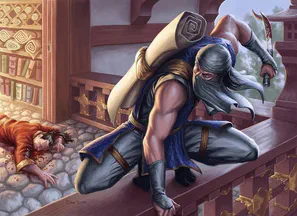



In the previous chapter, we saw how easy it seems, at least on paper, to get into Pauper: a few clicks are all it takes to find a decklist, copy it, and show up at the table. But choosing sixty cards is just the beginning. The real transition happens when you actually start playing those cards, and that's exactly where many players hit their first misunderstanding about the format.
From the outside, Pauper is often looked down upon as Magic’s "Thursday night complex": a cheap, local indie band destined to play far away from the big stages. A format made of commons, so it must be simpler. Almost like a little time-killer before the real concert starts.
It’s an understandable assumption, but also a deeply flawed one. It would be like arguing that a song built on three chords is automatically easy to play well: the tools might be basic, but what matters is how you use them. Pauper works the exact same way. The cards are common; the decisions are anything but.
And this is precisely where what I like to call the "First-Time Pauper Complex" comes from: the surprise of players entering the format expecting something straightforward, only to discover a game of precision, preparation, deep knowledge, and endless nuances.
The Illusion of Price
The first trap is financial.
Pauper allows you to build many competitive decks for a fraction of what you would spend in other Magic formats. It’s one of its biggest selling points, and a major reason why so many players decide to give it a shot. The problem starts when we automatically translate this affordability into a judgment on the format's difficulty: low cost, low skill level. The association is easy to make, but it doesn't hold up.
Pauper simply asks you to pay in a different currency. Not necessarily in cash, but in format matchup knowledge, experience, adaptability, and hours spent figuring out sequences and sideboard plans. The deck might be cheap, but learning to pilot it well takes time. And that’s exactly what makes the format so interesting: accessibility makes it easier to pull up a chair, but it doesn't bypass the grind required to actually get good. The ticket might be cheap, but that doesn't mean the concert is short.
Simple Doesn't Mean Easy
The second misunderstanding stems from the cards themselves.
If you look at many commons individually, it’s easy to think their play pattern is linear: creatures, removal, counters, cantrips, artifacts, lands—usually with effects you can understand at a glance. But Magic isn't played by reading one card at a time. It’s played by managing resources, information, timing, and priorities, and it’s in the interaction between seemingly simple elements that Pauper builds its incredible depth.
A decision made on turn three can easily come back to haunt you five turns later. Playing a land versus holding it in hand, burning a removal spell immediately versus waiting, developing the board versus leaving mana up: these are seemingly minor choices that completely reshape how the game unfolds.
In Pauper, you don’t usually lose because your opponent resolved a single, unbeatable bomb. Far more often, games are decided by the accumulation of micro-advantages and tiny punts: a resource spent a turn too early, an unnecessary attack, showing a card too soon, or sequencing your plays in the least efficient order.
It's like playing a song everyone knows: the notes might be simple, but miss the tempo by a fraction of a second and the whole thing falls apart. The format rewards precision because most games are built decision by decision.
The Decision-Making Complex
Once you actually sink your teeth into Pauper, you quickly realize there are very few shortcuts. Sure, you'll have nutty nut-draws, insane topdecks, and games that wrap up in a few turns, but as the skill level of your opponents goes up, relying solely on the raw power of your list won't cut it. You have to understand the flow of the game: what your role is at any given moment, whether you need to be the aggressor or play defense, which of your opponent's resources actually matters, and whether you can afford to play around a specific card or if doing so will cost you too much tempo.
The answers are constantly shifting. The exact same deck can require a completely different approach depending on the matchup or even your opening hand. A key card in one game can become completely dead in the next; a conservative line might be correct against one opponent and painfully slow against another.
Because of this, simply knowing "how your deck works" isn't enough. You have to learn what it wants to do in that specific game. It’s a subtle distinction, but a massive one.
Pauper Isn't Played in a Vacuum
And then there's the metagame.
In the previous chapter, we talked about the importance of analyzing data, results, and archetype shares before choosing a list. However, once you start hitting your local scene, you discover another fundamental truth: the Pauper that exists online is not necessarily the same Pauper you’ll face on Thursday night at your local game store.
Every local meta develops its own personality. Some stores are swarming with aggro, others are dominated by artifact strategies, and some are packed with players who love nothing more than long, grindy games and decks that generate value over time. The theoretically "best" list on MTGO isn't always the best list for the room you're actually playing in.
And that’s where the preparation gets fun. Knowing your local meta means understanding who you're going to face most often, which decks are piloted by the store's best players, which strategies are on the rise, and which are dying out. It also means accepting that a netdeck might be fantastic while still needing a few tweaks to run smoothly in your local meta. Pauper isn’t just a format; it’s the community you play it in.
Your Sideboard Tells the Story of Where You Play
Nowhere is this difference more obvious than in your sideboard.
Fifteen cards might not seem like much, but they often hold a wealth of information about the tournament you expect to play. A great sideboard isn't just a pile of generically strong cards; it's a toolbox of specific answers to specific questions: which matchups do we need to shore up, what strategies do we expect to run into, how much space can we dedicate to a single archetype without exposing ourselves elsewhere, and which maindeck cards lose their luster after Game 1?
These questions turn your sideboard from an afterthought into a core piece of your game plan. It’s also where the line between copy-pasting a deck and actually understanding it becomes clearest. You can import all seventy-five cards from a winning list, but if you don’t know why those fifteen cards were chosen, when to bring them in, and what to take out, you've only copied half the homework. The rest is on you.
Prepping for Thursday Night
It might sound a bit tryhard to talk about prep for a regular local tournament. After all, it's just Thursday night: you show up to the shop, play a few rounds, shoot the breeze, and go home. And that's totally fair. But one of the things I love most about Pauper is that you get to choose exactly how deep you want to go.
You can sit down just to play and have a good time, or you can treat every local event as a mini competitive laboratory. If you want to level up, preparing means remembering the matchups you faced in previous weeks, watching what others are playing, analyzing which cards overperformed and which felt dead, tweaking your sideboard, and trying to predict how the room might shift.
You don't need to treat your local league like a second job. You just need to pay attention, because one of the most critical skills in Pauper is reading the room and adapting. A list that just crushed a Challenge online might have been tuned for a completely different meta than yours, and while copying it card-for-card might work out, it should be a conscious choice, not autopilot.
True preparation starts when you stop asking "what's the best deck?" and start asking "what's the best deck for what I’m actually going to face?"
Knowing Your Opponent's Cards Too
Mastering your own deck is essential, but eventually, you hit a ceiling. To play Pauper at a high level, you have to start learning what your opponent can do: what their key cards are, which turns represent the critical choke points of the matchup, what resources they're trying to protect, and what cards they might still have in hand based on what they've already played.
The more you know the format's archetypes, the more information you can glean from every single action. A specific land drop can broadcast an entire sequence. A creature left untapped can completely change how you want to attack. Leaving two mana up can force you to respect possibilities that a less experienced player would completely ignore.
This doesn't mean playing every game in constant fear of everything your opponent could possibly have. It's about learning to distinguish what is possible from what is probable, and what is probable from what you can actually afford to play around. This kind of intuition only comes with time—by looking at lists, playing games, talking to opponents, reviewing your plays, and punting. That is exactly where studying stops being theory and becomes hard-earned experience.
The Complexity of Simplicity
At this point, the great paradox of Pauper becomes obvious: the format is named after Magic's humblest rarity, but that doesn't make the gameplay basic. In fact, the opposite is often true.
When resources are razor-thin and most cards can't single-handedly swing a losing board state back in your favor, every single decision carries immense weight. Managing tempo, hand size, mana, and the board state becomes a delicate balancing act that shifts constantly. You have to evaluate what to expend and what to hold back, know when to step on the gas and when to wait, recognize when the original game plan is dead and you need to pivot, read the matchup, anticipate your opponent's sequences, and diagnose your own mistakes instead of blaming every loss on variance and every win on your own genius.
This is the kind of complexity that fascinates me: not a convoluted complexity designed to make the game difficult for the sake of it, but the kind that flows naturally from player decisions. The cards might be common, but the possibilities they unlock are anything but.
Why I Keep Choosing Pauper
These are just some of the reasons why I, Flavio Ausilio, continue to play, love, and write about this format.
When I first started my Pauper journey, I wasn't necessarily looking for all of this. Like many players, I discovered its true depth only after playing it, and that’s probably what keeps me hooked. Every time I think I know a deck inside out, I run into a completely new scenario. Every time I think I have a matchup solved, an opponent’s line forces me to re-evaluate. Every time a list feels set in stone, the meta shifts and blows the discussion wide open again.
Pauper manages to be accessible without ever feeling shallow. It lets you jump in with minimal barriers to entry, but offers massive depth for those who want to master it. You can enjoy a game without knowing every single interaction, but if you decide to study the format, it will keep challenging you with new questions. And that, perhaps, is why it resonates with me so deeply.
Wrapping Up
Ultimately, the "First-Time Pauper Complex" comes down to mismatched expectations. We enter thinking a format built on commons must be a watered-down version of Magic. Then we sit down to play and discover that beneath those seemingly straightforward cards lies a massive world of matchups, resource management, meta calls, preparation, and adaptation.
Pauper doesn't need to be convoluted to be deep. Its complexity doesn't bog the game down; it gives it meaning. It's that feeling that makes you replay a decision from ten turns ago in your head after a loss; the feeling that, even after a win, makes you wonder if you could have played it cleaner; the feeling that drives you to swap out a card, test a new line, and show up at the shop again next week.
In the end, maybe that indie band metaphor isn't so far off after all. Pauper doesn't need the most expensive gear to sound incredible. It just needs players who know their parts, listen to what everyone else is playing, and know exactly when to shift the tempo.
Common cards, highly uncommon decisions. And once you realize that the format you thought was the simplest is actually the one constantly demanding more from you, the First-Time Pauper Complex has officially set in. By then, though, you won't want to stop playing.
Until next time,
Flavio