

MTG Formats: The Complete Guide to Every Way to Play
Standard, Modern, Pauper, Pioneer, Commander, Legacy, Vintage: Magic: The Gathering is not a one-size-fits-all game. Over more than thirty years, wildly different formats have emerged, each with its own rules for deckbuilding, card legality, banlists, and play styles.
Some formats only let you play with the most recent sets, while others open the floodgates to virtually the entire history of Magic. Some are built from the ground up for competitive one-on-one play, others are designed for multiplayer, and in Limited formats like Draft and Sealed, you don't even bring a deck—you build it on the spot during the event.
Understanding what the MTG formats are and the differences between Standard, Modern, Pioneer, Commander, and the rest is one of the very first steps to deciding how you want to play.
A format first and foremost dictates which cards are legal in your deck, but it can also determine minimum deck size, copy limits for individual cards, sideboard availability, player count, and specific gameplay rules.
Wizards of the Coast's official lineup currently includes more than twenty formats and play modes, including Commander, Standard, Pioneer, Modern, Pauper, Legacy, Vintage, Booster Draft, Sealed, Brawl, Historic, Timeless, Alchemy, Oathbreaker, Planechase, and Archenemy.
Before diving into each specific format, it helps to understand one fundamental distinction.
In Constructed formats, you show up to the table with a pre-built deck. Standard, Modern, Pioneer, Pauper, Legacy, and Vintage all fall into this category.
In Limited formats, on the other hand, you get your cards during the event itself. In Booster Draft, players pass booster packs around the table, drafting cards one by one; in Sealed, each player receives a set number of boosters and builds their deck entirely from that pool. In both cases, a Limited deck typically has a 40-card minimum, compared to the 60-card minimum of major Constructed formats.
The Major Magic Formats
Magic's most prominent formats vary wildly when it comes to card pool size, power level, and how fast the metagame shifts.
| Formato | Mazzo | Rotazione | Caratteristica principale |
|---|---|---|---|
| Standard | 60+ | Sì | Espansioni più recenti |
| Modern | 60+ | No | Card pool dal 2003 e set direct-to-Modern |
| Pauper | 60+ | No | Carte stampate almeno una volta a comune |
| Pioneer | 60+ | No | Da Return to Ravnica in poi |
| Legacy | 60+ | No | Quasi tutta la storia di Magic |
| Vintage | 60+ | No | Card pool amplissimo e Restricted List |
| Commander | 100 | No | Multiplayer singleton con comandante |
| Booster Draft | 40+ | — | Carte scelte durante il Draft |
| Sealed | 40+ | — | Mazzo costruito dalle buste ricevute |
The sheer number of available cards profoundly shapes how a format plays. A format with a smaller card pool like Standard tends to shift rapidly with every new set release. Modern, Legacy, and Vintage have access to a massive backlog of cards, enabling powerful interactions that are completely impossible in younger formats.
That said, non-rotating formats don't just stand still. New expansions, bans, strategic breakthroughs, and overall metagame shifts can radically alter a format even if it uses cards printed twenty or thirty years ago.
Standard and Its Rules
Standard is the flagship Constructed format built around Magic's most recent expansions.
The deckbuilding rules are straightforward:
- At least 60 cards in the main deck;
- Up to 15 cards in the sideboard;
- A maximum of four copies of any single card between the main deck and sideboard, excluding basic lands.
Matches are typically head-to-head, played in either Best-of-One or Best-of-Three.
The defining feature of Standard that sets it apart from other major Constructed formats is rotation.
As new sets release, the card pool grows, but older sets periodically phase out of legality. This constant cycle keeps the format fresh, forcing players to adapt, tweak, or completely replace their decks over time.
Standard currently operates on a roughly three-year rotation cycle. However, 2026 is an exception and will not feature a rotation; starting in 2027, rotation will trigger with the release of the first premier set of the year, at which point the six oldest sets will rotate out of Standard.
This is a major shift from the old system, where rotation was traditionally tied to the fall release.
Standard remains one of the easiest entry points for anyone looking to break into competitive Magic. The card pool is much smaller and easier to learn than Modern, Legacy, or Vintage, and most of the cards you need are from relatively recent products.
Even so, the format is highly competitive and demanding to master, making it crucial to stay sharp with dedicated, up-to-date meta reports. Because the card pool changes so often, deckbuilding skills and meta-gaming carry massive weight. A single new set can spawn entirely new archetypes, push tier-two decks to the top, or suddenly turn a previously unplayable draft uncommon into a key format staple.
You can play Standard in paper and on MTG Arena, and it remains a cornerstone of the competitive play circuit, serving as a primary path to the Arena Championship and the Pro Tour.
Modern and the Competitive Metagame
Modern blows the doors off the available card pool.
Historically, its card pool begins with Eighth Edition and Mirrodin, released in 2003, and includes every premier set released since.
On top of that, Wizards has introduced sets designed to bypass Standard and inject cards directly into the format, most notably the Modern Horizons series.
The deckbuilding rules are standard: a 60-card minimum, up to 15 cards in the sideboard, and a four-copy limit per card (excluding basic lands).
Unlike Standard, Modern does not rotate. Once a card enters the format, it stays legal forever, unless it lands on the banned list.
This allows players to stick with the same archetype for years, mastering its matchups, complex play lines, and sideboard plans. But don't let the lack of rotation fool you—Modern is anything but stagnant.
The Modern metagame can move incredibly fast.
New sets, direct-to-Modern releases, and banlist updates constantly shake up the hierarchy. A Tier 1 archetype can fall out of favor overnight, a fringe rogue strategy can suddenly find the missing piece to become elite, and a new engine can spawn an entirely new deck.
Modern is a continuous tug-of-war between stability and constant evolution.
The massive card pool accommodates every archetype imaginable: aggro, midrange, control, combo, tempo, ramp, and bizarre strategies that defy traditional categorization. Thanks to incredibly efficient answers, the format is more than capable of handling equally terrifying threats.
Compared to Standard, Modern demands a much deeper knowledge of potential interactions. Just knowing the top ten decks isn't enough; even low-tier strategies can pack enough raw power to run away with a tournament if you're unprepared.
That's why keeping an eye on Top 8 lists, Challenge results, major paper tournaments, and metagame shares is essential to understanding how competitive Modern is shifting.
Pauper: Power in Common Cards
Pauper is a highly competitive format built entirely around common cards.
The golden rule is simple: if a card has been printed at least once as a common in a paper set or on Magic Online, it's legal in Pauper.
This means that once a card is printed as a common, it remains legal forever, even if it gets upshifted to uncommon or rare in later reprints—unless, of course, it gets banned.
Just like other major Constructed formats, Pauper requires a minimum of 60 cards, a 15-card sideboard, and has a four-copy limit per card (excluding basic lands).
Pauper is often called the budget format of Magic, and it's true that the average price of a deck is a fraction of what you'd pay in Modern, Legacy, or Vintage.
However, don't mistake "cheap" for low power or low complexity. Pauper pulls from a massive portion of Magic's history, and many of these commons are incredibly efficient. Decades of cheap cantrips, top-tier removal, premium counterspells, efficient threats, and card-advantage engines allow for highly optimized, competitive decks.
As a result, the Pauper metagame features defined Tier 1 archetypes, deep matchups, and intricate sideboard play.
It's also a format with incredibly passionate local communities, dedicated leagues, and independent tournaments, alongside a massive, thriving presence on Magic Online.
Of course, alongside Constructed, Booster Draft and Sealed Deck remain some of the absolute best ways to experience Magic.
Drafting tests your ability to evaluate cards on the fly, read signals from other players, and build a cohesive deck with limited resources. Sealed, on the other hand, is about making the absolute most of a random pool of cards. It's the go-to format for Prerelease events, making it the perfect, level-playing-field way to experience a brand-new set without needing a pre-built deck.

Eternal Formats and Pioneer
Not all non-rotating formats are created equal, and they don't all technically belong to the same category.
Wizards uses the term Eternal specifically for formats that allow cards from any set in Magic's history, mainly Legacy, Vintage, and Commander. Pioneer and Modern are non-rotating, but they have a hard cutoff date in the past and aren't classified as "Eternal" in the official sense.
Alongside these official formats, player-driven communities have carved out their own historic card pools. Premodern is easily one of the most successful examples of this.
Legacy and Vintage
Legacy and Vintage are the premier competitive Constructed formats for playing with Magic's deepest history.
Legacy lets you play cards from virtually the entire history of the game, governed by a curated banlist designed to keep the format's power level in check. The result is an incredibly fast, powerful, and interactive environment.
Cards that would be instantly banned in other formats run wild here, balanced by equally potent, free answers. This means a Legacy game can end on turn one with a lightning-fast combo, or turn into a highly technical, grueling battle of resource management.
The sheer depth of the card pool also means historic archetypes can survive and thrive for decades, evolving whenever a new, compatible tool gets printed.
The main barrier to entry for paper Legacy is financial. Many of the format's cornerstone cards are on the Reserved List, meaning Wizards will never reprint them. The limited supply of these cards makes certain decks incredibly expensive to assemble.
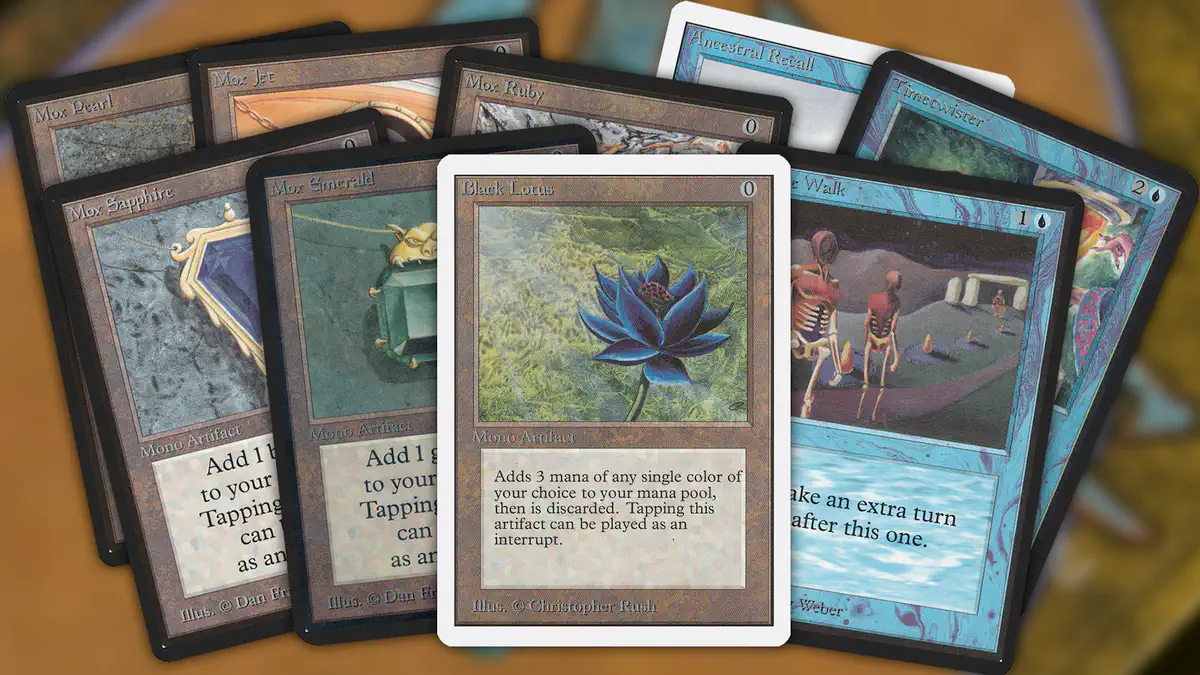
Vintage takes things to the absolute extreme. It is the only format where you can play almost every card ever printed, including the most legendary, broken pieces of cardboard in existence.
What makes Vintage truly unique is its Restricted List. Instead of outright banning cards that are too powerful, Vintage restricts them to one copy per deck (including the sideboard). This allows players to cast iconic, game-breaking cards without letting those cards completely warp the format in playsets of four.
Vintage is essentially Magic's ultimate high-power laboratory: fast mana, tutors, combos, broken artifacts, graveyard strategies, and thirty years of design history clashing in the same space.
Make no mistake, Legacy and Vintage are entirely different beasts than "Modern with older cards." The card pools, the speed of the games, the style of the answers, and the philosophy of the banlists create an entirely unique gameplay experience.
Pioneer and Premodern
Pioneer is much younger than Legacy or Vintage and was created with a specific goal: to provide a major, non-rotating Constructed format that doesn't require players to buy expensive cards from the early 2000s.
Its card pool begins with 2012's Return to Ravnica and includes every subsequent premier set.
Decks must have at least 60 cards, sideboards are capped at 15, and cards are subject to the standard four-copy limit.
Pioneer does not rotate. New sets simply expand the format without pushing older cards out, meaning the banlist is the only tool used to remove cards from the environment.
This positions Pioneer perfectly between Standard and Modern. Compared to Standard, you can keep playing your favorite deck for years. Compared to Modern, the card pool is more manageable and lacks the hyper-efficient free spells and answers that define Modern play.
Pioneer is also fully playable on MTG Arena. The old "Explorer" name, which the platform used as it worked toward parity with the paper Pioneer card pool, has officially been retired in favor of Pioneer.
Premodern, on the other hand, is a completely community-created and community-managed format, free from official Wizards oversight.
Premodern spans from Fourth Edition to Scourge, covering the golden era of 1995 to 2003. The core idea is to play with old-frame cards that were legal in Standard during that era, governed by a custom banlist.
The format was created in 2012 by Martin Berlin and has since grown a highly active, passionate international community, with premodernmagic.com serving as its central hub.
One of Premodern's biggest selling points is its absolute stability. The card pool is completely locked, yet the metagame still manages to shift and evolve through clever deckbuilding, new archetype interpretations, and innovative sideboard tech.
This makes Premodern the exact opposite of Pioneer: while Pioneer constantly looks forward as new sets shake it up, Premodern looks back at a specific, beloved era of Magic, finding new depth within a fixed card pool.
Commander and Multiplayer Play
Commander completely tears up the traditional Magic deckbuilding rulebook.
It's a multiplayer-first format, typically played with four players, where each deck contains exactly 100 cards:
- One Commander;
- 99 other cards.
Except for basic lands (and cards that explicitly say otherwise), you can only run one copy of any card. This makes Commander a singleton format.
Your Commander must be a legendary creature, and it dictates your deck's "color identity." You cannot run any cards that feature mana symbols outside of your Commander's color identity.
The Commander starts the game in the Command Zone and can be cast from there. Each time you cast your Commander from the Command Zone after the first, it costs an additional  generic mana for each previous time it was cast.
Players start with 40 life instead of 20. There is also a unique loss condition: if a player takes 21 points of combat damage from a single Commander over the course of the game, they lose.
The multiplayer dynamic makes Commander a completely different game than competitive 1v1 Magic. It's not just about what your deck can do to a single opponent; you have three opponents to worry about, leading to temporary alliances, political negotiations, table talk, and a massive amount of open information.
Deckbuilding is just as unique. The massive card pool and singleton rule let you build decks around specific creature types, mechanics, characters, wild combos, or purely thematic, narrative concepts.
On the opposite end of the spectrum is cEDH (Competitive Commander), where the exact same rules are pushed to the absolute limit of speed, consistency, and optimization.
Because the gap between a casual thematic deck and a turn-two cEDH combo deck is so massive, finding a common language to set expectations before a game is crucial.
To help with this, Wizards currently uses an optional system called Commander Brackets:
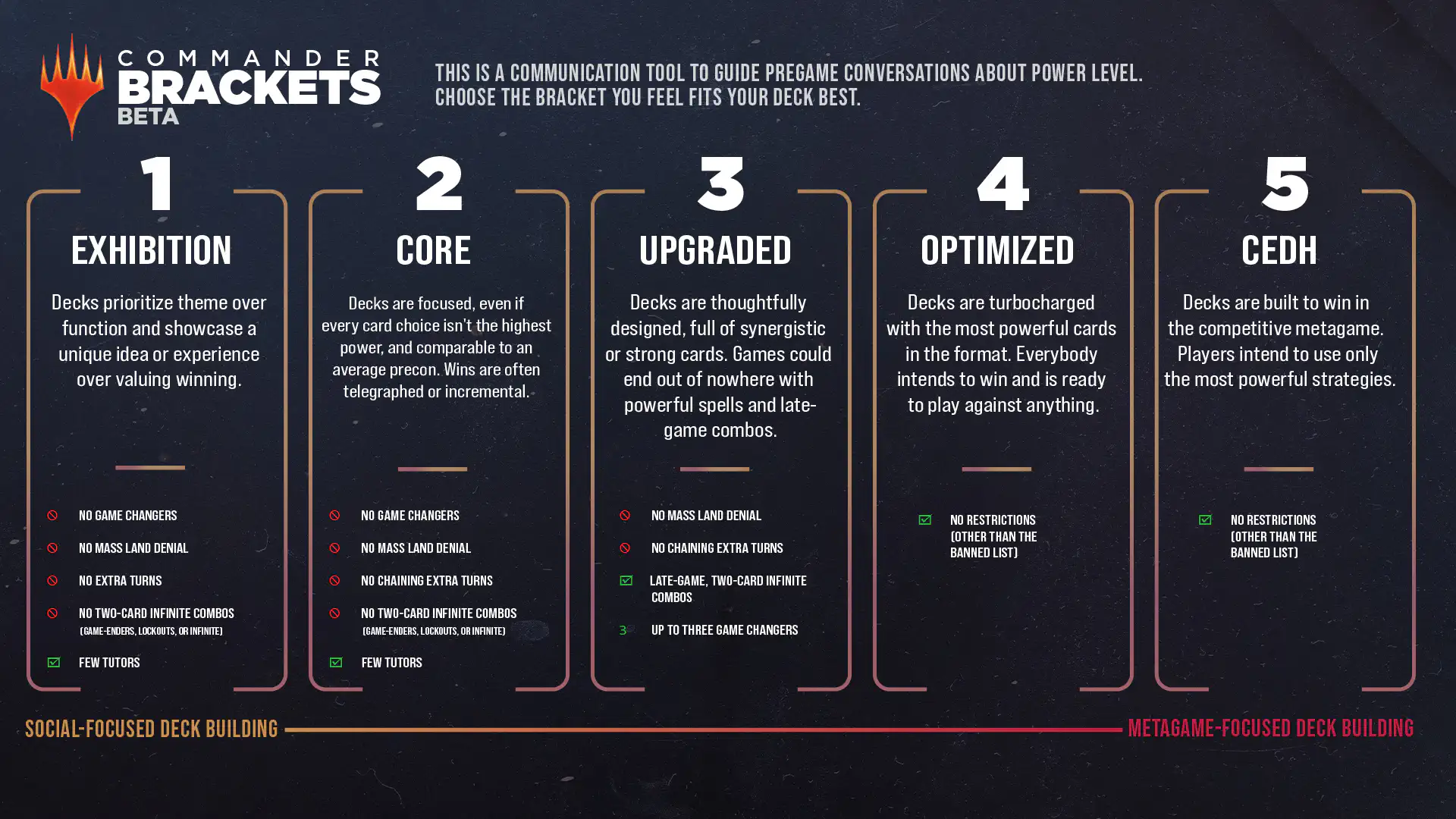
Bracket 1 – Exhibition, Bracket 2 – Core, Bracket 3 – Upgraded, Bracket 4 – Optimized, and Bracket 5 – cEDH.
Brackets 1-3 are generally geared toward different tiers of casual, social play, while Brackets 4 and 5 cover high-power and highly competitive games. The system also utilizes a list of "Game Changers"—cards known for drastically swinging the power level of a game. Wizards continues to emphasize that the Commander Bracket system is currently an optional beta.
Commander isn't the only way to play multiplayer Magic, though.
Two-Headed Giant pits two teams of two against each other, sharing a life pool and taking their turns simultaneously.
Oathbreaker features 60-card singleton decks built around a Planeswalker and a designated "Signature Spell."
Planechase adds oversized Plane cards that alter the rules of the game globally, while Archenemy pits one player with a deck of powerful "Scheme" cards against a team of three opponents.
There's also Commander Draft, 1v1 Commander, and countless other community-brewed variants.
This incredible flexibility is exactly why Commander is at the absolute center of the Magic ecosystem today, recognized by Wizards as the game's most popular format.
Digital Formats on Magic Arena
While MTG Arena lets you play tabletop formats digitally, it also hosts unique formats built specifically for the digital client.
Standard and Pioneer can be played both online and in paper, as can Draft and Sealed when the active sets are available.
Other formats, however, are completely tethered to Arena's unique card pool and digital features.
Alchemy is based on Standard but introduces digital-only cards, mechanics that would be impossible to track in paper, and rebalanced versions of existing cards. This allows Wizards to digitally buff or nerf cards to balance the format without having to ban them outright.
Historic is a non-rotating Constructed format exclusive to Arena. It includes almost every card available on the platform, including digital-only cards and rebalanced versions. Wizards curates this as a digital-first playground.
Timeless takes a different approach. It is Arena's "no-holds-barred" Constructed format, allowing you to play the most powerful cards on the platform. To keep game-breaking cards in check, Timeless uses a Restricted List instead of a banlist, limiting certain powerhouse cards to a single copy between the main deck and sideboard.
While Historic aims for a curated, balanced environment, Timeless is a wild west where you can play almost everything Arena has to offer.
Brawl takes the core ideas of Commander and shrinks them into a fast-paced, 1v1 format.
A Brawl deck consists of exactly 100 cards: a Commander and 99 singleton cards. Your Commander can be a legendary creature or a Planeswalker, your deck must match its color identity, and there is no sideboard.
Players start with 25 life, and games are Best-of-One with a single free mulligan.
As of June 23, 2026, Arena also features Competitive Brawl. This is a distinct competitive format, not just a ranked queue for casual Brawl; it features its own matchmaking system and, crucially, a separate banlist.
This division perfectly highlights the advantages of digital Magic: Arena doesn't have to just mimic the tabletop experience. It can adjust cards on the fly, lean into digital-only mechanics, and curate different matchmaking pools with distinct balancing philosophies.
Meanwhile, Magic Online (MTGO) serves a different purpose, remaining the premier digital platform for formats Arena can't yet support, like Modern, Legacy, Vintage, and Pauper.
Top 8 Decks and Metagame Tier Lists
Learning the rules of a format is just the baseline. To actually play it well, you have to understand its metagame.
The "metagame" (or "meta") refers to the collective mix of decks, strategies, and archetypes that players are actually running at any given time.
Two formats with identical rules can have completely different metagames due to their card pools. In Standard, new sets and rotation can flip the meta on its head in a weekend. In Modern, the card pool is more stable, but new set releases and bans still trigger massive shifts. Pauper, Pioneer, Legacy, and Vintage each have their own distinct, self-contained ecosystems.
To analyze these metas, players rely on tournament results, decklists, Top 8 breakdowns, and tier lists.
A Top 8 lists the decks that made the final bracket of a specific tournament. While this is incredibly valuable data, you have to read between the lines.
A single Top 8 finish doesn't automatically mean a deck is the best choice in the format. You have to consider the tournament's size, the skill level of the players, the deck's overall representation in the room, and how consistently it performs over multiple events.
For example, if Mono-Red Aggro makes up 20% of a tournament field and puts two players in the Top 8, that's just basic statistics. But if a rogue combo deck played by a single player makes it all the way to the finals, that's a signal that the archetype might be seriously flying under the radar.
Tier lists, on the other hand, estimate the overall power and position of archetypes within the wider meta. While naming conventions vary, they generally break down into:
- Tier 1: The absolute best, defining decks of the format;
- Tier 2: Highly competitive decks that are slightly less dominant, less popular, or more reliant on specific matchups;
- Tier 3: Niche, rogue, or budget strategies that can win but require very specific meta conditions to thrive.
No tier list is permanent. The metagame is a living, breathing puzzle. When a deck becomes too popular, the rest of the field adapts by packing specific sideboard hate and switching to counter-strategies. If a Control deck starts winning every event, opponents will load up their sideboards with anti-control tools, dragging its win rate down over the following weeks and opening the door for previously unfavored archetypes to thrive again.
When deciding what deck to run, it's always smarter to look at a broad sample of Top 8s and recent finishes rather than a single event. The same goes for comparing decklists: some cards are non-negotiable core pieces of an archetype, while others are flexible slots tuned to beat the meta expected at a specific tournament.
Always analyze lists, results, and tiers within the context of their specific format. A Standard Tier 1 deck, a Modern Tier 1 deck, and a Pauper Tier 1 deck exist in completely different worlds and cannot be compared in terms of absolute power.
Frequently Asked Questions
What is the most played Magic format?
Commander is the undisputed king of casual and multiplayer Magic, and Wizards officially curates and promotes it as the game's most popular format.
However, "most played" depends on where you look. For competitive, tournament-minded players, Standard, Pioneer, and Modern remain the premier choices. On MTG Arena, a massive portion of the player base is dedicated to digital-only formats, while paper social play is completely dominated by Commander.
What are the physical dimensions of a Magic card?
A standard Magic: The Gathering card measures approximately 63 x 88 mm (2.5 x 3.5 inches). This is the industry-standard "Standard Size" in the trading card game accessory market, meaning any standard-size sleeves or deck boxes will fit Magic cards perfectly.
While there are exceptions like oversized commander cards and token components, every card you put in a tournament deck adheres to these exact dimensions.
How does Standard rotation work?
Standard rotation periodically purges older sets from the format, keeping the card pool focused on the most recent releases.
Under the current system, Standard pools roughly three years of sets. There is no rotation in 2026. Starting in 2027, rotation will occur with the release of the year's first premier set, phasing out the six oldest Standard-legal sets.
This means Standard decks have a shelf life: eventually, key cards will rotate out of the format. However, those cards remain fully legal in non-rotating formats like Pioneer, Modern, or Commander.
What is the best format for beginners?
There is no single correct answer—it completely depends on what kind of experience you are looking for.
If you want to learn competitive, tournament-style play, Standard is the most accessible jumping-off point. The card pool is smaller and easier to digest than Pioneer or Modern, and the cards are easy to acquire.
If you just want to hang out and play with friends, Commander is the perfect fit. It is built for multiplayer and lets you build incredibly expressive, personal decks.
If you want to experience a new set release, Sealed (especially at a Prerelease event) is ideal. It requires zero prior card collection and puts everyone on an even playing field.
Booster Draft is the best choice if you want to develop your card evaluation, deckbuilding, and synergy-spotting skills all at once.
Pauper is a fantastic option for players who want high-level competitive Constructed play on a budget, while Pioneer is the logical next step for players who want to build a deck that will never rotate out of Standard.
Which formats are exclusive to Magic Arena?
The primary formats exclusive to MTG Arena are Alchemy, Historic, Timeless, and Brawl—along with Competitive Brawl, which launched in June 2026.
Alchemy features digital-only cards and rebalanced versions of paper cards. Historic is a non-rotating format built around Arena's entire digital library. Timeless lets you play almost every card on the platform, utilizing a Restricted List to manage game-breaking power levels. Brawl is a 1v1, 100-card singleton format built around a Commander, while Competitive Brawl is a dedicated competitive queue with its own custom banlist.
Arena also hosts paper-equivalent formats like Standard and Pioneer, as well as Draft and Sealed. However, you cannot play Modern, Legacy, or Vintage on Arena, as the platform does not yet contain those older card pools.
This incredible diversity of formats is exactly why Magic has continued to thrive and evolve for over three decades.
Whether you want to ride the waves of a shifting Standard meta, master a single Modern or Pioneer deck for years, dive into the competitive efficiency of Pauper, explore the deep history of Legacy, Vintage, and Premodern, or gather friends around a Commander table, there is a format for you. And if you don't feel like bringing a deck at all, Draft and Sealed let you start fresh every single time.
Ultimately, the best approach is to try a little bit of everything and let your own preferences guide you toward your favorite way to play.
Alex