

Top 4 Things to Know About Standard This Week - Episode 15
Star City Games hosted the Cincinnati RC. It had two possible trajectories: a meta similar to the London Spotlight, where decks were valued without a precise logic other than the emergence of a certain tendency to shift towards control decks; or a meta more similar to the Japan and South Korea RC, which clearly leans towards a certain type of control. Cincinnati replicates the latter.
In the week of May 11-17, the Cincinnati RC takes place. After a PT, a Spotlight, and an Asian RC, meta evolutions lead us towards control strategies. But a certain type of control. Cincinnati records this reality, and we will try to make a vertical analysis of it. Finally, it's time for the classic bi-weekly update on the format's prices.
1) RC Cincinnati Analysis:
The Day One field distribution was as follows:
·

 Prowess 15.9%
·

 Landfall 15.20%
·
Spellementals
10.6%
· 4c Control 7.6%
·
 Excruciator 4.1%
·
Lessons 4%
·
MOMO 3.9%
· MonoG Landfall 3.7%
·
Discard 3.2%
·
Control 3.2%
·
Ouroboroid 3%
·
Prison/Tempo
2.30%
·
Rhythm 1.9%
·
Elementals 1.8%
·
Omniscience
1.7%
· Others 17.8%
The following decks made it to the Top 8 in the indicated numbers:
· 2 4c Control
·
2 Prowess
·
1 Omniscience
·
1 Control
·
1 Fling
·
1 Spellementals
First place goes to Zachary Aymie with 4c Control.
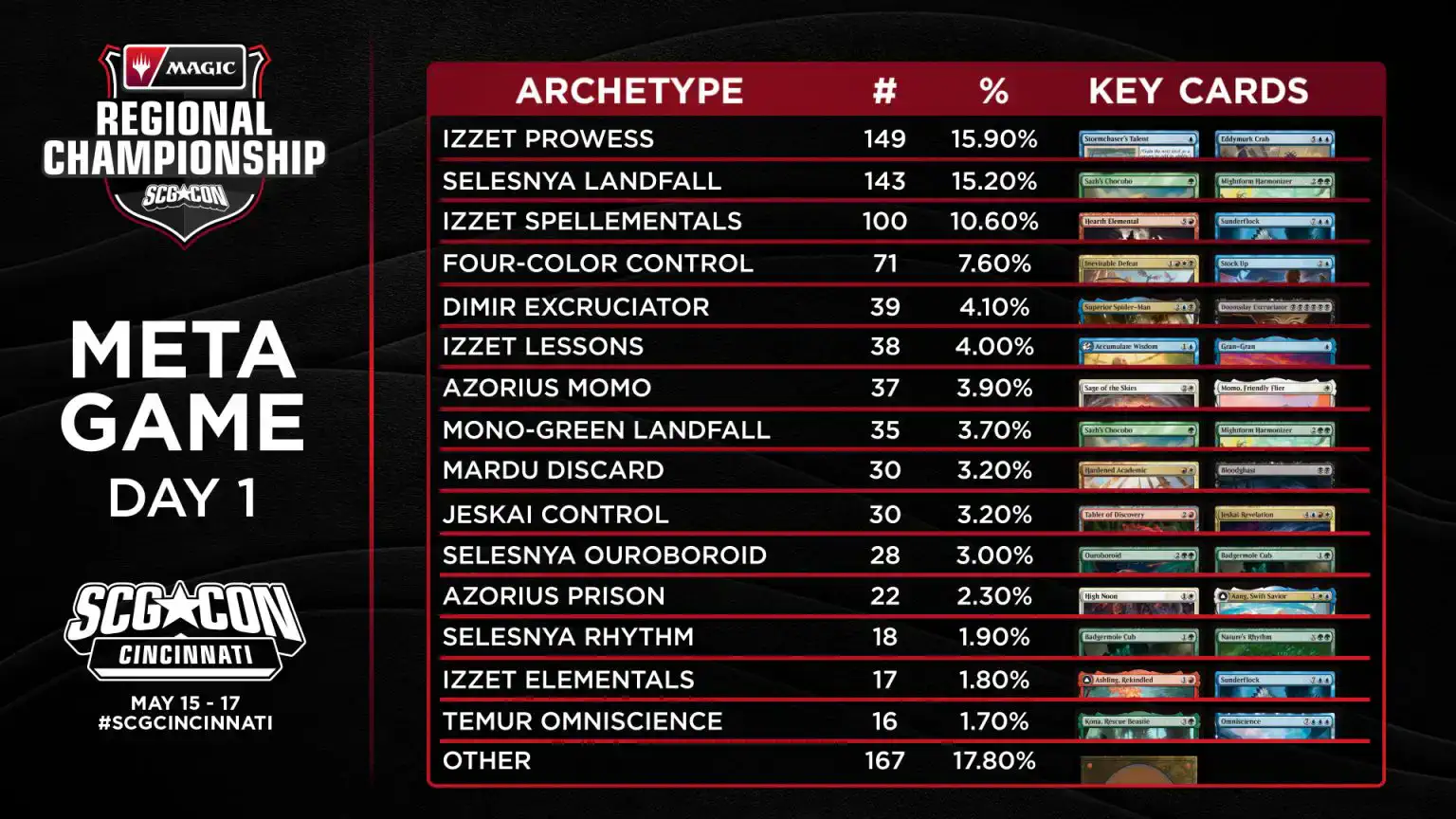
Starting from the beginning, the Metagame Breakdown and the Top 8 frame give us a clear idea of the direction Standard is taking. However, one must know how to interpret the data. Starting from the initial participation, we can already see two major movements: an increase in Landfall decks and Control decks.
Immediately behind these
peaks, there's a positive pressure from Excruciator and
decks, whether they are aggro or tempo, and a decrease in
Prowess, Lessons, Control, and
Rhythm decks. The "Others" category should be set aside because,
as you can see, we have presence data even below 3%. This is useful on one hand,
but also distorting in some circumstances. After all, anything below 3% could
be included in "Others."
So, we already have a first key to understanding. On Day One, it
seems we are slowly moving away from a top-tier metagame declared as vs (or ) and everything else, to
a metagame that presents as Control Strategy vs
Aggro/Combo Strategy. This reading, as presented, is not sufficient.
Indeed, we must consider Day Two.
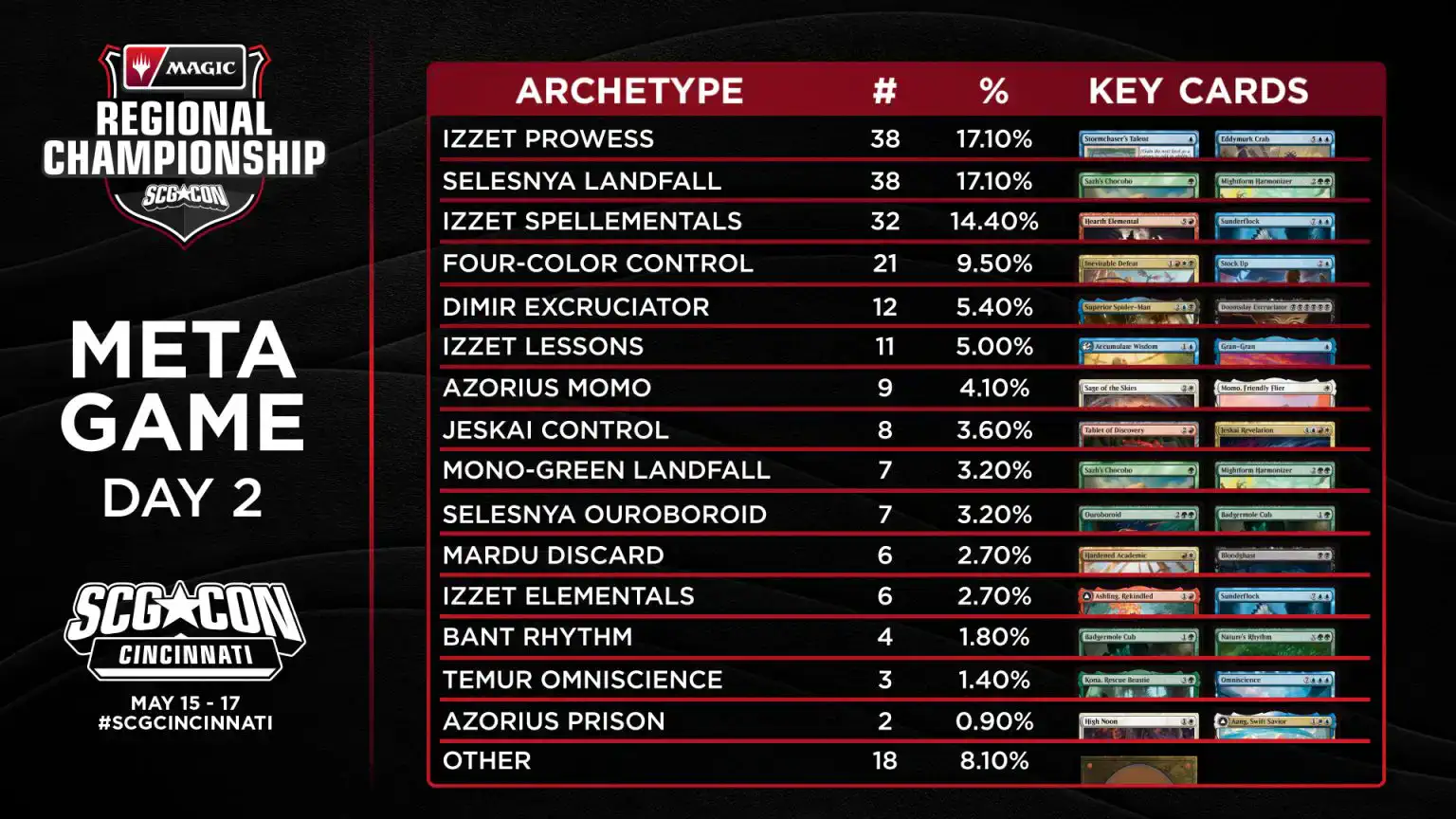
Usually, Day Two field percentages are given to provide an indicative scoreboard of the variation. I never quite like that. I find a piece of data that isn't typically shown, because it requires a comparative analysis, much more interesting: how much a specific archetype has decreased in absolute terms compared to Day One. This is because, even though we're talking about the same information presented in different ways, the logic of what I propose is much clearer in showing the direction of archetypes.
Let's take an example: on Day One,
Prowess constituted 15.9% of the meta with 149 decks, while 4c
Control was 7.6% of the meta with 71 decks out of the total present. On
Day Two, Prowess formed 17.1% of the meta with 38 decks and 4c
Control 9.5% with 21 decks. Stated this way, both archetypes gained
participatory ground from one day to the next. Too bad one lost 74.5% of its
components, while the other lost only 70.4%.
We are, in truth, talking
about the same news. It's just that, as it's generally presented, the most
intuitive reading is "Prowess gained 1.2 points and 4c
Control gained 1.9 points, with a difference of 0.7." The way I
present it, Prowess lost 4.1 percentage points more than 4c
Control. The difference is that a variation below 1% (0.7 points) is
almost statistically irrelevant; whereas a variation of 4.1% begins to be an
indicator of a trend.
Well then, let's try to compile this Day One to Day Two variation for the hot decks. Let's reverse the ranking from who loses the least to who loses the most:
·
Spellementals
-68%
·
Excruciator
-69.2%
· 4c Control -70.4%
·
Lessons -71.1%
·
Control -73.3%
·
Landfall -73.4%
·
Prowess -74.5%
·
Ouroboroid -75%
·
MOMO -75.7%
This perspective is appealing, if we like it,
because it gives us at least two new keys to understanding. Firstly, we see
that in the upper margin there are four control strategies, or strategies with
strong control elements. Indeed, Excruciator is formally
considered a combo deck, but in truth it would be a Combo/Control. Both
in its construction and its in-game behavior, Combo/Control, in the map
of archetypes, is enclosed within the strategic category of Control, not Combo.
In the lower margin, however, we only have aggressive strategies. Within them,
the mechanics are extremely different, but all proactive.
So we can say that at the beginning of the tournament, the meta was already oriented towards more reactivity than proactivity, and this tendency was then confirmed by the facts. Midway through the tournament, the reactive approach paid off much more than the proactive one. Secondly, while the various proactive strategies are less distant from each other in terms of effectiveness, we clearly see that among control strategies there are rewarding directions and poor directions. We will focus on this in the third point of this column.
Continuing, in the Top 8, the split already
identified is evident. Four control decks, one combo deck, and three prowess
decks made it in, considering that Fling, in the end, is a
prowess deck with a micro-combo support made possible by Callous
Sell-Sword. We have exactly one reactive half and one proactive half.
In fact, Omniscience is structurally a Big Spells Combo and,
therefore, a proactive deck by general theory. If we combine the three keys to
understanding, we can have a completely different opinion of the format than
what emerged starting in December 2025. After five months, Standard should no
longer be thought of as decks vs /x Landfall and all others,
but as reactive vs proactive. And proactive is slowly losing ground.
From this perspective, next week's banlist update
should technically be a no-change, unless policy choices are desired. This is
because the first major pole, , can be divided into reactive (Spellementals and
Lessons) and proactive (Prowess and its various facets, such as
Opus). All are clearly strong decks, but the one that performs best
among them is not what we would expect. It is Spellementals, which is a
reactive control. But one couldn't even say that is a problem as control,
because Lessons, which is another type of control, is on a sharply
declining line.
The second major pole, the Cub decks, which perform best in the Landfall variation, is also slowly losing steam. The only difference is that, while before it was kept in check because it was the deck to beat, now it can no longer be so, because there are too many decks to beat to focus on one main threat, and because, if it were still the case, it should at least rise by a percentage similar to the increased use being made of it.
In essence, it can no longer be said that Cub decks are performing worse than expected because the rest of the meta mainly focuses on opposing them (of course, the meta counters them, but there is no longer a single dominant polarity that makes such a directed counter-offensive possible as before), nor that Cub decks are underrepresented because players do not want to face a meta directed against them. Furthermore, these two things go hand in hand.
2) Winner's Deck Performance in Top 8
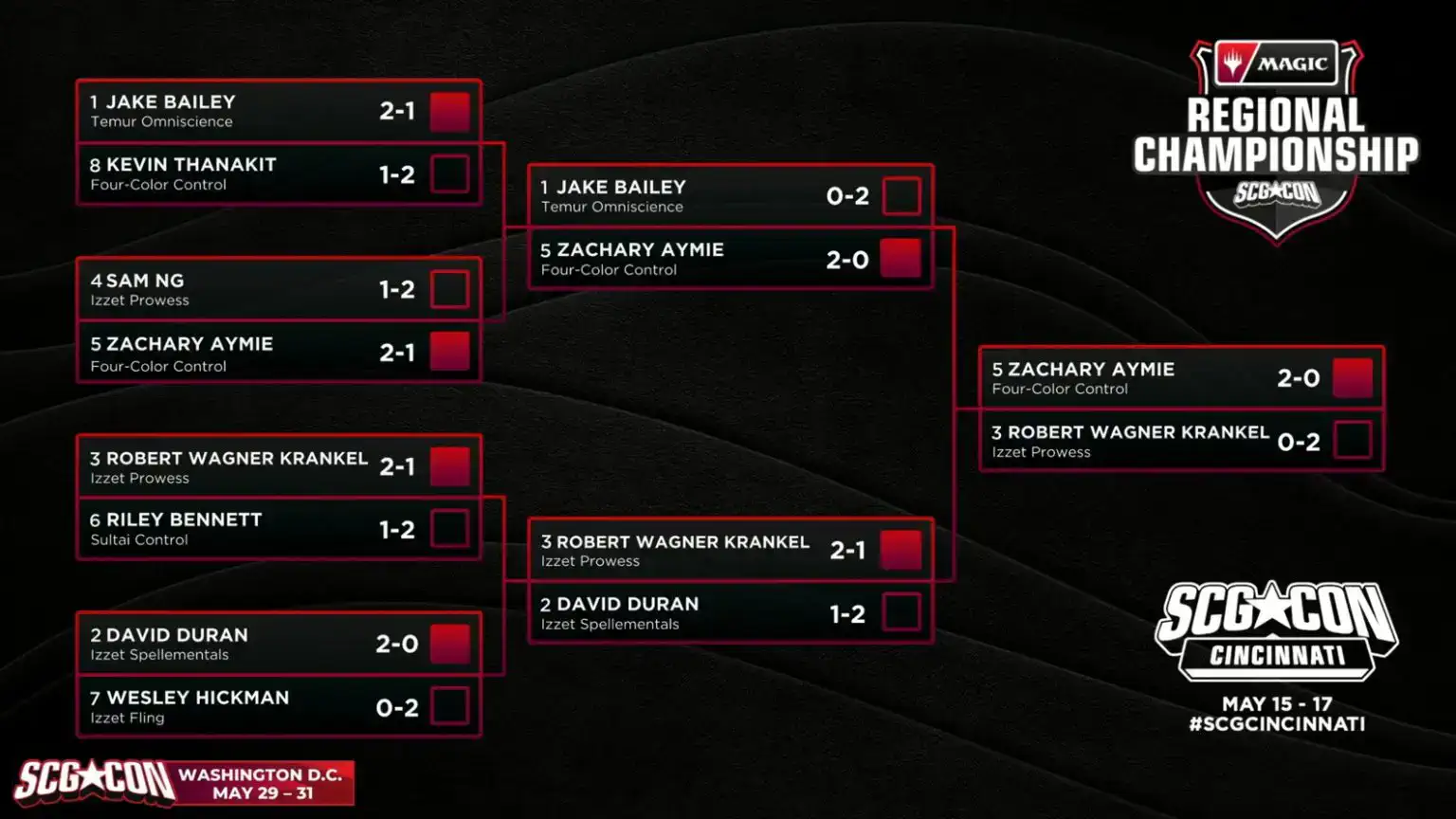
Zachary Aymie faced two
Prowess and one Omniscience during the Top 8. I
had the impression it was a decreasing ladder. In the quarterfinals, he faced
Sam NG, piloting a very traditional Prowess. Sam NG only made
two variations: the first consists of including one Prismari Charm
in the main deck and one in the sideboard. The second involves including a
Wan Shi Tong among the fifteen sideboard cards. They went to three
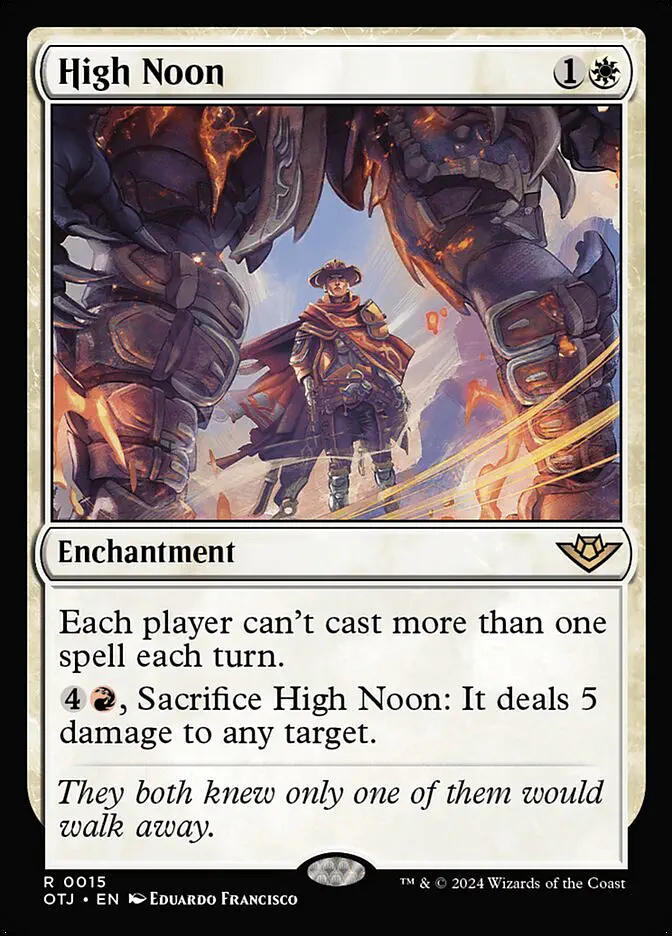
games, and Aymie managed to win the last one thanks to High Noon, a
card included in his decklist's sideboard.
In the semi-final, a high-tension match was played,
based on endurance. After several times narrowly avoiding defeat, Four Color Control managed to beat
Omniscience and advanced to the final. At the top, Zachary Aymie
clashed with Robert Wagner-Krankel, who was piloting another Prowess,
more experimental than the first.
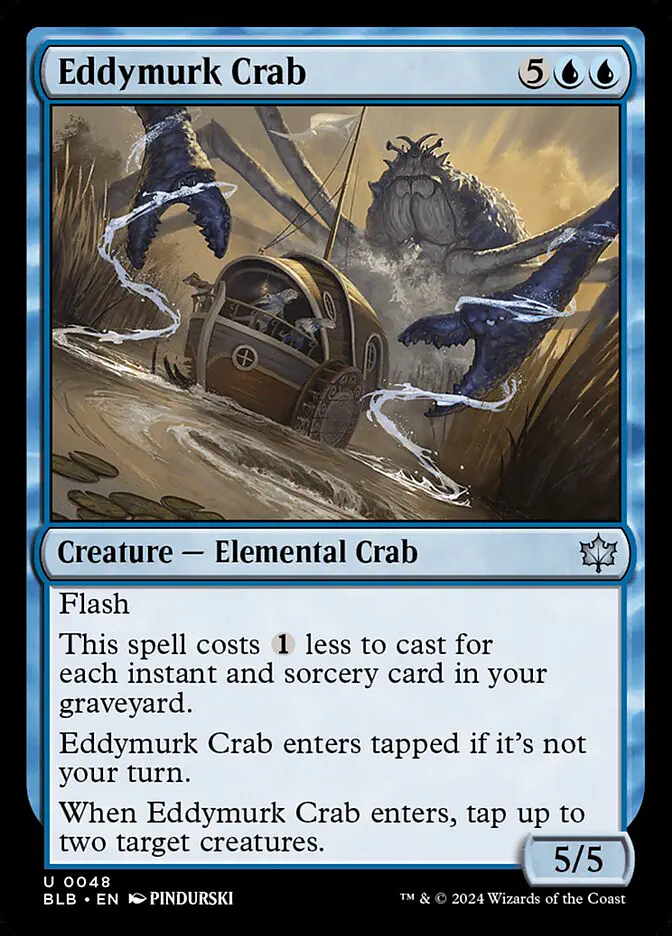
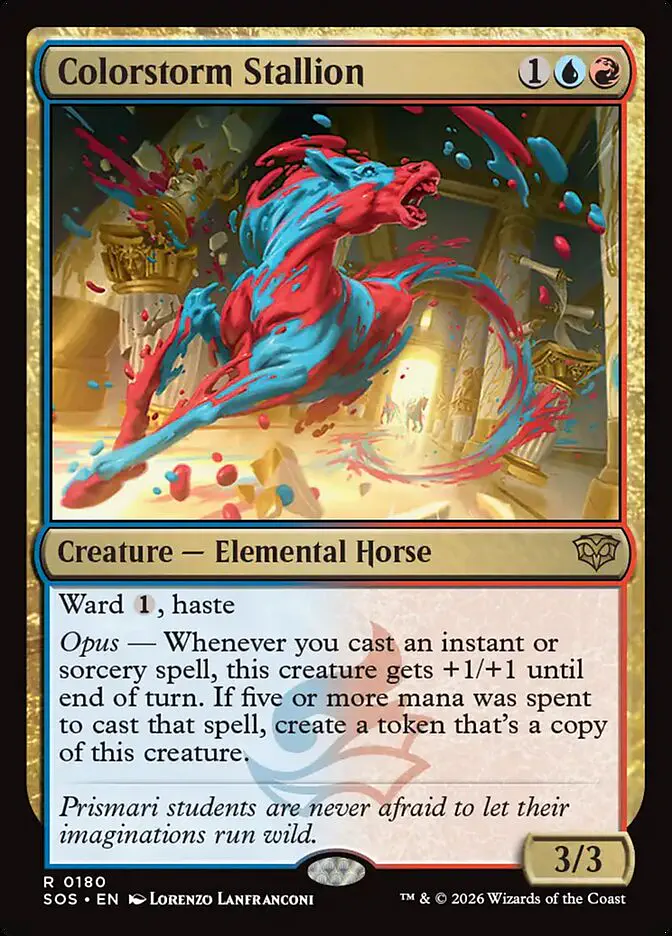
Eddymurk Crab and Colorstorm Stallion
No multiple copies of Eddymurk Crab and Colorstorm
Stallion between main deck and sideboard. An that aimed to
win the game as quickly as possible, sacrificing some effects on the opponent's
board. More Glass Cannon. Aymie won the first game quickly and the second
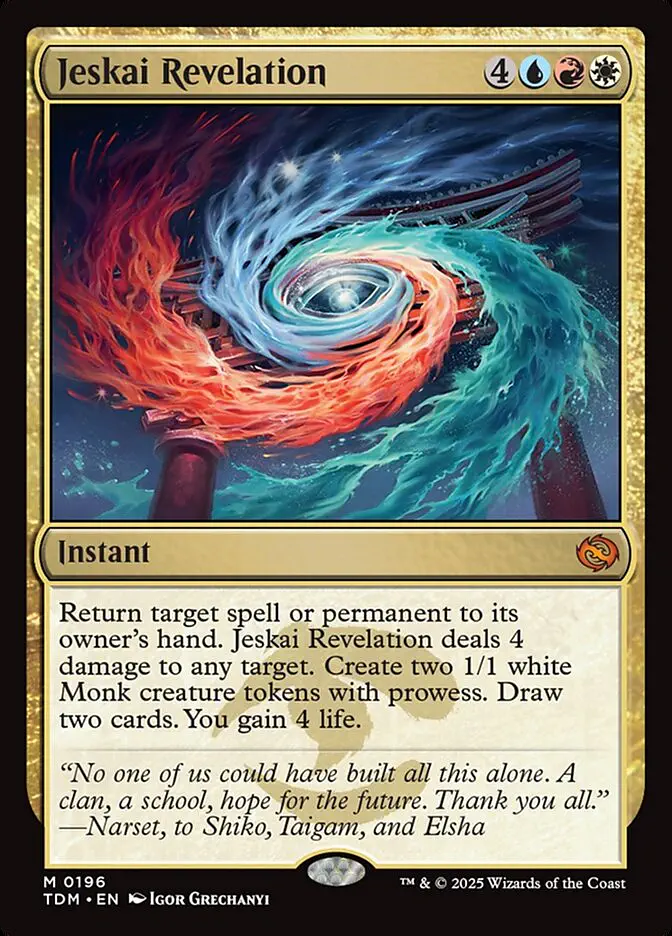
thanks to sideboarding High Noon, which allowed him to manage the game
by safely casting Jeskai Revelation multiple times.
3) Control Deck Analysis
One beautiful thing about this Standard is how it manages to have a very retro feel, despite being the most progressive format. Among the various control decks that seem to be reshaping the face of the format, the most rewarding strategies are old-school Draw-Go. This is surprising. We all note that the Draw-Go archetype has gradually disappeared from competitive Magic due to the evolution of the game itself.
The archetype, which would be old-fashioned hard control, is based on answer spells, card quality/card advantage spells, and very few win conditions, to be deployed when the opponent has exhausted their resources or is no longer in a position to play them profitably.
MTG has developed by providing increasingly performing threats, without simultaneously investing in equally effective management spells. In this way, a board-centric game has been favored, at the expense of a stack-centric game. Let's look at this concept with a simple example: Counterspell is historically considered one of the strongest counters in the game.
After all, how many spells exist that neutralize everything for just two mana? When we play it against Liliana of the Veil, we are very strong. But what about when we have to play it against Ragavan, Nimble Pilferer, which costs only one mana? In that case, the opponent dominates us. When control spells, whether counters or removals, are dogmatically used to manage threats more efficient than themselves, it means they are structurally inadequate.
From here, a series of very interesting discussions can begin, such as the fact that the concept of "hard removal" in MTG is now obsolete, or that card quality/card advantage spells are often too controlled to avoid redundancy as a design choice. I will not bore you further with these beautiful things.
Perhaps I will write an article about them in the future, but this is not the place. Here, I am interested in noting that this Standard demonstrates an important thing about rotating formats: it can happen that answers find a way to keep pace with threats. In this sense, Standard is the oldest format of all.
Indeed, let's look at the lists of
Spellementals. Gosh, it's the most classic Draw-Go of all. Clearly, always
updated to the present, however, easy-to-protect creatures as a win condition,
and everything else divided between drawing and managing.
In this case, the creatures are not inherently armored, but become easy to defend thanks to the fact that they always enter at a mana discount, which allows various counters in response to answers. Furthermore, we have Sunderflock which, more than being a creature, is a spell. It wouldn't be entirely correct to think of it as an asymmetric wrath, because in truth it does Cyclonic Rift, but you get the idea. Let's be clear, it's obvious that this is not a Randy Buehler 1998-era Draw-Go, but the logic remains the same. Even though times have changed.
Even more representative of the archetype is
4c Control. Its only oddity is that we win with a big non-creature spell,
namely Jeskai Revelation. It's also very nice to note that
three types of Control entered the Cincinnati Top 8, all Draw-Go, and each of
them depicts the history of the different closing conditions of the archetype
that have succeeded each other over time: creature, then big non-creature spell,
and finally, Planeswalker ( Control). Aside from this
reflection on what form of control is now rewarded in Standard, we can say at
least two things about the archetype in the format.
The first is that not all control decks
work; only Draw-Go ones do, for now. Lessons is a Control deck,
but it seems to be in increasing difficulty, despite some excellent results
(e.g., it was in the Top 8 at the PT). There's not even a shadow of Lock, and
this makes us understand that, for now, non-blue control is not possible.
The second
is that Draw-Go decks are doing well now because they have found a way to
accelerate. It's not just about streamlining the mana curve, but concerns the
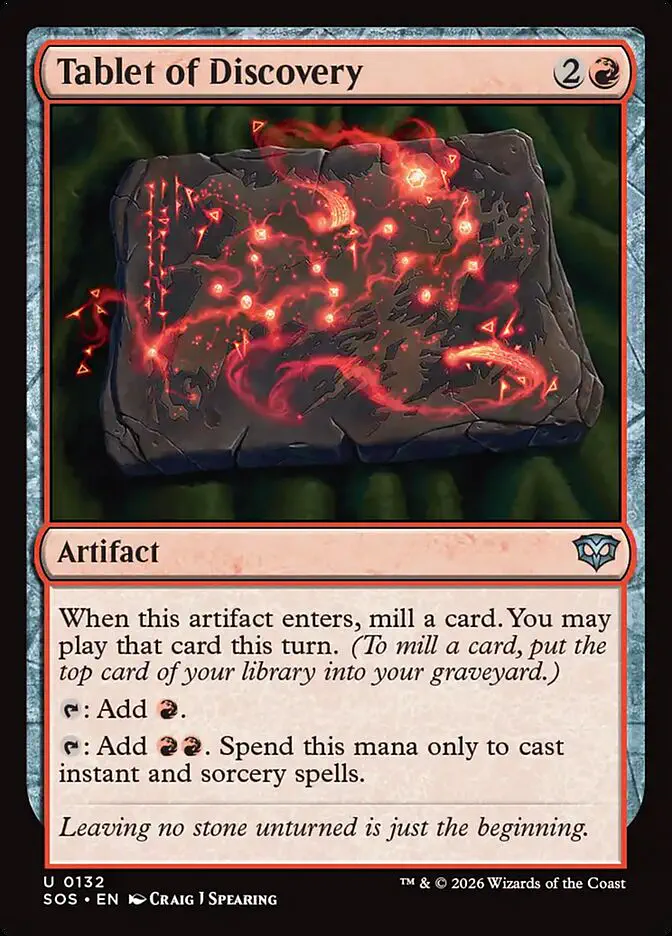
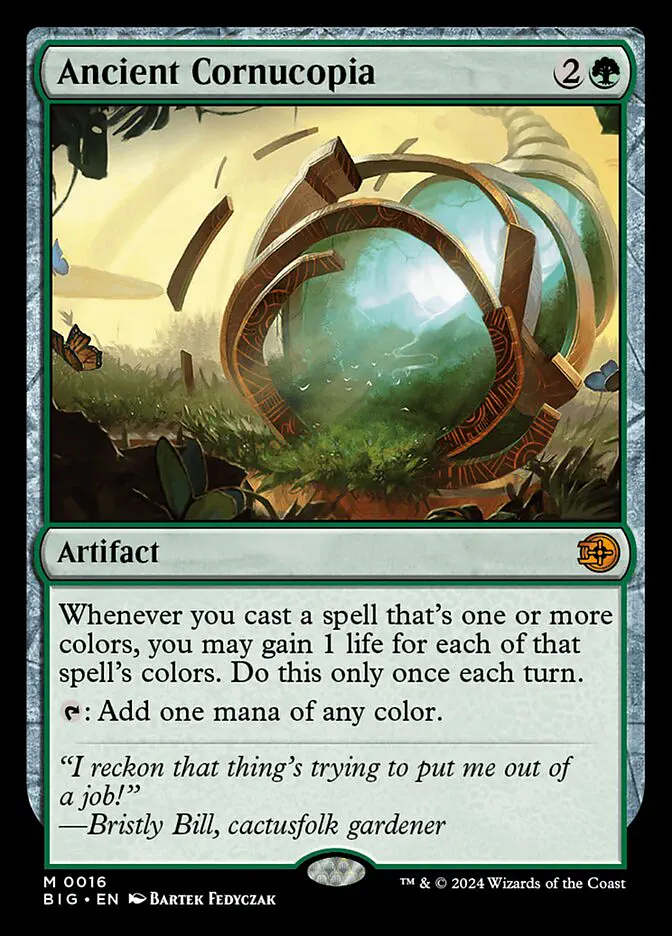
use of cards like Tablet of Discovery, or the good old Ancient
Cornucopia for , which allow indirectly discounting the
mana cost of their spells to keep them in pace with threats.
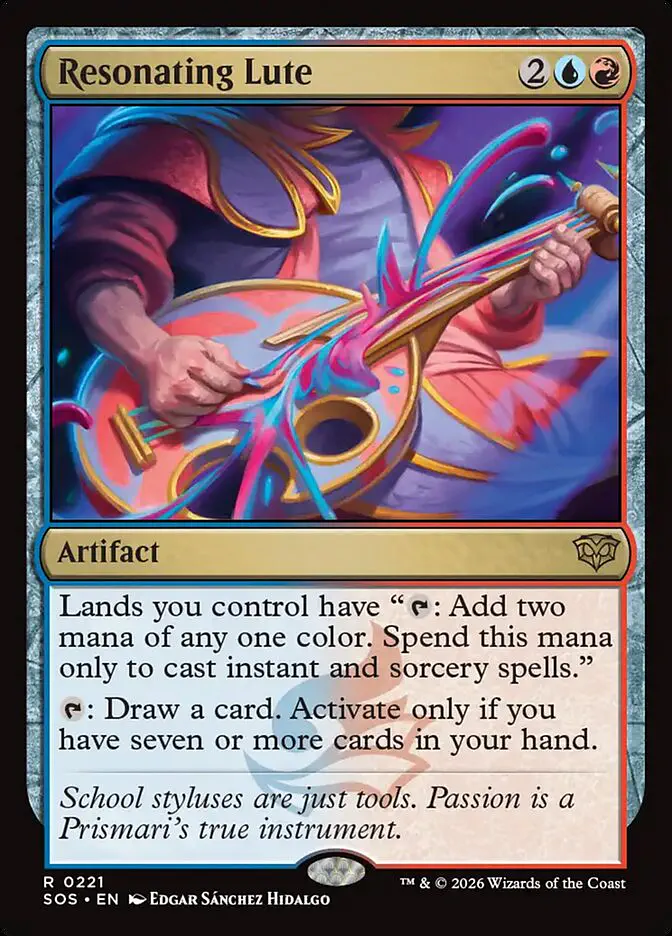
Resonating Lute, which is no longer seen but I'm convinced it will
return, follows the same logic.
4) Price Update
Standard MOLE Index price update for the format. The field distribution, compared across multiple meta-tracking databases from the last two weeks, yielded an analysis sample of 10 decks:
- Excruciator
- Landfall
- Lessons
- Prowess
- Spellementals
- Opus
- Momo
- Rhythm
- 4c Control
- Control
The arithmetic mean rises to €358, while the robust median falls to €256.5.
The geometric mean increases towards €358.5, with:
- lower outlier consisting of Spellementals
- upper outlier covered by Rhythm
The cost of Standard remains contained, but with increasing internal diversity. decks continue to lower the entry price of the format, while the cost of every other strategy slightly increases.
The geometric mean of the other formats used for comparison remains substantially unchanged:
- Vintage: €31,288.42
- Legacy: €4,043.26
- Modern: €649.04
- Pioneer: €328.75
- Pauper: €77.29
Considering all formats as a sample, Standard returns to third place as the most economical format. If we limit the scope to competitive formats only, i.e., Modern, Pioneer, and Standard, then Standard is the middle format, but its difference with Pioneer is almost negligible.
“See You Space Cowboy”
Francesco