

Top 4 Things to Know About Standard This Week - Episode 17

In the week of May 25th to 31st, all European eyes were on the Regional Championship held in Prague. However, concurrently, the Washington Regional Championship and the Chiba Spotlight in Japan were also played.
We will cover the highlights of all these tournaments. To conclude, the usual bi-weekly update on the format's prices.
1) RC Prague
More than eight hundred players attended this Standard format Regional Championship. The Day 1 field breakdown was as follows:

 Prowess 22.9%
- 4 Color Control 8%
 Excruciator 7.7%
- MonoG Landfall 7.6%
- Spellementals 7.2%
 MOMO 7.2%
- Discard 5.2%
 Landfall 5.1%
- Lessons 4.4%
- Lessons 3.2%
- Prison/Tempo 2.3%
- Others 29.8%
A very complex Metagame Breakdown that reflects, on one hand, a strong balance of resources in the format, and on the other, a continuous search for the strategy that ensures the most secure path to overall victory.
On the first point, the data is quite explicit. The only need for clarification concerns the large percentage of Prowess. We'll cut to the chase here, as we have long explained how the Prowess category actually contains at least three very different decks. From classic Prowess to the Opus deck based on Colorstorm Stallion.
Even dividing the category into just two large macro-aggregates—a more old-fashioned Prowess with the classic creature package of Slickshot Show-Off, Eddymurk Crab, Elusive Otter, and an Opus Deck optimized around the Stallion—we would have a meta with a hypersymmetric internal distribution.
In fact, there would be seven deck categories with very close metashares, ranging from a minimum of 7.2% to a maximum of 11.45%.
This data is supported by the fact that the general winrate of Tier 1 and Tier 1.5 decks, across a truly advanced sample of matches from the largest tournaments, falls within a range of 49% to 55%.
The combination of extreme deck variety, a widespread and symmetrical metashare, homologous overall winrates for all top tiers, and the increasingly absent polarization of the format means that there is no single "deck to beat." Instead, decks constantly contend for dominance, rapidly shifting the meta from reactive to proactive and vice versa.
On Day 2, the metashare conversion and respective winrates were as follows:
- Prowess MS: 35.1% / WR: 54.4%
- MonoG Landfall MS: 9% / WR: 53.4%
- Spellementals MS: 8.1% / WR: 48.1%
- 4c Control MS: 7.2% / WR: 48.1%
- Momo MS: 6.3% / WR: 50.9%
- Lessons MS: 6.3% / WR: 57.9%
- Discard MS: 5.4% / WR: 48.8%
- Ouroboroid MS: 4.5% / WR: 56%
- Excruciator MS: 3.6% / WR: 43.6%
- Landfall MS: 2.7% / WR: 46.3%
- Midrange MS: 1.8% / WR: 52.7%
- Others MS: 9.91% / Average WR: 46.2%
Let's look at the most relevant events.
First, Control performed rather poorly on Day 1, except for Lessons, which was the best-performing deck. Even by the end of Day 2, Lessons continued to impress and even converted into the Top 8.
The two 4c Control decks that reached the final did so not due to an overperformance of the deck, but rather to the skill of the two players piloting them. Congratulations to Rasmus Enegren, the winner, and Riccardo Dias, the runner-up.

WINNER - Four Color Control
- 4 × Jeskai Revelation
- 3 × Consult the Star Charts
- 3 × Inevitable Defeat
- 2 × Flashback
- 2 × No More Lies
- 2 × Sear
- 1 × Abrade
- 1 × Fire Magic
- 1 × Firebending Lesson
- 1 × Get Lost
- 1 × Three Steps Ahead
- 1 × Thunder Magic
- 4 × Stock Up
- 2 × Day of Judgment
- 1 × Together as One
- 4 × Tablet of Discovery
- 4 × Great Hall of the Biblioplex
- 3 × Sacred Foundry
- 3 × Steam Vents
- 2 × Gloomlake Verge
- 2 × Mistrise Village
- 2 × Shattered Sanctum
- 1 × Floodfarm Verge
- 1 × Godless Shrine
- 1 × Hallowed Fountain
- 1 × Meticulous Archive
- 1 × Mountain
- 1 × Multiversal Passage
- 1 × Plains
- 1 × Stormcarved Coast
- 1 × Sunbillow Verge
- 1 × Sundown Pass
- 1 × Thundering Falls
- 2 × Emeritus of Ideation // Ancestral Recall
- 2 × Flashfreeze
- 2 × High Noon
- 2 × Strategic Betrayal
- 1 × Day of Judgment
- 1 × Disdainful Stroke
- 1 × Pest Control
- 1 × Pyroclasm
- 1 × Return the Favor
- 1 × Stoic Sphinx
- 1 × Wan Shi Tong, Librarian
Furthermore, it should be noted that by the end of Day 2, Excruciator performed much better than on Day 1, where it had an uncomprehensibly low winrate for the deck.
The answer lies in the Day 1 match-up "chicane," which effectively disfavored Excruciator decks. Or at least, this partially explains the anomalous data. The rest of the missing performance is likely attributable to bad luck, or the preparation and skill of the players.
2) RC Washington
The largest of the three tournaments we'll discuss today. Let's start with the Day 1 field breakdown:
- Prowess 24.7%
- Control 10.10%
- MonoG Landfall 8.8%
- Discard 6.9%
- Excruciator 6.8%
- Spellementals 5.1%
- Momo 5%
- Landfall 3.8%
- Lessons 2.6%
- Lessons 2.4%
- Tempo/Prison 2.3%
- Fling 1.9%
- Omniscience 1.7%
- Ouroboroid 1.7%
- Control 1.1%
- Other 15%
This reveals a tournament where the metagame interpretation is slightly different from the European one. It seems Americans lean more towards Control, but at the same time, they are less advanced in its evolutions.
In fact, Lessons is very scarce, while Lessons is still quite present compared to the continental field distribution.
The high reactivity of the metashare discourages and tempers combo decks, and this explains the low presence of Omniscience in all tournaments, despite being one of the decks with the highest opportunities for improvement.
The latter could soon update to Sultai and follow a more controlling game plan in the early turns, before transitioning to combo. Similar to the initial Excruciator.
On Day 2, the metashare was reported as follows:
- Prowess 28.10%
- MonoG Landfall 13%
- Excruciator 6.7%
- Control 6.3%
- Discard 6%
- Spellementals 4.9%
- Momo 3.9%
- Landfall 3.5%
- Lessons 3.5%
- Lessons 3.2%
- Ouroboroid 2.5%
- Omniscience 1.8%
- Tempo/Prison 1.1%
- Rhythm 1.1%
- Airbending 1.1%
- Other 13.70%
Here we have confirmation that 4c Control disappointed performance expectations, similar to Europe. We must also admit that part of this is due to the meta already organizing itself to counter it.
Excruciator had a good performance, in line with expectations, which contradicts the European data. MonoG Landfall and Prowess, here too, performed consistently well.
Finally, Discard and Omniscience performed effectively in the various stages of the tournament, even if they didn't reach exceptionally brilliant heights.
A very aggressive Top 8, won by Jordan Selesnick with Momo, a deck that didn't perform very well in terms of winrate. Here are the Top 8 positions:
- Momo
- MonoG Landfall
- Aggro
- MonoG Landfall
- Spellementals
- Prowess
- MonoG Landfall
- Spellementals
It's a bit surprising that, among the control strategies, Spellementals converted here and not the others. Spellementals suffers greatly from graveyard hate, which is now massively present, and also from cards like High Noon, which block spellslinger sequences.
Given their strong presence in current sideboards and some main decks, the deck should have generally been at a greater disadvantage than a 4c Control deck.
3) Spotlight Chiba
This Japanese Spotlight was much more oriented towards Prowess compared to previous Asian tournaments. Not only was it the most played deck, but it also converted very well into the top placements and achieved a quite respectable overall winrate.
54% overall is truly an excellent result in a non-polarized Standard like today's. Moreover, the final statistical sample is enormously more widespread than that of other archetypes, precisely due to the high initial participation in the metashare.
The sample of games on which the overall winrate of Prowess is calculated is almost three times larger than that of MonoG Landfall.
MonoG Landfall also achieved a significant overall winrate of 55%. However, given the vastness of the Prowess sample, who knows how MonoG Landfall's overall winrate would have varied if it had played three times as many games. Perhaps it too would have flattened out to 54%. Or, perhaps, it would have been even lower, as another very popular deck was Spellementals, which has a better matchup against MonoG Landfall than against Prowess.
Here too, an upward trend in 4c Control decklists is noted, as they are among the most played decks and performed slightly better than the performance reported in the two RCs already discussed above.
However, it must be remembered that an RC is a much more competitive tournament than a Spotlight. When we talk about performance, results obtained on the most difficult tracks count more.
That said, it's also true that 4c Control wasn't particularly well-positioned in this Spotlight, as it has a tough time against MonoG Landfall. Given the latter's non-negligible presence, achieving a 51% overall winrate for 4c Control is still something to pay attention to.
A fairly clear picture is beginning to emerge for 4c Control. The deck has become very popular. It is strong enough to be anticipated and managed, but it doesn't perform as well as many players expect.
Even in the Chiba Spotlight, despite its balanced winrate, it only secured one position within the Top 32. Two positions if we consider the Top 64.
It is also interesting to note how the choice between MonoG Landfall and Landfall is evolving. From recent tournaments, and this latest one confirms it, it essentially emerges that it is advantageous to return to the MonoG version, which has better matchups against the decks with the highest percentage presence in the meta.
This is always true, except against Tempo, where the Selesnya version is more rewarding, and against itself. That is, when you want to play Landfall and choose , you lose percentage points of winrate against almost the entire meta, but you prey well on other Landfall strategies.
It must also be said that a clear piece of evidence emerges: MonoG Landfall is currently the best way to play Landfall, but also the most difficult. It yields many results, if we are very good at playing it.
It seems trivial, but it isn't. It's not the case for all decks. It depends on how punishing they are for wrong choices.
Having concluded this extremely general overview of the meta's salient aspects, here is the Top 8:
- Prowess
- Prowess
- Prowess
- Discard
- Control
- Prowess
- Prowess
- Jeskai Lessons
Thus, we have a top 8 where six positions are occupied by aggressive strategies and two by pure control.
Just outside the podium's door, Yoshinori Hida's Excruciator. This remains, in my opinion, one of the most advantageous decks in the current metashare. Not for its winrate, for which there are certainly better options, but because a capable player can overcome many unfavorable matchups the deck faces.
The versatility of the deck is truly rewarding. The rather sparse presence of Cub decks at the higher echelons of a non-polarized meta is intriguing.
The Sultai Control that made it into the Top 8 is also fascinating. A built in a very old-fashioned way, but one that demonstrates a deep understanding of the live meta.

TOP 8 - Sultai Control
- 2 × Marang River Regent
- 4 × Consult the Star Charts
- 4 × Rakshasa's Bargain
- 4 × Requiting Hex
- 4 × Shoot the Sheriff
- 2 × Spell Pierce
- 2 × Three Steps Ahead
- 1 × Bitter Triumph
- 1 × Dispelling Exhale
- 1 × Outrageous Robbery
- 1 × Urgent Necropsy
- 4 × Deadly Cover-Up
- 3 × Duress
- 1 × Nowhere to Run
- 4 × Gloomlake Verge
- 4 × Great Hall of the Biblioplex
- 4 × Swamp
- 4 × Undercity Sewers
- 4 × Watery Grave
- 4 × Willowrush Verge
- 2 × Petrified Hamlet
- 2 × Flashfreeze
- 2 × Qarsi Revenant
- 2 × Stoic Sphinx
- 2 × Wan Shi Tong, Librarian
- 1 × Annul
- 1 × Disdainful Stroke
- 1 × Duress
- 1 × Negate
- 1 × Nowhere to Run
- 1 × Strategic Betrayal
- 1 × The Unagi of Kyoshi Island
Yuya Hosokawa pilots an excellent pure Draw Go, with some choices that make me slightly raise an eyebrow. However, it has proven to be functional, which is not easy for a control deck without accelerators in current Standard.
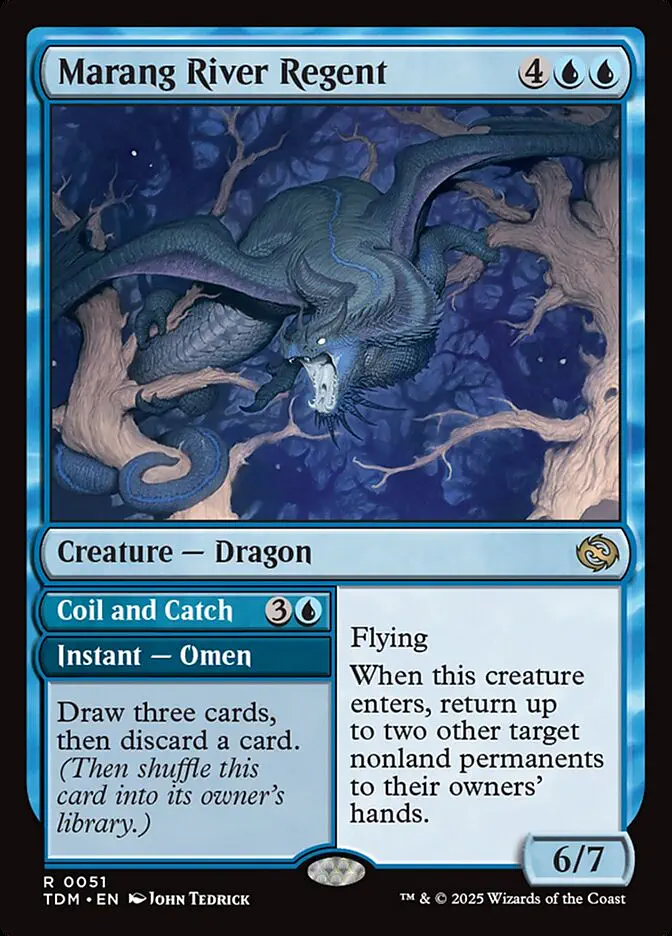
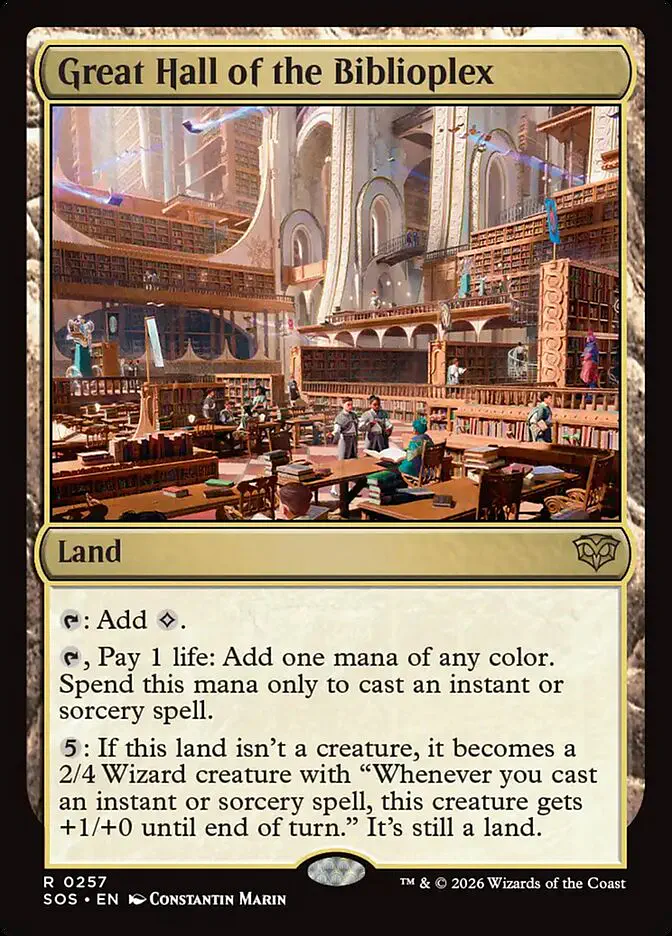
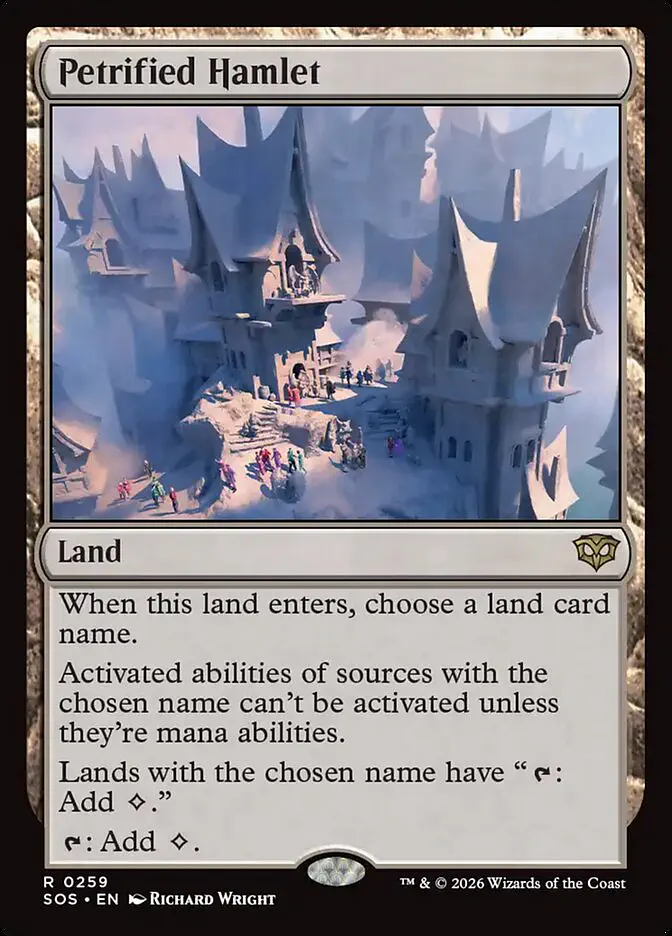
The main deck win conditions are two Marang River Regent and four Great Hall of the Biblioplex. Within the deck, two "needle" lands, Petrified Hamlet, to eliminate the advantage of utility lands, which are now very impactful.
You can lose a game to animated lands with Ba Sing Se's Earthbend, or a control mirror to spells made uncounterable by Mistrise Village, to give two examples.
Then, a single copy of Urgent Necropsy to have an extra opportunity to go 2 or 3 for 1 on a large variety of removable resources, and a single copy of Outrageous Robbery, which can take away one or more win conditions from the opponent and redirect them back to yourself.
The latter is a card I don't appreciate for its randomness, but it often finds concrete utility, always proving unexpected.
The card quality and card advantage package is excellent, consisting of the two best cards in the format for this purpose: Consult the Star Charts and Rakshasa’s Bargain. These are also the true current reason to play control in those colors. Losing Tablet of Discovery, in fact, is not easy to compensate for.
Space can probably also be found for one or two Stock Up, giving up something experimental, like Nowhere to Run.
The rationale for having this removal in the main deck and even in the sideboard, I imagine, lies in the possibility of bouncing it and reusing it with Marang River Regent's ETB. However, this isn't exactly a power play.
Nowhere to Run is a card that is barely usable outside of a dedicated strategy like Bounce. It's a rather deficient removal when compared to the average power level of current Standard. -3/-3 is truly too little for a two-mana hard removal.
Stoic Sphinx
Creature — Sphinx
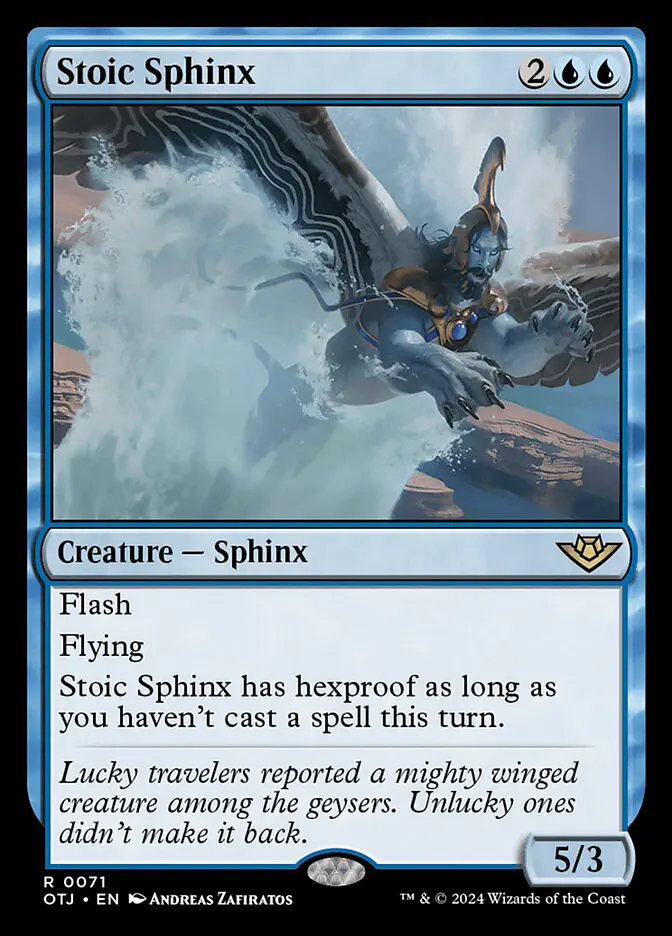
Stoic Sphinx
Creature — Sphinx

Flash
Flying
This creature has hexproof as long as you haven't cast a spell this turn.
The sideboard, in my opinion, is rather questionable. The inclusion of two Stoic Sphinx, a card that has also started to appear here in Europe, is very nice. However, there are many sideboard slots dedicated to the creature package (Quarsi Revenant, Wan Shi Tong, Rhe Unagi of Kyoshi Island) and only one aimed at graveyard hate, consisting of a single copy of Strategic Betrayal.
I understand the desire to change win conditions as needed, but graveyard hate in the format is very relevant and complex in its nuances. Strategic Betrayal is an exquisite card, but I don't see why not include two, or something different like Ghost Vacuum.
I believe this last card is underestimated in current deck constructions. It can do truly oppressive things, even with its second ability, which seemed unplayable a year ago.
Consider, for example, stealing the sorcery or instant in the graveyard that allows Flow State to generate card advantage before its resolution. Or imagine stealing an Emeritus of Ideation or a Superior Spider-Man from Excruciator, which means the opponent has to figure out how to resolve Ghost Vacuum before comboing off, because they might perish from their own combo.
Another aspect of the sideboard that doesn't convince me is the absence of slots dedicated to faster wraths than Deadly Cover-Up. I wonder what the point is of not including Day of Black Sun in our game plan.
All this being said and granted, it's the deck that has sparked my curiosity the most. I find it both creative and competitive, and Yuya Hosokawa has skillfully wielded it with great mastery.
4) Price Update
Standard MOLE Index price update for the format.
The field distribution compared across multiple meta-tracking databases over the last two weeks returned an analysis sample of 11 decks:
- Excruciator
- Landfall
- Lessons
- Prowess
- Spellementals
- 4c Control
- Momo
- Tempo-Prison
- Discard
- Lessons
- MonoG Landfall
The arithmetic mean drops to €343, the median approaches €355. The geometric mean flexes towards €323.5, with the lower outlier being Spellementals and the upper outlier being Tempo-Prison in the version with Quantum Riddler.
The cost of Standard remains contained and very symmetrically distributed. The Decks continue to lower the entry price of the format, but new control setups or aggressive strategies like Mardu Discard also have very contained prices, despite using many colors.
The geometric mean of other formats taken for comparison remains substantially unchanged in this regard:
- Vintage €31,650.84
- Legacy €8,468.18
- Modern €670
- Pioneer €355.70
- Pauper €82.05
Therefore, taking all formats as a sample, Standard returns to second place as the most economical format.
If we limit the scope to competitive formats only, i.e., Modern, Pioneer, and Standard, then Standard is the most economical format of the last two weeks.
“See You Space Cowboy”
Francesco