

Magic: The Gathering Rulebook: The Complete Guide to the Rules and PDFs
The Magic: The Gathering rulebook establishes how to start a game, draw cards, produce mana, cast spells, attack, block, and determine the winner. The fundamental rules are relatively simple to learn, while the Comprehensive Rules compile even the most complex technical cases and card interactions.
To start playing, you don't need to memorize the entire rulebook. It is enough to understand a few fundamental concepts: life totals, mana, card types, game zones, turn structure, the stack, and combat.
In this guide, we'll look at how to play Magic: The Gathering, starting with the rules for beginners and moving up to the differences between Standard and Commander. You will also find direct links to download the official Magic rulebook in PDF format.
Magic Rulebook in PDF: Quick Download
- Download the Comprehensive Rules updated to August 7, 2026 – English PDF
- Download the Magic Tournament Rules updated to February 27, 2026 – English PDF
The Italian guide is the most straightforward document for learning the basics, but it dates back to Magic 2015. The Comprehensive Rules, on the other hand, are the complete and updated technical rulebook, while the Tournament Rules govern the procedures used in sanctioned events.
Magic Rules for Beginners
The rules of Magic for beginners can be summarized as follows: each player uses a deck of cards to produce mana, cast spells, put creatures onto the battlefield, and defeat their opponents.
In a standard one-on-one game, each player starts with:
- 20 life points;
- an opening hand of seven cards;
- a shuffled deck, called a library;
- no permanents on the battlefield.
Before the game begins, players randomly determine who starts. In two-player games, the player who goes first skips their first draw step and therefore does not draw a card during their first turn.
If a player is not satisfied with their opening hand, they can take a mulligan. They shuffle their hand back into their library, draw a new hand of seven cards, and, once they decide to keep, put one card on the bottom of their library for each mulligan they have taken.
In multiplayer games and Brawl, the first mulligan is free: it does not count toward the number of cards that must be put on the bottom of the deck.
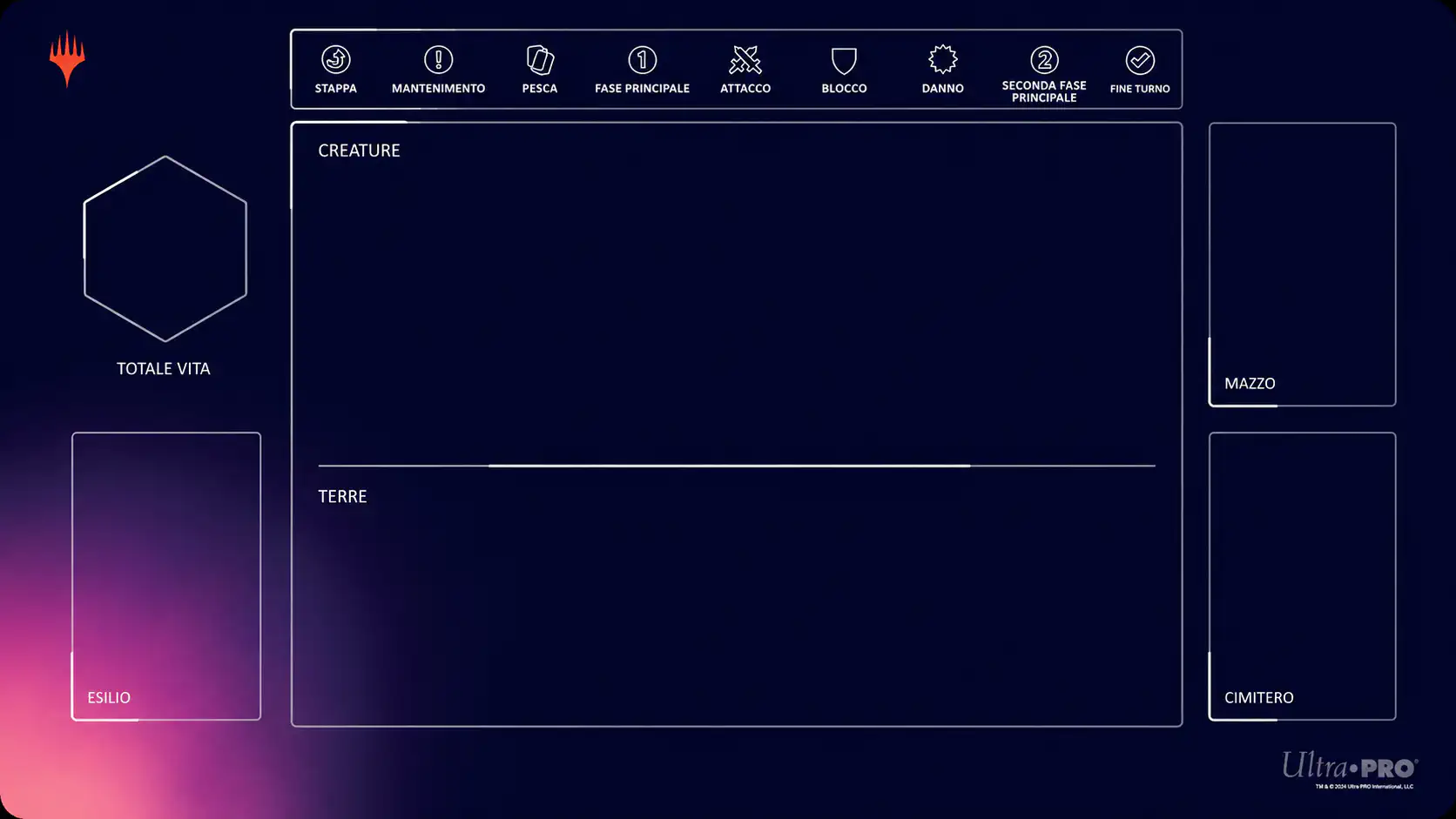
Several distinct game zones are used on the table:
- the deck or library, which is the pile from which you draw cards;
- the hand, which contains the cards available to the player;
- the battlefield, where permanents sit (typically creatures on top, lands on the bottom);
- the graveyard, where resolved spells and destroyed permanents normally end up;
- exile, a separate zone used by numerous card effects;
- the stack, where spells and abilities wait to resolve;
- the command zone, used in Commander and certain other variants.
Goal of the Game and Basic Components
The goal of a game of Magic is to win, which normally means reducing your opponent's life total from 20 to 0.
Creatures and spells can deal damage, and when a player has 0 or less life, they lose the game the next time state-based actions are checked.
There are also other lose conditions. A player loses if:
- they must draw more cards than are remaining in their library;
- they have ten or more poison counters;
- a card or effect directly states that they lose the game;
- they concede the game.
Additionally, some cards feature alternative win conditions that allow you to win without bringing your opponent's life total down to 0.
To play, you essentially need:
- a deck for each player;
- a way to keep track of life totals;
- any necessary dice, tokens, and counters;
- a flat surface on which to lay out the cards.
In the main Constructed formats, a deck must contain at least 60 cards. Except for specific rules of a format or restrictions on a card itself, you can run a maximum of four copies of any individual card, except for basic lands.
In Limited formats, such as Draft and Sealed, decks must contain at least 40 cards and can include any number of copies of the same card opened during the event. The sideboard of a Constructed deck can contain up to 15 cards.
Each player's deck becomes their library at the start of the game. Cards are kept face down and, unless a specific effect allows it, you cannot look at them or freely change their order.
Card Anatomy and Spell Types
Understanding the anatomy of a Magic card lets you see how much it costs, what card type it has, and what effect it produces.
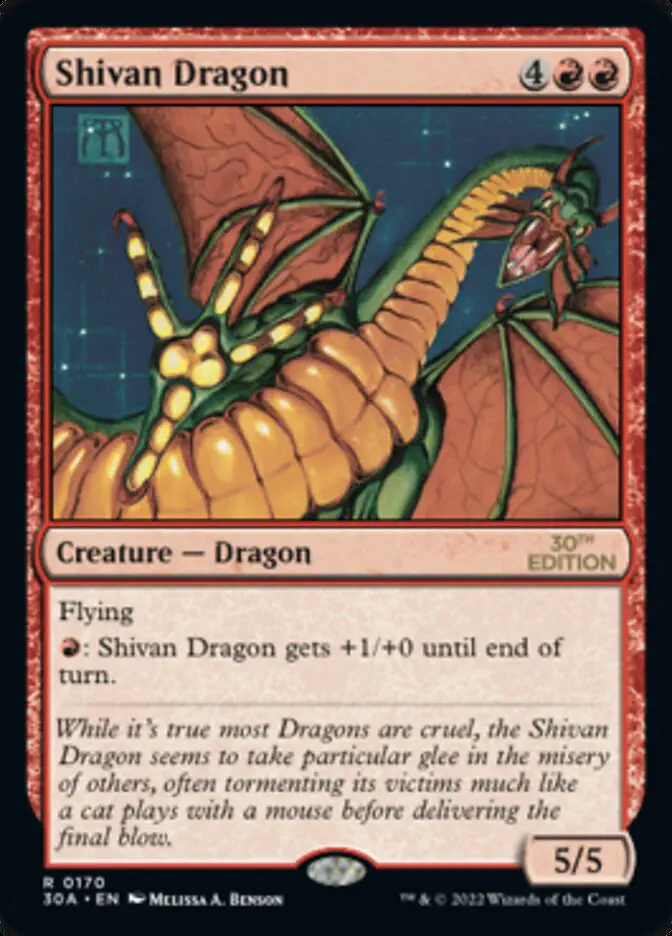
Shivan Dragon
Creature — Dragon


Flying
: This creature gets +1/+0 until end of turn.
On a standard Magic card, starting from the top left, we find:
- card name;
- mana cost, generally in the upper right corner;
- art crop/illustration;
- type line;
- rules text;
- any flavor text, which does not affect gameplay;
- power and toughness, in the case of creatures;
- loyalty, in the case of Planeswalkers;
- defense, in the case of Battles;
expansion symbol, rarity, and collector number.
The fundamental parts of a card and its different types are described in Sections 2 and 3 of the Comprehensive Rules.
The main card types are as follows.
Forest
Basic Land — Forest
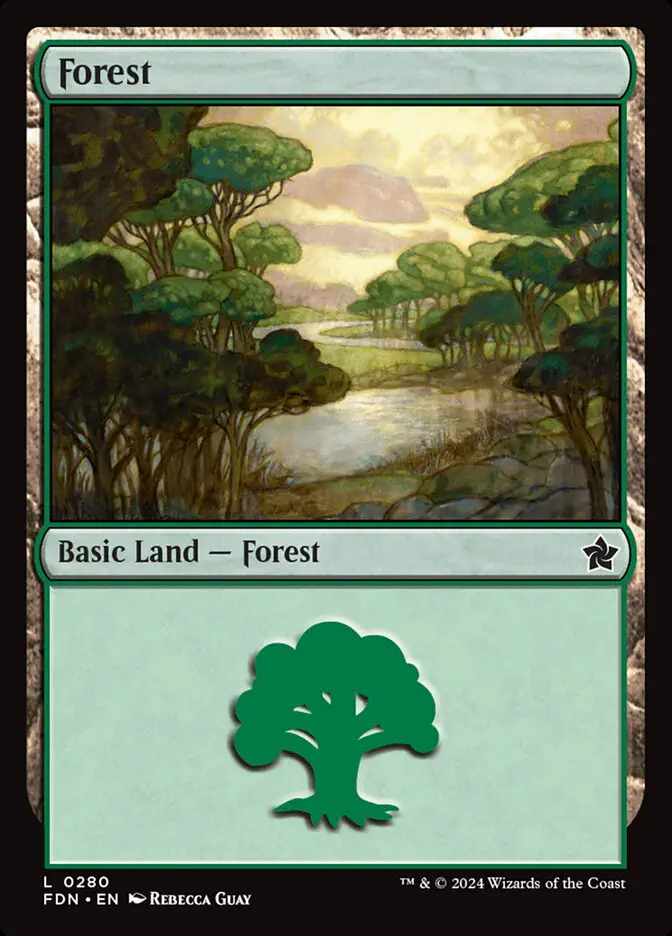
Forest
Basic Land — Forest
( : Add
: Add  .)
.)
Land: used primarily to produce mana. A land is not cast as a spell and, normally, you can only play one land during each of your own turns. Not all lands necessarily produce mana, though the five basic lands have intrinsic abilities that generate it.
Craw Wurm
Creature — Wurm
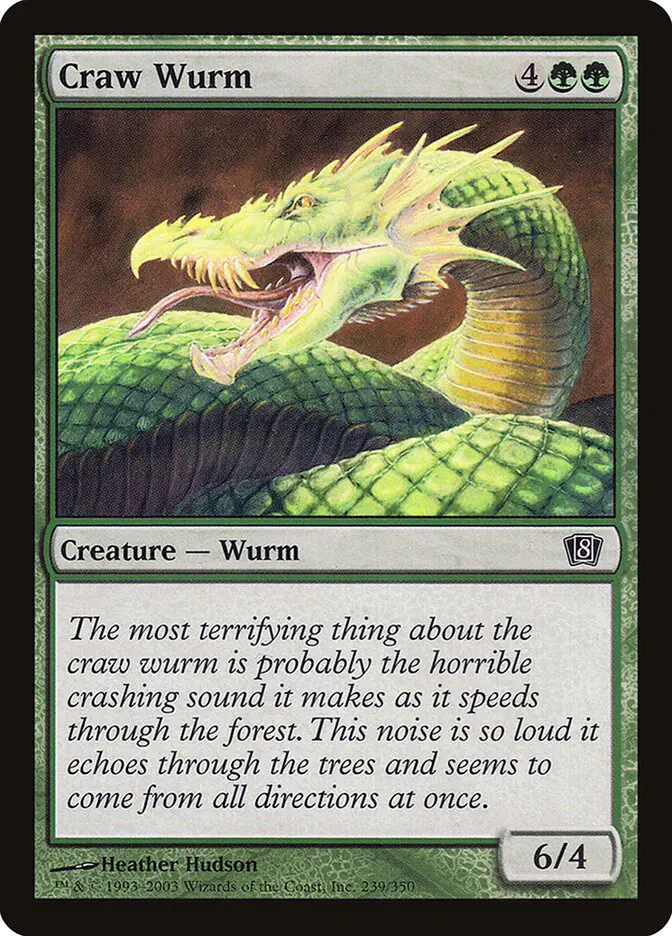
Craw Wurm
Creature — Wurm
Creature: a permanent that can attack, block, and use its own abilities. In the bottom right corner, it displays power and toughness. A 6/4 creature normally deals 6 damage in combat and is destroyed if it has at least 4 damage marked on it.
Damage does not directly reduce toughness. A 6/4 creature that takes 1 damage remains a 6/4 with 1 damage marked on it until the cleanup step.
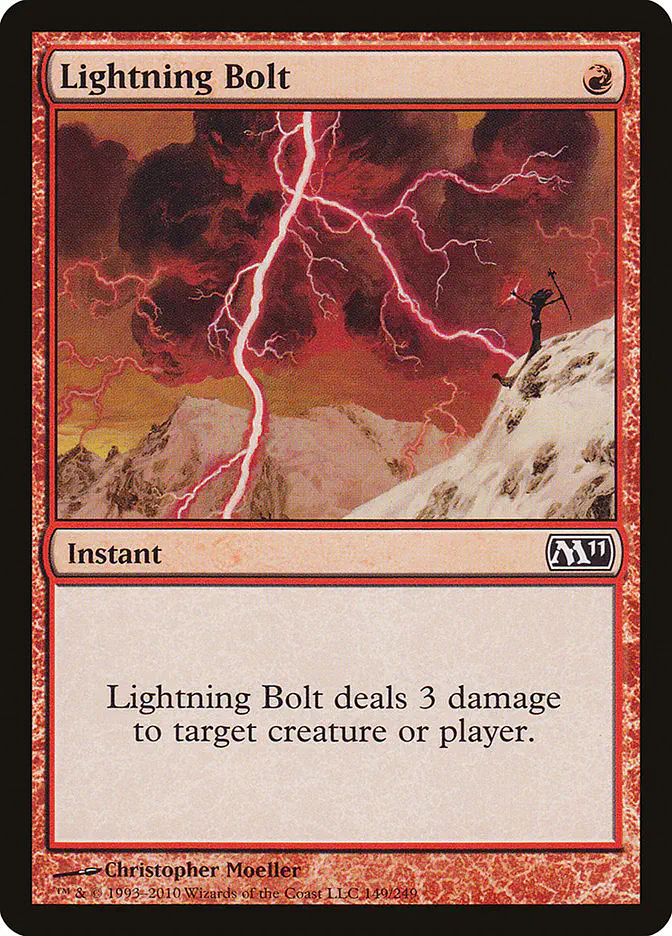
Lightning Bolt
Instant
Lightning Bolt deals 3 damage to any target.
Instant: produces an effect and is then put into the graveyard. It can be cast whenever a player has priority, even during an opponent's turn.
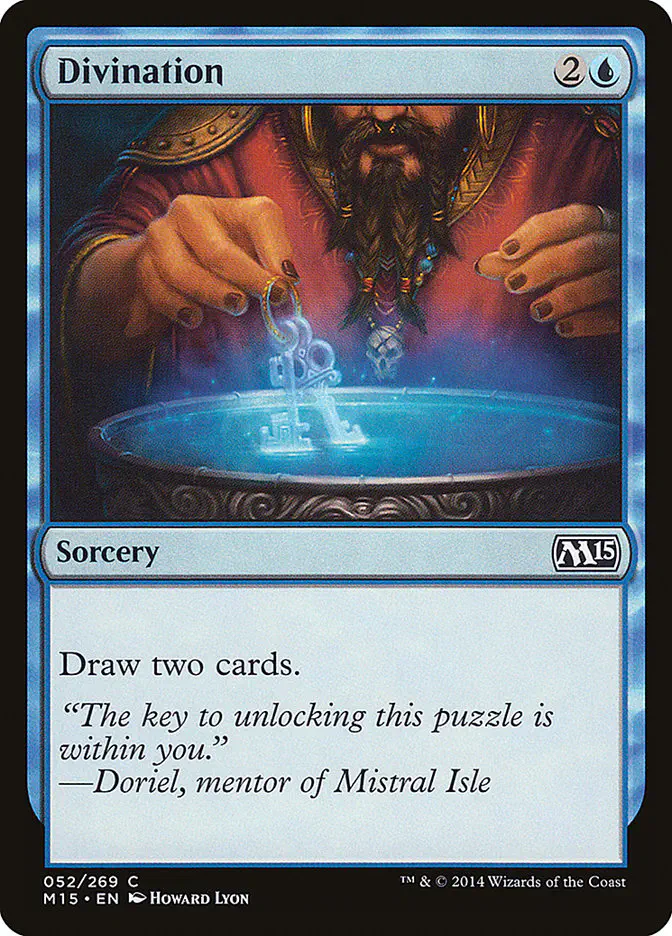
Divination
Sorcery


Draw two cards.
Sorcery: produces an effect and is normally put into the graveyard after resolution. It can only be cast during one of your own main phases, when you have priority and the stack is empty.
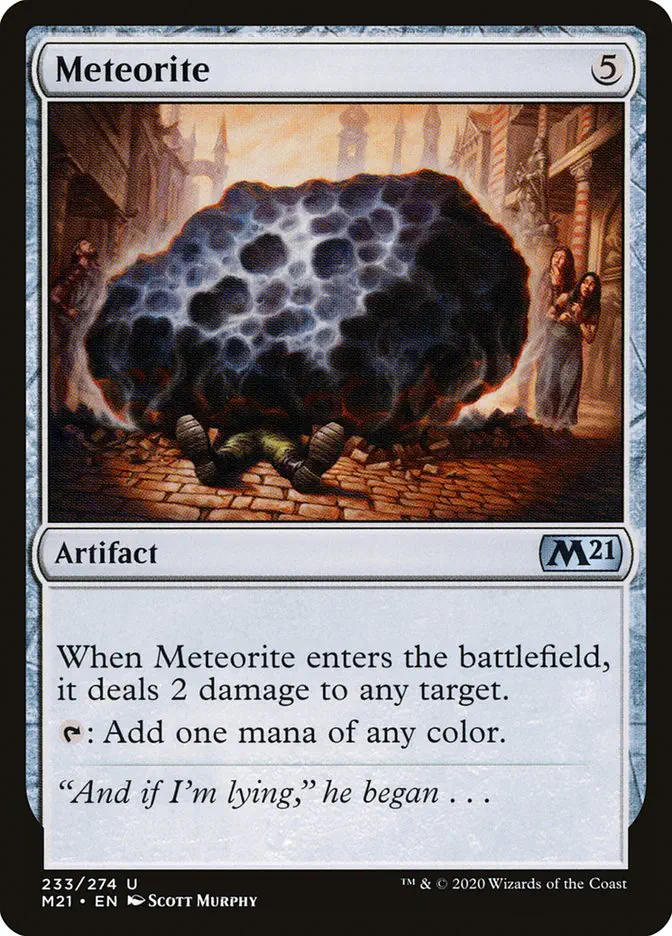
Meteorite
Artifact

When this artifact enters, it deals 2 damage to any target.
: Add one mana of any color.
Artifact: represents objects, structures, equipment, or other permanents. An artifact spell that resolves enters the battlefield.
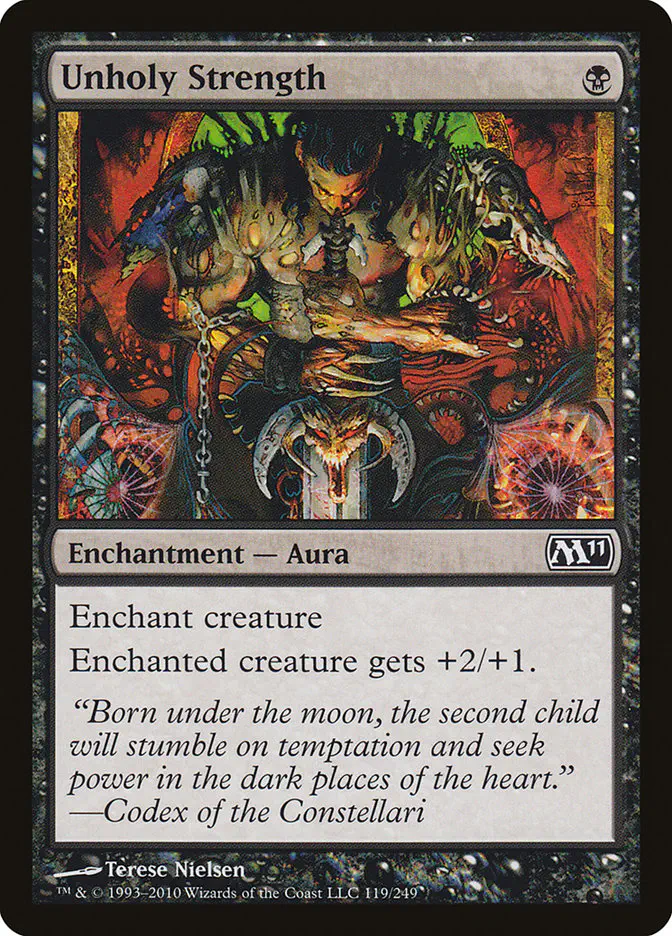
Unholy Strength
Enchantment — Aura
Unholy Strength
Enchantment — Aura

Enchant creature
Enchanted creature gets +2/+1.
Enchantment: a permanent that remains on the battlefield to provide ongoing effects or abilities. Auras are enchantments that are attached to an object or, when specified, to a player.
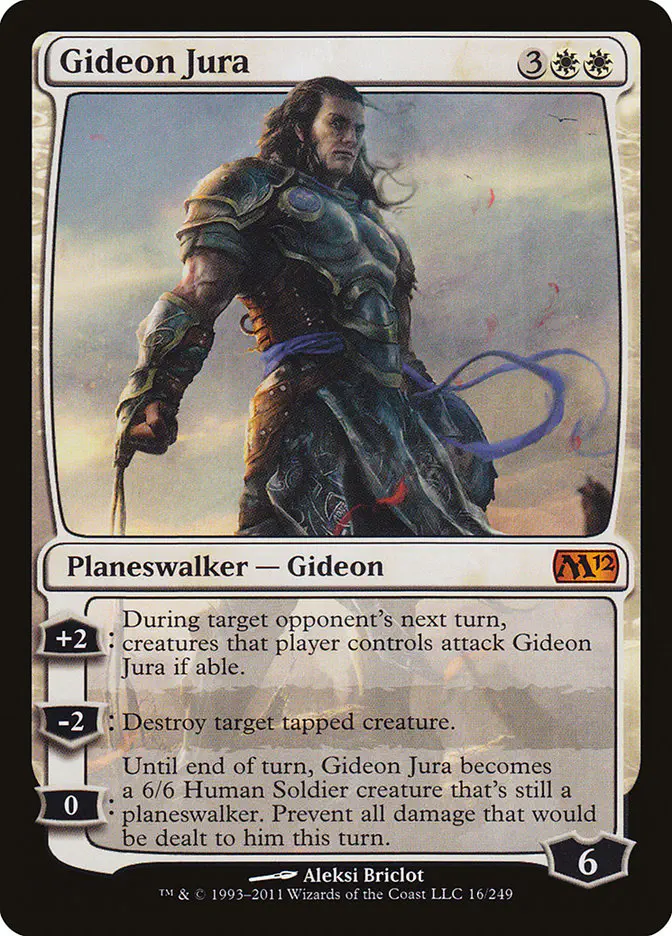
Gideon Jura
Legendary Planeswalker — Gideon
Gideon Jura
Legendary Planeswalker — Gideon


+2: During target opponent's next turn, creatures that player controls attack Gideon Jura if able.
−2: Destroy target tapped creature.
0: Until end of turn, Gideon Jura becomes a 6/6 Human Soldier creature that's still a planeswalker. Prevent all damage that would be dealt to him this turn.
Planeswalker: a permanent that enters with loyalty counters and has abilities with costs expressed by adding or removing loyalty. Planeswalkers can be attacked during combat.
Invasion of Ikoria
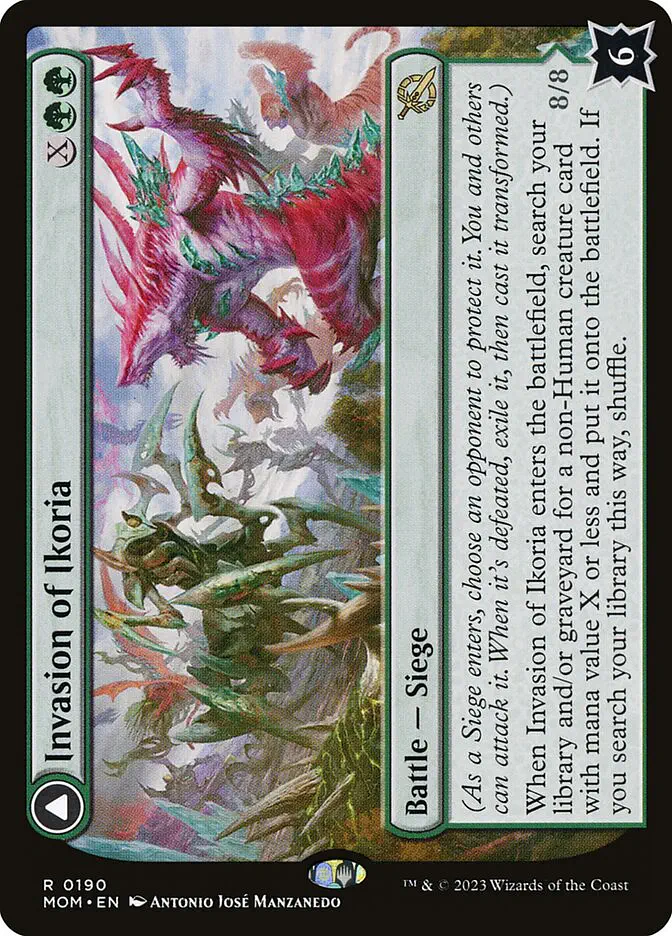
Zilortha, Apex of IkoriaBattle — Siege

(As a Siege enters, choose an opponent to protect it. You and others can attack it. When it's defeated, exile it, then cast it transformed.)
When this Siege enters, search your library and/or graveyard for a non-Human creature card with mana value X or less and put it onto the battlefield. If you search your library this way, shuffle.
Battle: a permanent with a defense value. Some Battles can be attacked and, when they are defeated, produce the effect specified by their rules.
A fundamental distinction for beginners is this: land cards are not spells, whereas other cards are normally cast as spells.
When a permanent spell, such as a creature, artifact, enchantment, Planeswalker, or Battle, resolves, it enters the battlefield. Instants and sorceries, by contrast, produce their effect and are normally put into the graveyard.
Structure of the Game and Turn Phases
A game of Magic is organized into turns, and each turn consists of five major phases.
The order of the phases is:
- beginning phase;
- first main phase;
- combat phase;
- second main phase;
- ending phase.
The beginning phase includes three steps:
- untap step;
- upkeep step;
- draw step.
During the untap step, the active player untaps all tapped permanents they control. During the upkeep, any abilities that trigger at this time are put onto the stack. During the draw step, the player draws a card.
In the first main phase, you can play lands and cast spells, respecting their normal timing rules.
Next comes the combat phase, during which the player can attack with their creatures.
The second main phase works exactly like the first. If the player has already used their normal land play for the turn, they cannot play a second land, unless a card explicitly allows them to do so.
The ending phase includes the end step and the cleanup step. During cleanup, the active player discards down to their maximum hand size (normally seven cards), and any damage marked on creatures is removed.
Managing Mana and Casting Spells
Mana management in Magic consists of producing and spending the resource required to cast spells and activate abilities.
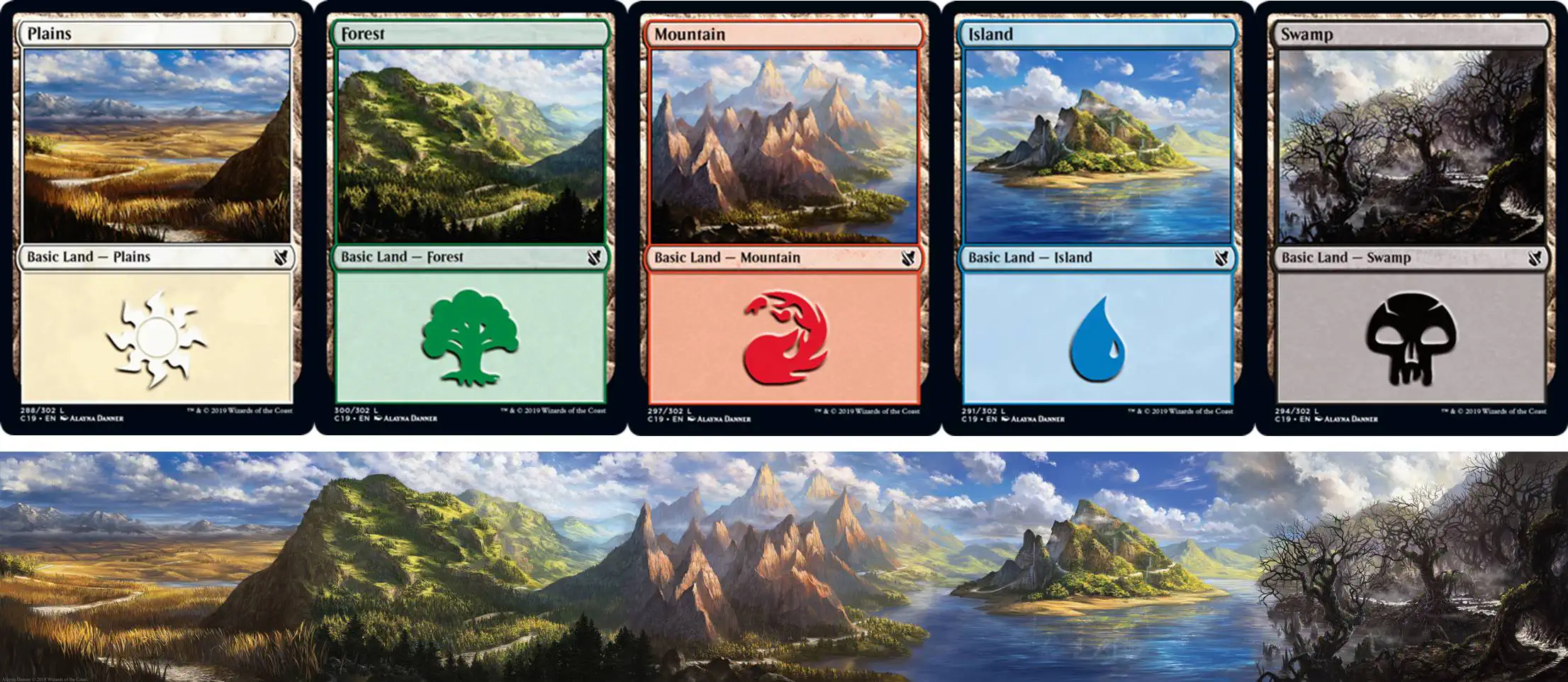
The five colors of Magic correspond to the five basic lands:
- Plains → , white mana;
- Island → , blue mana;
- Swamp → , black mana;
- Mountain → , red mana;
- Forest → , green mana.
To produce mana, a basic land is normally tapped (rotated sideways). The produced mana is added to the player's mana pool and can be used to pay costs.
Lands and mana are not the same thing: the land is the permanent that produces the resource, while mana is the resource generated.
If a spell costs , you must spend:
- one blue mana to pay for ;
- two other mana to pay for the generic cost of .
Generic costs can normally be paid with mana of any color or type.
Mana does not remain available forever. A player's mana pool empties at the end of each phase and step, unless a card states otherwise.
It is also important to distinguish between mana cost and mana value.
The mana cost is represented by the symbols printed on the card. The mana value is the total number of mana required, regardless of color. A card with a cost of thus has a mana value of 3.
To cast a spell, a player must:
- announce the spell;
- put it onto the stack;
- make any required choices;
- choose any targets;
- determine and pay the total cost.
After a spell has been cast, other players can respond if they receive priority.
Priority dictates who can take actions at any given moment. The player who has priority can normally:
- cast an instant;
- activate an ability;
- perform certain special actions;
- during their own main phase and with the stack empty, cast non-instant spells.
The stack contains the spells and abilities waiting to resolve. It works on a "last in, first out" basis.
If a player casts a creature and their opponent responds with an instant, the instant is placed on top of the creature spell. If no one adds other spells or abilities, the instant resolves first, followed by the creature.
When all players pass priority in succession without adding anything, the top object on the stack resolves. After it resolves, players receive priority once again.
Not all actions use the stack. Playing a land is a special action, and normal mana abilities resolve instantly without using the stack.
Combat Phase and Assigning Damage
The combat phase in Magic determines which creatures attack, which are blocked, and how damage is assigned.
The combat phase consists of five steps:
- beginning of combat;
- declare attackers step;
- declare blockers step;
- combat damage step;
- end of combat step.
During the declare attackers step, the active player chooses which creatures attack and what they are attacking. A creature can attack:
- an opponent;
- a Planeswalker controlled by an opponent;
- a Battle that can be attacked.
Attacking creatures are normally tapped. A creature with vigilance, however, does not tap when it attacks.
A creature cannot normally attack unless its controller has controlled it continuously since the beginning of their most recent turn. This restriction is commonly known as summoning sickness. A creature with haste can ignore it.
During the declare blockers step, the defending player chooses which of their untapped creatures will block the attackers. Blocking does not automatically tap a creature.
A blocking creature can normally only block a single attacker, whereas a single attacker can be blocked by multiple creatures.
During the combat damage step:
- an unblocked creature deals its damage to the player or permanent it is attacking;
- a blocked creature deals damage to the creatures blocking it;
- blocking creatures deal damage to the creatures they are blocking.
Attackers and blockers normally deal their damage simultaneously. Abilities like first strike and double strike can create an additional combat damage step, altering this sequence.
A creature that has taken damage equal to or greater than its toughness is destroyed as a state-based action and put into the graveyard.
Current rules no longer use the old damage assignment order. If a creature is blocked by two or more creatures, its controller can freely distribute damage among them, without having to establish a strict order beforehand and without being forced to assign lethal damage to the first before hitting the second.
For example, if a 4/4 creature is blocked by a 3/3 and a 1/1, its controller can assign:
- 3 damage to the 3/3 and 1 to the 1/1;
- 4 damage to the 3/3;
- 4 damage to the 1/1;
- 2 damage to each;
- any other split permitted by the rules.
Abilities like trample, deathtouch, lifelink, flying, first strike, and double strike further modify how creatures fight or assign damage.
Rules for Standard and Commander Formats
The rules for Standard and Commander use the basic rules of Magic but add specific restrictions regarding deck construction, starting life totals, and gameplay structure.
Standard retains the classic structure of competitive, one-on-one play.
Commander, on the other hand, uses 100-card singleton decks, a commander, 40 life, and is generally played in a multiplayer format.
Magic Commander Rules and Multiplayer Variants
The rules of Magic Commander feature a 100-card deck, a commander, 40 life, and normally a multiplayer setup.
A Commander deck contains exactly:
- 1 commander;
- 99 other cards.
Except for basic lands and cards that explicitly state otherwise, every card must have a different name. Commander is therefore a singleton format and does not normally utilize a sideboard.
The commander is generally a legendary card designated by the format's rules. Updated rules allow as a commander any legendary card that is a creature, Vehicle, or Spacecraft with at least one power/toughness box. Some cards also feature abilities that explicitly allow them to be used as a commander.
The commander determines the deck's color identity.
Color identity takes into account:
- the commander's colors;
- mana symbols in its cost;
- mana symbols in its rules text;
- any color indicators and characteristics specified by the rules.
If a commander has a blue and red color identity, the deck can contain blue, red, blue-red, and colorless cards, but not cards with a white, black, or green color identity.
The commander starts the game in the command zone and can be cast from there by paying its normal cost.
Each time it is cast again from the command zone, it costs an additional generic mana for each previous time it was cast from that zone during the game. This cost is commonly called the Commander Tax.
If a commander would be put into a graveyard or exile, its owner can choose to move it to the command zone when state-based actions are checked. If it would be put into their hand or library, its owner can choose to send it to the command zone instead.
Each player normally starts with 40 life and draws seven cards.
Commander also adds a unique lose condition: a player who takes at least 21 combat damage from the same commander over the course of the game loses, regardless of their current life total. Damage dealt by different commanders is tracked separately.
A standard Commander game is played as a Free-for-All multiplayer match, generally with four players.
During combat, a player can:
- attack one or more opponents;
- attack different Planeswalkers;
- split their attacking creatures among multiple players.
The multiplayer element introduces dynamics that do not normally exist in one-on-one games: temporary alliances, negotiations, deciding which opponent to attack, and managing threats from multiple players.
There are also several other multiplayer variants.
Two-Headed Giant: two teams of two players share a turn and a starting total of 30 life per team.
1v1 Commander: adapts Commander for a two-player game. This variant may use different rules and banlists depending on the platform or tournament circuit.
Commander Draft: combines Commander and Limited. Players normally draft two cards at a time and build decks of at least 60 cards. In this variant, you can use multiple copies of the same card drafted during the event.
Planechase: adds a planar deck that modifies the game globally.
Archenemy: pits a team of players against a single opponent empowered by special Scheme cards.
Oathbreaker: uses 60-card singleton decks led by a Planeswalker and a Signature Spell.
The normal rules regarding mana, the stack, priority, combat, and spell resolution continue to apply in Commander.
The Standard Format and League Rotation
The Standard format uses decks of at least 60 cards and allows you to play only the expansions currently legal in the format.
The main construction rules are:
- at least 60 cards in the main deck;
- a sideboard of up to 15 cards;
- a maximum of four copies of the same card across the main deck and sideboard;
- no limit on the number of basic lands.
Standard is normally played one-on-one. Matches can be Best-of-One or Best-of-Three.
The main feature of the format is rotation.
New expansions enter Standard periodically, while once a year, older sets exit the format. Rotation keeps the card pool from expanding indefinitely and refreshes the competitive metagame.
In 2026, Standard will not undergo rotation. Starting in 2027, rotation will happen after the Prerelease of the year's first premier set and will remove the six oldest Standard sets. This keeps the format encompassing roughly three years of expansions.
Standard leagues follow the Standard format's rotation and do not normally have a separate rotation schedule.
A league or tournament uses the Standard card pool that is legal on the scheduled date of the event. Once rotation occurs, cards from the exiting sets can no longer be played in Standard decks, unless they have been reprinted in a set that remains legal.
A card that rotates out of Standard is not completely useless. It can still be played in other formats where it is legal, such as Pioneer, Modern, Legacy, Vintage, or Commander.
Before participating in a league, it is highly recommended to check:
- the event date;
- legal sets;
- the latest banned list;
- any specific rules specified by the organizer.
The official Standard format page keeps the list of legal expansions up to date.

Official Resources and Technical Manuals
The main official resources to verify Magic rules are the Comprehensive Rules, the Magic Tournament Rules, expansion Release Notes, our Gym, and the Oracle card database.
These tools serve different purposes.
The basic guide helps you learn how to play.
The Comprehensive Rules are used to resolve technical questions and complex card interactions.
The Magic Tournament Rules establish how events must be organized and run.
The Release Notes explain the mechanics introduced by a new expansion and provide clarifications on individual cards.
The Oracle database, accessible via Gatherer, contains the official up-to-date text of the cards. When the printed text on an older card differs from its Oracle text, the Oracle text is always used during gameplay.
The Complete Rulebook and Comprehensive Rules
The complete rulebook of Magic is contained in the Magic: The Gathering Comprehensive Rules.
The Comprehensive Rules are the ultimate technical reference document compiling general rules, exceptions, and unique edge cases of the game.
Wizards notes that they are not designed to be read cover-to-cover like a beginner's guide. They are primarily meant to be searched for answers to specific questions.
The version available at the time of this guide's publication:
- is effective as of August 7, 2026;
- contains 312 pages;
- is available in PDF, DOCX, and TXT formats;
- stands as the official technical reference for the game's rules.
The document is organized into large sections:
- game concepts;
- parts of a card;
- card types;
- zones;
- turn structure;
- spells, abilities, and effects;
- additional rules;
- multiplayer rules;
- casual variants;
- glossary.
Every rule is assigned a specific number. Among the most frequently referenced sections are:
- rule 100: general principles and deck construction;
- rule 103: starting the game;
- rule 104: ending the game;
- rule 106: mana;
- rule 117: timing and priority;
- rule 405: the stack;
- rule 500: turn structure;
- rule 510: combat damage;
- rule 601: casting spells;
- rule 704: state-based actions;
- rule 903: Commander.
This numbering system allows players to cite rules precisely during discussions, tournaments, or when seeking rules clarifications.
For competitive play, there are also the Magic: The Gathering Tournament Rules. This document does not replace the Comprehensive Rules but adds standards regarding:
- roles and responsibilities at events;
- match structure;
- pre-game procedures;
- deck registration and deck checks;
- sideboarding;
- communication between players;
- time management;
- concessions and draws;
- formats and card legality;
- sleeves and card protection;
- public, private, and derived information.
The version currently featured on the WPN page is effective as of February 27, 2026.
Where to Download the Magic Rulebook in PDF
The Magic rulebook in PDF can be downloaded for free from the official Wizards of the Coast website.
For easy access, here are the direct links to the main documents.
Updated Comprehensive Rules
Download the Comprehensive Rules updated to August 7, 2026 – PDF
The Comprehensive Rules represent the complete and updated technical rulebook. This is the document to consult to verify:
- interactions between multiple effects;
- priority and the stack;
- combat rules;
- continuous effects;
- copies;
- targets;
- replacement effects;
- state-based actions;
- multiplayer rules;
- Commander;
- keywords and mechanics.
The PDF is in English and spans 312 pages.
Magic Tournament Rules
Download the Magic Tournament Rules updated to February 27, 2026 – PDF
The Tournament Rules are geared primarily toward competitive players, judges, and tournament organizers. They govern procedures used in official tournaments and complement the standard game rules.
Official Pages to Check for Updates
Since Wizards updates these documents periodically, you should always check for the latest versions on these official pages:
When a new version is published, the international rules page updates the links to the latest PDF, DOCX, and TXT files.

From Rules to Strategy: Advanced Magic Gym
Advanced Magic Gym is Metagame's free course dedicated to players who already know the fundamental rules of Magic: The Gathering and want to learn how to apply them more mindfully during matches.
Knowing the rules lets you know what actions are legal, but to truly level up you must also understand how to evaluate resources, manage game speed, identify your role, build an efficient deck, and properly utilize your sideboard.
The course, curated by Francesco Guidorizzi, guides the reader from general game theory all the way through deckbuilding and sideboarding. It doesn't replace the Comprehensive Rules; rather, it represents the next logical step to translate rules knowledge into superior strategic decisions.
MTG Course Index
- Preface: Game Theory, Deckbuilding, and Sideboard
- Introduction
- Resource in MTG
- Speed in MTG
- Offense and Defense in MTG
- Efficiency in MTG
- Flexibility in MTG
- Proactivity and Reactivity in MTG
- General Principles of Deckbuilding
- The Art of Sideboarding
- Conclusion
If the rulebook explains how Magic works, Advanced Magic Gym explains how to use those rules to play better.

Frequently Asked Questions
How do Magic rules work for new blocks?
Magic rules for new blocks utilize the same general Comprehensive Rules, with the necessary updates added to accommodate new mechanics and cards.
While the term "block" is still used informally by some players, Magic no longer regularly follows the old model where multiple consecutive sets formed a single block.
Modern expansions are generally designed as standalone products, even when they share settings, characters, or narrative arcs. Wizards abandoned the traditional block model after finding several limitations in a structure relying on linked large and small sets.
When a new expansion is released, Wizards typically publishes Release Notes explaining:
- new mechanics;
- new keywords;
- any new card types or subtypes;
- clarifications on interactions;
- rulings for individual cards;
- format legality information.
If a new set requires general rules updates, Wizards also updates the Comprehensive Rules.
To understand the rules for a new expansion, you should first consult its Release Notes and, for technical inquiries, the most recent version of the Comprehensive Rules.
What are the main differences between basic rules and Commander?
The main differences between basic rules and Commander involve deck size, allowed card copies, starting life totals, the commander, color identity, and the multiplayer format.
In a standard one-on-one Constructed game:
- the deck contains at least 60 cards;
- you can use up to four copies of the same card;
- each player normally starts at 20 life;
- there is no command zone;
- the commander damage rule does not apply.
In Commander:
- the deck contains exactly 100 cards;
- one or more cards permitted by the rules are designated as the commander;
- with rare exceptions, each card can appear only once (singleton);
- cards must match the commander's color identity;
- each player normally starts at 40 life;
- the commander starts in the command zone;
- recasting the commander from the command zone increases its cost by ;
- taking 21 combat damage from the same commander results in losing the game;
- the format is typically played in a multiplayer setting;
- a sideboard is not normally used.
The standard rules concerning mana, the stack, priority, permanents, abilities, combat, and resolving spells remain completely valid in Commander.
Where can I find the official Magic: The Gathering manual in PDF?
The official Magic: The Gathering manual in PDF is available for free in the Rules section of the Wizards of the Coast website.
To consult the complete and updated rules, you should use:
Comprehensive Rules updated to August 7, 2026 – PDF
To learn the rules for sanctioned events, you can download:
Magic Tournament Rules updated to February 27, 2026 – PDF
The Italian guide is simpler and more immediate, but dates back to Magic 2015. The English Comprehensive Rules represent the official, up-to-date technical reference for game rules and interactions.
What are the Magic Comprehensive Rules?
The Magic Comprehensive Rules are the complete and official technical rulebook for Magic: The Gathering.
The document contains all rules necessary to govern the game, including scenarios a beginner is unlikely to encounter in their first few matches:
- continuous effects;
- layers;
- dependencies;
- replacement and prevention effects;
- copies;
- triggered abilities;
- state-based actions;
- double-faced cards;
- face-down objects;
- multiplayer rules;
- casual variants;
- hundreds of keyword-defined abilities and actions.
The Comprehensive Rules are not a manual to be read cover-to-cover. They are primarily a reference document to use when a precise question about the rules comes up.
To learn the game, the most effective path is to:
- read the basic rules;
- play a few games;
- learn turn phases and combat;
- understand the stack and priority;
- consult the Comprehensive Rules only when a specific interaction arises.
The complete rulebook exceeds 300 pages because it must govern interactions between tens of thousands of cards printed throughout Magic's history. However, the rules needed to get started remain relatively few: draw cards, play lands, make mana, cast spells, attack, and bring your opponent to 0 life.
Alex