

Guide Index
1. How it Works and What it Really Changes
2. White, Blue, Black, Red, and Green Cards
3. Multicolored and Colorless Cards
4. Do Brackets and Game Changers Work?
In February 2025, the world of Magic saw one of the most significant changes in recent years for Commander. As of February 11th, the Bracket System came into effect, a new system designed to help players sit at the same table with shared expectations about the power level of their respective decks.
More than a year later, however, many players are still unclear about what this tool really is and how to use it. In this guide, we will try to clarify.
First, it's important to understand that the Bracket System is not an additional rulebook, but a set of guidelines that players should use even before starting a game. The goal is to allow everyone to know, even before shuffling their libraries, what kind of experience to expect from the table.
If used correctly, this system also allows people who don't know each other to have much more balanced and fun games, especially during fairs, festivals, and side events of major tournaments, where you often find yourself playing with people from completely different playgroups.
For those coming from the world of role-playing games, the concept is very similar to the so-called "session zero" or statement of intent between Dungeon Master and players. Before the campaign begins, shared expectations, themes, and limits are established to understand if everyone wants to have the same type of experience. The Bracket System applies the same principle to Commander games.
The Five Brackets
The system is divided into five power levels. In a dedicated article, we will analyze each category in detail, but here is a general overview.
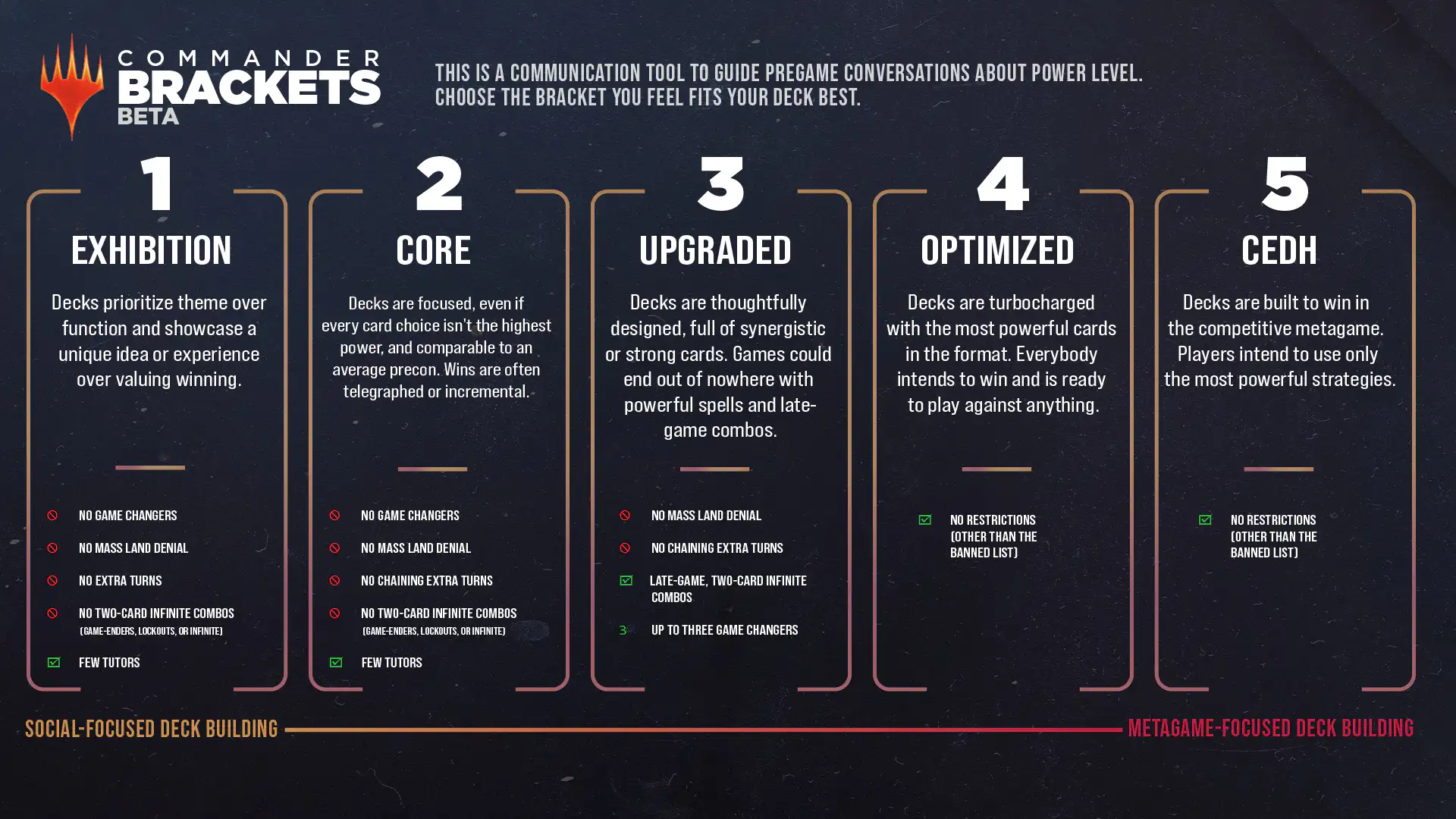
Bracket 1 — Exhibition
This is the most casual level of the format.
Decks are generally built following a precise theme rather than efficiency criteria: for example, using only cards illustrated by the same artist or creatures united by a particular characteristic.
Gamechangers, Mass Land Denial effects, two-card combos, or extra turns are not allowed, except for very rare exceptions strictly related to the deck's theme.
It is normally expected that each player will play at least nine turns before winning or losing.
Bracket 2 — Core
This is often identified as the level of preconstructed decks, but this definition is not entirely correct.
Decks belonging to this category follow a precise strategy but generally forgo the archetype's most powerful cards. The game develops through incremental advantage to a fairly predictable conclusion.
Gamechangers, Mass Land Denial, extra turns, and two-card combos remain forbidden.
The expectation is that each player will play at least eight turns.
Bracket 3 — Upgraded
Here, decks built with a well-defined strategy and solid card synergies begin to appear.
Up to three Gamechangers are allowed. Mass Land Denial remains forbidden. Spells that grant extra turns can be used, provided they are not chained, while two-card combos are allowed only if they do not allow winning before the sixth turn.
The expectation is that the game will last at least six turns.
Bracket 4 — Optimized
The only true restriction is the banlist.
Decks are built to be extremely consistent and fast in achieving their win condition.
Normally, a game ends within the fourth turn.
Bracket 5 — cEDH
This is the only category expressly designed for competitive play.
Decks are optimized to win in the shortest possible time and built considering the competitive metagame. In this case too, the only limit is the format's banlist.
What is a Game Changer?
With the introduction of the Bracket System, the concept of a Game Changer was also created.
These are a group of cards that the Commander Format Panel considers particularly impactful both during deck construction and during the game.
Furthermore, any card removed from the Commander banlist automatically becomes a Gamechanger until the next official list update.
In the next chapter, we will see the current complete list, divided by color, along with the reasons that led to their inclusion.
Next: Card List >>