


Top 4 Things to Know About Standard This Week - Episode 13

Welcome to this new installment dedicated to analyzing the competitive evolution of MTG Standard. In the week spanning April 27th to May 3rd, we had the pleasure of following the Pro Tour Secret of Strixhaven (SOS), an event that delivered great thrills to all of us who constantly strive to improve our gaming skills. One of the primary reasons for attending tournaments or following them remotely is precisely to get better. In this light, the Pro Tour is an event for everyone: self-improvement is available to anyone who wants it, not just the most established competitive players. Today's article starts precisely from this fundamental principle. We will begin with a very brief overview of the PT in the first point, to offer readers who missed it a quick summary of the event. We will not dwell further on this point, as other specific analysis articles written by pro players will be released soon. Here, we will highlight some scattered notes from the event. Quick as a flash, we will discuss ideas, thoughts, and reflections on the PT, from a player to players.
1) Pro Tour Secret of Strixhaven: What Happened in Las Vegas
Last weekend, the Pro Tour dedicated to Secret of Strixhaven took place in Las Vegas. The event had a Limited and a Standard component. Here, we will set aside Limited, despite its significant relevance, to focus on the theme of this column: the Standard format. The field distribution was as follows:

 Prowess 30.5%
- MonoG Landfall 19.1%
- Spellementals 8%
- Lessons 7.4%
 MOMO 4.3%
- Control 3.7%
 Landfall 3.4%
- Maestro 2.8%
- Tempo 2.5%
 Midrange 2.5%
- Excruciator 1.8%
- Others 14.2% (e.g., Omniscience, MonoR, Control, etc.)
The following decks, in the indicated numbers, made it into the Top 8: 2 W/G Landfall (with an 18.18% conversion rate), 2 MonoG Landfall (3.23%), 1 Lessons (4.17%), 1 Tempo (12.5%), 1 Spellementals (3.85%), and 1 W/G Ouroboroid (with an impressive 50% conversion rate). The tournament was won by American Nathan Steuer, to whom we extend our warmest congratulations, piloting W/G Landfall. The most widely played cards from Secret of Strixhaven were: Flow State, Colorstorm Stallion, Prismari Charm, Traumatic Critique, Impractical Joke, Emeritus of Ideation, Great Hall of the Biblioplex, and Erode.
I reiterate that this is merely a basic summary of what happened; it is entirely partial and non-exhaustive, useful only for a quick overview of the event in its Standard dimension. For a considered analysis, I refer to more specific articles, such as the one by Marco Vassallo which will be published shortly. For example, the Top 8 conversion rate I calculated is not an absolute indicator of deck performance; one should look at the inclusion performance in the Top 32 or Top 64. Or, the W/G Ouroboroid has a colossal conversion rate because the initial sample was only two copies, which creates a statistical illusion. Furthermore, the Limited portion, which heavily influences the final result, has been overlooked. In short, do not draw conclusions from this chronicle. You would be deluding yourself. It is not intended for that purpose.
2) What I Saw That I Expected to See
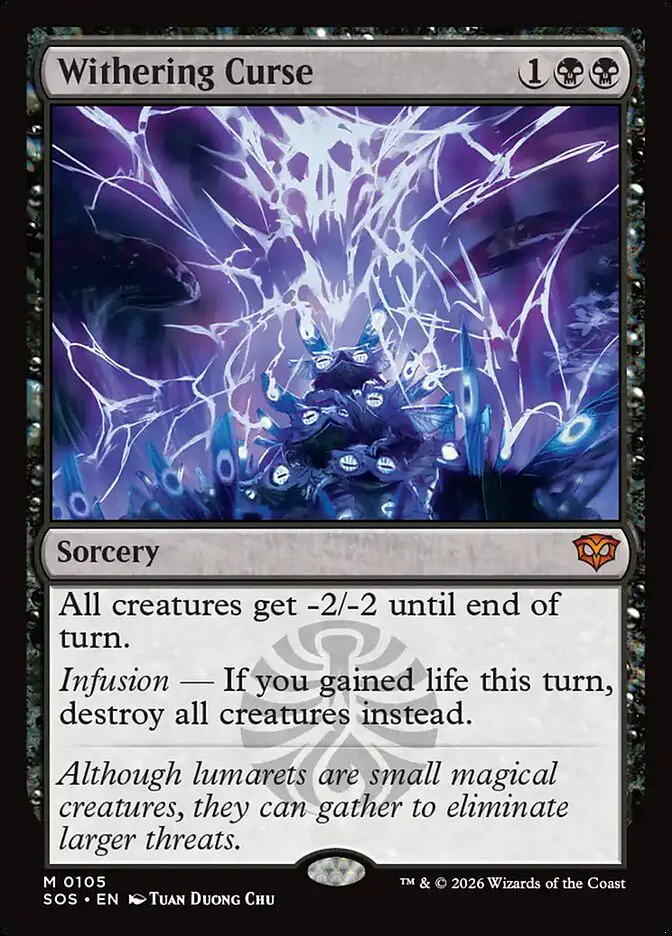
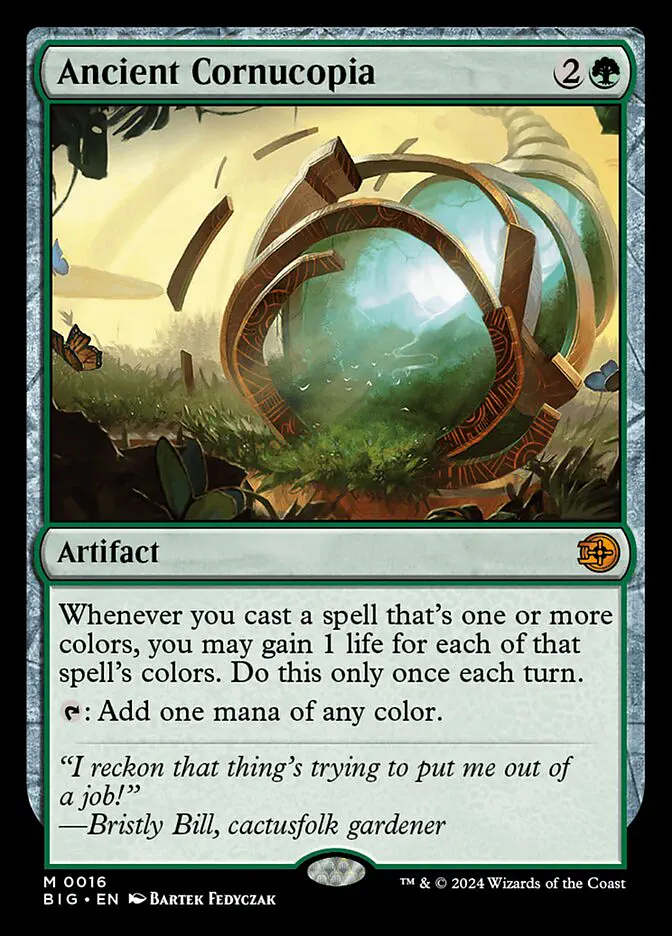
I found the mutual assistance that Withering Curse and Ancient Cornucopia lend each other in a Control shell to be delightful. I was sure that Withering Curse would find a home; a 3-mana "wrath" so malleable couldn't remain in the shadows. Then there are the thousand faces of Firdorch Core, which now gives new value to Unholy Annex by counting as a Demon type, though this isn't exactly a new discovery. I also really appreciated the reappearance of Cool but Rude in a -based deck that shapes a non-linear Aggro deck, showing how deep an archetype can be if you aim for game flexibility. I was very fond of the Kona, Rescue Beastie-based deck brought by Paul Gabat, which incorporates black to go for a second Reanimator path. I had already talked about a very similar deck a few issues ago and found it very innovative. Here I would have dared to include a copy of Grave Researcher to test it on the field, but this is more of a perverse desire of mine. Finally, I liked seeing Resonating Lute played in every deck where I would have played it myself; it's a card I adore, and seeing it so widespread touches my sentimental chords, as well as confirming its technical validity in actual play.
3) What I Saw That I Did Not Expect
The first surprising thing was a new Combo deck based on Molten-Core Maestro. To be fair, it's clear that Molten-Core Maestro is a "combo addicted" card, like all cards that return spent mana. However, structuring such a deck quickly is extremely difficult. You need to find at least two extremely synergistic cards, and I am terrible at this; I don't have a particular affinity for this mindset that seeks chess-like plays. All Combo decks are based on one or more power plays, and the rest of the deck aids in executing a stylistic maneuver so impactful that it leads to victory. The included cards must have either a high level of synergy and/or excellent meta management power. Doing this with very little time before participating in such an important event means taking a considerable risk. Of course, they must have tested seriously as a team, but playtesting is an in vitro exercise; the best one can do, but still in vitro.
Molten-Core Maestro
Creature — Goblin Bard
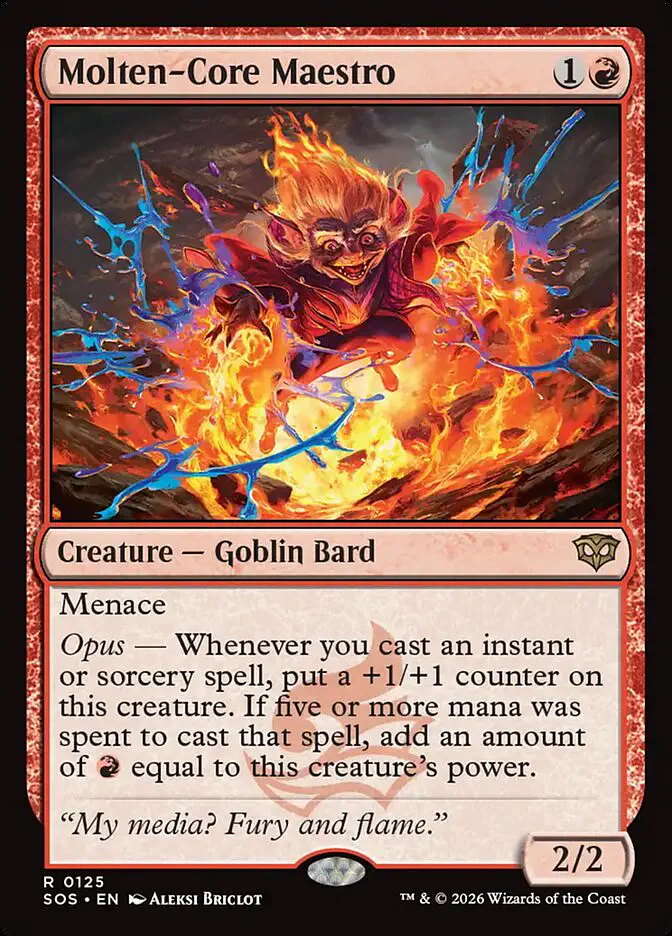
Molten-Core Maestro
Creature — Goblin Bard

Menace
Opus — Whenever you cast an instant or sorcery spell, put a +1/+1 counter on this creature. If five or more mana was spent to cast that spell, add an amount of equal to this creature's power.
I would have expected to see Molten-Core Maestro included in Prowess or MonoR. As soon as I read the card at the Secret of Strixhaven prerelease, I thought its permanent pumping would be a big upgrade for Prowess decks, as they would no longer be forced to squeeze spells into the early phases of a turn, or during combat to grow their creatures. In MonoR, instead, it mimics the Valiant ability of Heartfire Hero but better; it's nice to be able to cast Burst Lightning with its Kicker cost, technically allowing it to be played for 0. That said, Combo was a pleasant surprise. The Molten-Core Maestro grows rapidly thanks to the density of instants and sorceries. When you cast Sorceress's Schemes for its flashback cost with another in hand, the game begins for infinite red mana and a huge Molten-Core Maestro. There's no need to explain here how Combustion Technique, Firebending Lesson, or Ashling's Command help the combo; what matters is that the idea, born from a modification of Lessons, is solid and has two closing plans: the Maestro and Prismari Charm.
Another unexpected sight was Consult the Star Charts in Lessons. This is a difficult deck to modify due to its stringent deckbuilding. I would have expected the future of Lessons, which is a sui generis Control, to involve enhancing card advantage through Muse Seeker. Instead, the choice of Consult the Star Charts slows the deck down but allows for extreme precision in resource selection. I don't know if this is a universal path or a specific inclusion by Rui Zhang for this PT, but it was a clever find. The true and unique transversal innovation of this Pro Tour was precisely realizing that Lessons can be dissected and reassembled in many ways, even to the point of no longer being Lessons. This was the real innovation: successfully demonstrating how to manipulate a deck considered almost immutable. In this Standard, creativity remains at high levels.
4) What I Didn't See That I Wanted to See
Two things, in particular, were missing. The first is a different Aggro deck, perhaps based on MOMO but tri-color, that re-evaluated long-acquired cards. For example, a deck based on the new Blech, Loafing Pest and the bats seen post-Bloomburrow. It seems strange to me that only one tribal (elementals) has emerged. Cards like Essence Channeler, Zoraline, Cosmos Caller, Cosmos Caller, and Deep-Cavern Bat have excellent synergies with Blech, Loafing Pest and would benefit from the agile removals guaranteed by colors.
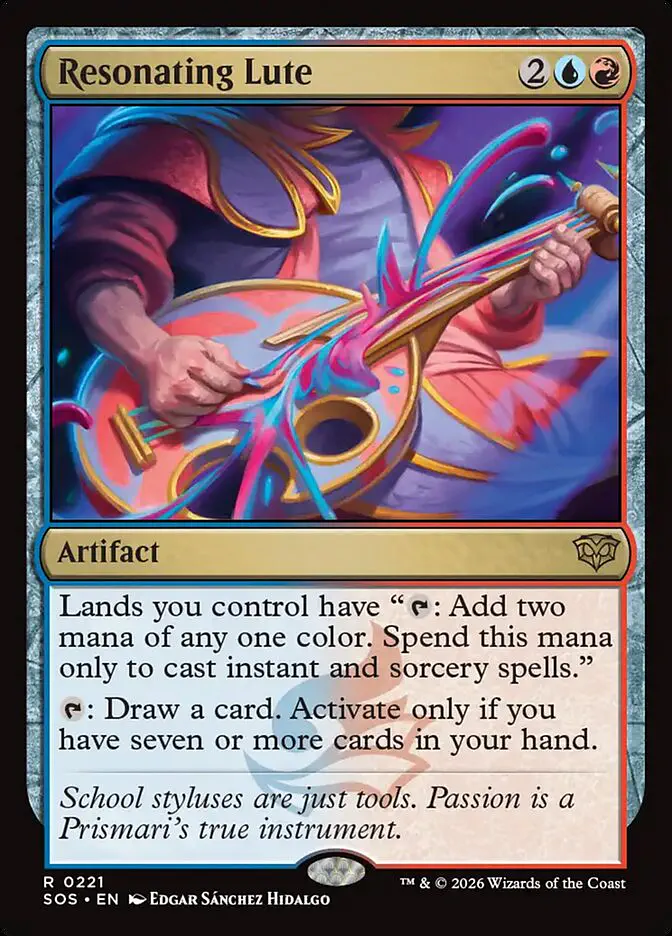
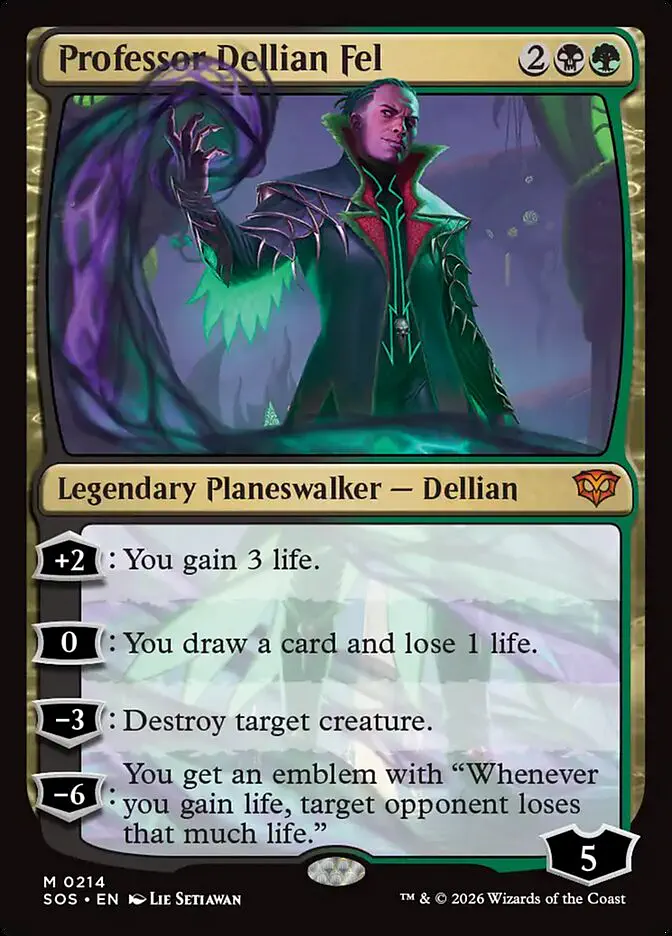
The second thing is a Control. I was sure that Control would no longer be the only possible setup, now that we have Resonating Lute and Professor Dellian Fel pushing towards 4/5 colors. The Control from the Japanese team was excellent, an operation of shimmering eclecticism, yet it surprises me that no one tried a Bant Control focusing on Cuboid Colony. It's an excellent threat: easy to defend, playable on the opponent's turn, low-intensity, and evasive. It has great potential to shorten the deck's crucial turn via Quandrix Charm, which in such a deck could itself be included as a 4-of because it would never lose value: soft counter and specific removal whenever advantageous, or a big anabolic pump for our little bees. Furthermore, there are many old resources that can give various nuances to the deck, such as High Noon (perhaps with a red splash) against or swarm decks. I would have ventured into such a deck. I imagine it wasn't done because, being quite far removed from the current structuring of Standard brews, it was thought that the closing conditions would not keep pace with those of similar control decks in different colors. However, in this, I see a bit of an undervaluation of the deck's underlying logic.
“See You Space Cowboy”
Francesco