

In the week between April 20th and 26th, we witness the first practical application of SOS cards. If, in the previous issue of this column, we listed all the new cards theoretically interesting for the format, now, from a competitive perspective, we move on to practical data. We'll take the metagame-dominant decks immediately before SOS and analyze their possible variations due to the new cards. The interpretive key will not be marginal gain, which is increasingly fashionable, but rather the logic of the deck. Marginal advantages should only be estimated when a long series of data inductively confirms them, not when they are hypothesized. Deck logic, on the other hand, does not need a long series of observed events to make a reasonable statement. If a card aligns with the system it's inserted into, it will be included whenever it improves the system as a whole. We will conclude with our classic bi-weekly format update.
1) Variations in Tier 1 decks
The distribution of the playfield on the eve of Secret of Strixhaven sees three dominant decks we've known for a long time: 
 Prowess, MonoG Landfall, and Lessons. What we will do now is sample a series of winning lists of these three decks and trace recurring patterns in their resources. Then, we will consider the possibility that these resources might change due to a new card imported from SOS.
Starting with the first, for example, we can say that every Prowess deckbuild includes 4 copies of Stormchaser’s Talent. At the same time, however, there is no new card in SOS comparable to that talent, nor one that can perform a similar function in the deck. This leads us to state the obvious: Stormchaser’s Talent will continue to be played as a 4-of until something new and better appears.
Having understood this modus operandi, let's sift through all the decks and draw more interesting conclusions. Prowess has, in my opinion, one easy-to-guess variation and one more difficult one. The first consists of the 4 copies of Stock Up present in most brews. These constitute the only main resource with which the deck can generate card advantage, besides the game effect generated by Boomerang Basics cast on one of your own permanents.
However, a 3-mana sorcery in a Prowess deck is a card used precisely because there's nothing better. This isn't to say it's a weak card. Stock Up is an excellent card. It's just highlighting that, in a deck where we would always want to see cheap 1 or 2-mana spells, and preferably instants, including such a heavy sorcery constitutes a clear compromise. On the other hand, the game is worth the candle. Prowess needs to not run out of cards too early. Moreover, Stock Up can be recurred by leveling up Stormchaser’s Talent in attrition games.
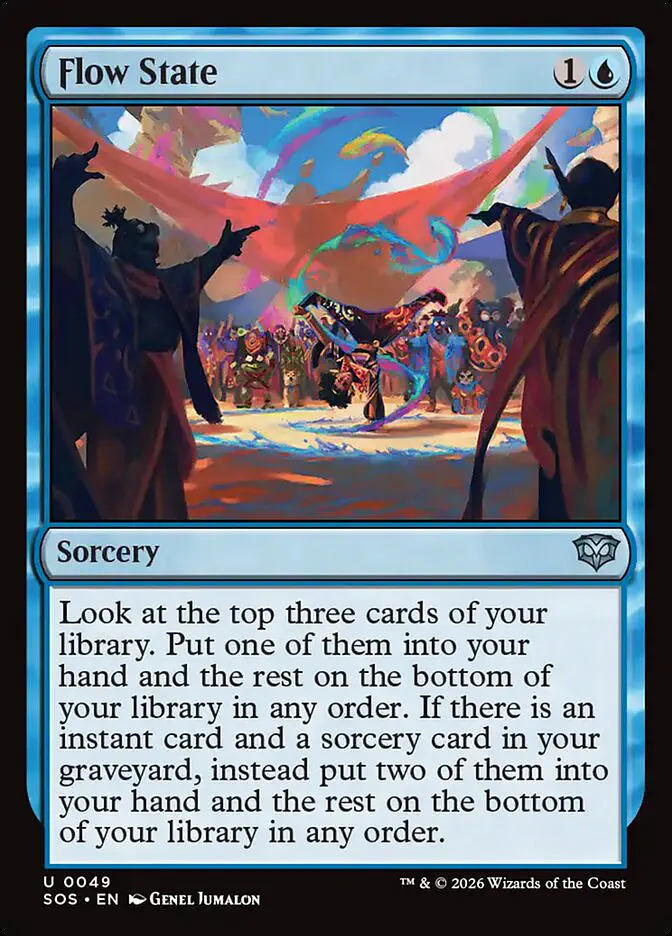
However, in SOS, the card Flow State has appeared, which closely resembles a more agile Stock Up. It costs only two mana, is also a sorcery, looks at three cards instead of five, and, if a truly trivial condition for the deck is met, puts two of them into your hand. I wouldn't be surprised if, from now on, Stock Up is mixed with Flow State in Prowess lists. Perhaps 3 copies of the former and 1 of the latter; perhaps 2 and 2. It will also be necessary to understand how much exposure to graveyard attacks one is willing to risk.
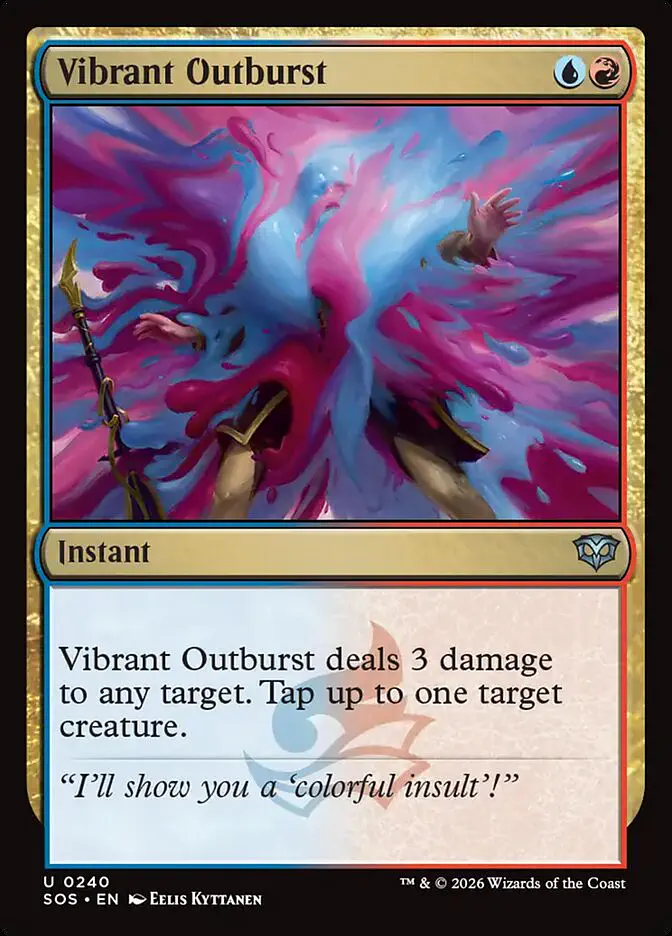
Besides this card, Vibrant Outbrast is worth considering. For just two mana of the right colors, we could deal 3 damage to any target and tap a permanent. This card seems fully in line with the deck's logic, but we need to understand what its ideal slot might be, because at curve 2 there is only Slickshot and a discounted Eddymurk Crab. Both are cards that cannot be given up, or would not want to be given up.
A removal for a threat is always a difficult trade, especially in a deck that has few threats to rely on. Therefore, the only option is to increase the curve to play Vibrant Outbrast and sacrifice a 1-mana spell. Looking among the optional cards, we can find Bounce Off, which generates a tempo advantage that can be replaced in many situations by Vibrant Outbrast.
To understand if and how many Vibrant Outbrast we could play, the new meta will have to tell us a) in how many situations it is a better resource than Bounce Off and b) if the mana base and the spellslinger flow of the deck are hindered by the new spell's 2-cost. Considering that Bounce Off is usually played in later stages of the game where mana access is not an issue, I would say that the addition as a replacement can happen.
For MonoG Landfall, on the other hand, the key card that could enter the deck is Planar Engineering. This allows you to put 4 lands onto the battlefield and trigger related effects. It constitutes a second win condition in addition to Mightform Harmonizer. However, figuring out where to slot it in is not easy.
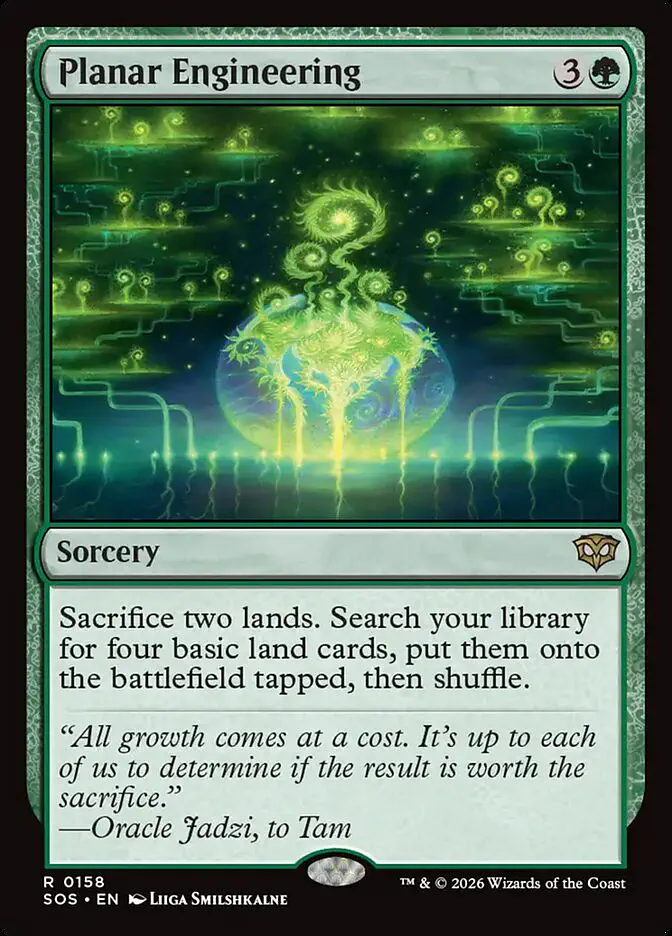
Planar Engineering
Sorcery


Sacrifice two lands. Search your library for four basic land cards, put them onto the battlefield tapped, then shuffle.
Considering that the only replaceable card among the threats is Surrak, which performs a totally different task, it might be better to look at the utility section. This also means sacrificing something to do something else, given the non-existence of spells played with a similar effect. In my opinion, it makes sense not to add this second line at the cost of depressing the first. Therefore, I would not remove Archdruid's Charm.
A second win condition solidifies the deck's strategy more firmly, so perhaps it makes sense to add one or more copies of this card instead of Esper Origin, which finds its greatest purpose precisely in manipulating the top of the library to find the right card at the right time. However, Esper Origin has so many different interactions in the deck that cannot be reduced to what has already been said.
At this point, it makes sense to swap the field effect of Meltstrider's Resolve for this new card, sacrificing board control for a faster win. However, it's a very forced change, because replacing a one-mana resource with a four-mana resource requires a reconsideration of the manabase, despite the deck's strong ramp. Nevertheless, the deck's logic is to be internally synergistic and non-interactive. It would be more in line with the deck's logic to lose the ability to remove an opponent's resource with an enchantment that still needs a valid target on resolution, than to lose the ability, for example, to mill lands with Esper Origin, which would then become fuel for Icetill Explorer.
Finally, Lessons is, unexpectedly, the Tier 1 deck that gained the least from the new expansion. In my opinion, it is quite simple to imagine that Muse Seeker will be tested within the deck. Its Opus effect makes it an additional Artist’s Talent. Of course, they are not exactly the same. Muse Seeker is a creature, so it is much more susceptible to removal than an enchantment.
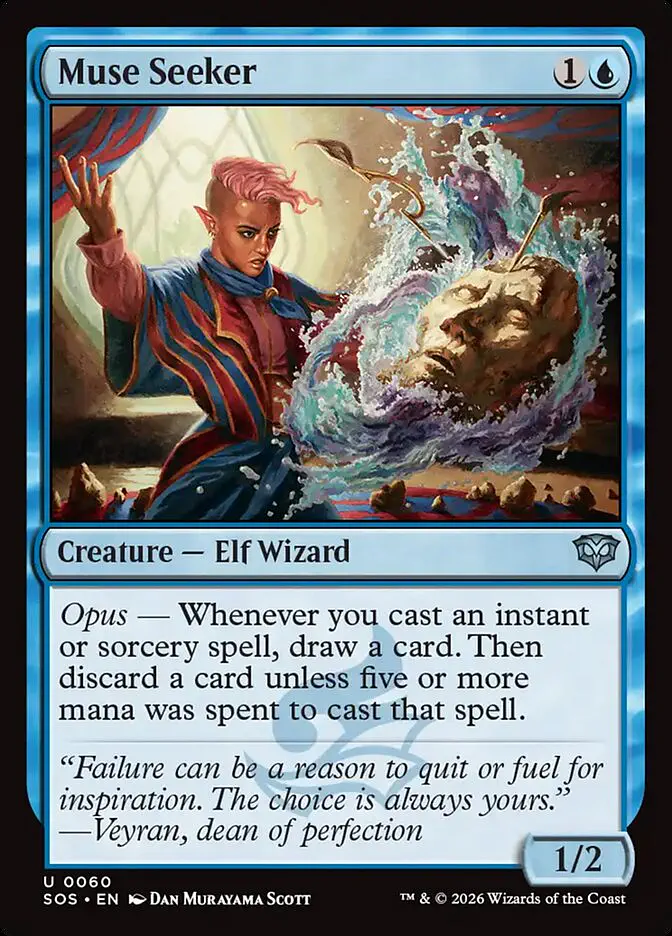
However, thanks to Muse Seeker's Opus, we will draw before discarding, which is usually better. But again, Muse Seeker forces us to draw, while Artist’s Talent does not. Clearly, all these dimensions of the two cards need to be evaluated, but the role they play within the deck is identical: they help find key cards to win at the right time, while filling the graveyard.
In a deck concept that is already very vulnerable to graveyard hate, it doesn't make sense to view the additional exposure to this phenomenon brought by the card in a negative light. Considering all that has already been said, I suppose Muse Seeker might be seen on battlefields.
"Instead of what?" is the real challenge to figure out. Lessons is the Tier 1 deck with the most constrained deckbuilding. This is because it lives on the beat of two hearts: the first are the Monuments and Artist's Talents, the second is the Lessons and Grand Grand package.
Stormchaser’s Talent are already cut from most builds to prioritize cards like Three Steps Ahead, which, despite not being a Lesson, has excellent synergies with the rest of the deck. Given the situation, the only relatively replaceable parts of the deck are either the less valuable Lessons for the deck in this meta, i.e., It’ll Quench Ya!, Iroh’s Demonstration, and Boomerang Basics (where Stormchaser’s Talent are not included), or non-Lesson spells like Three Steps Ahead and Burst Lightning (when seen as a single copy).
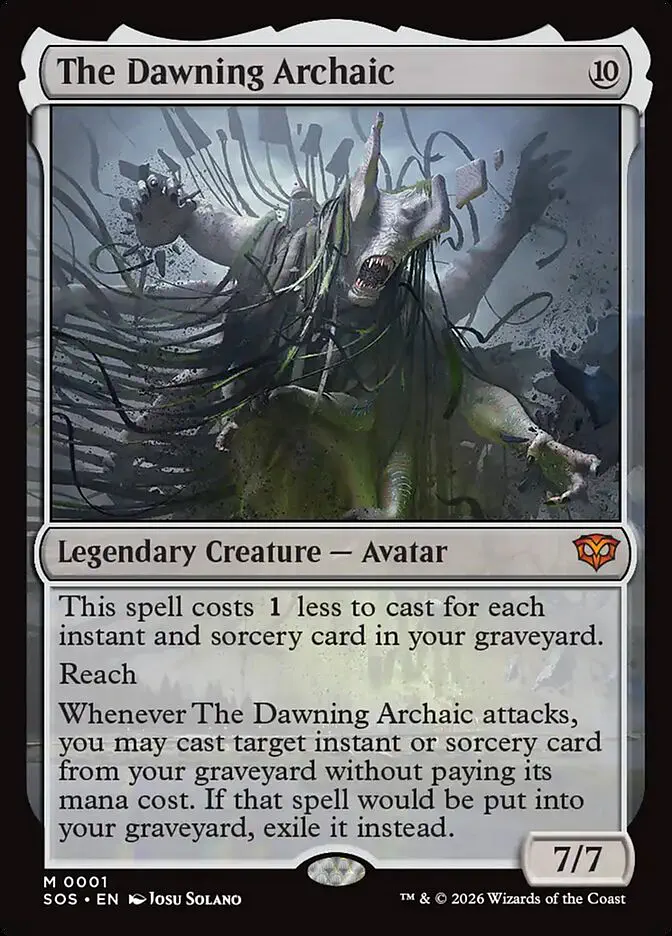
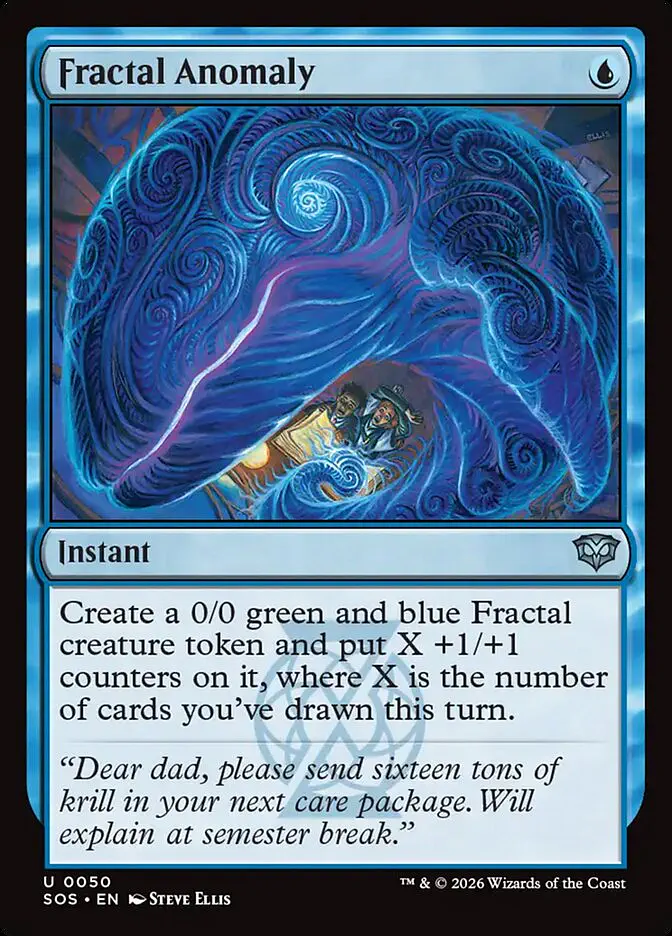
Unfortunately, these same slots are the only ones replaceable for the two additional cards I'll be discussing. Other interesting new resources that can be added to the deck are The Dawning Archaic and Fractal Anomaly. These are absolutely optional and may never see play. What they do is provide an alternative win condition for the deck with creatures that have a non-negligible body.
The Dawning Archaic is particularly fascinating because it seems painted onto the deck's mechanics. I'd love to have it as a one-of in the deck. However, it suffers terribly in post-side games. I find it to be a game one card. Furthermore, the fact that it doesn't protect itself in any way is limiting in a deck that places few targets for opposing removals. If its triggered ability had also been an ETB, it would have provided more security.
Fractal Anomaly speaks for itself. At the first well-engineered draw advantage, we place a significant body to deal with. Too bad it's just a body. But it can also block.
2) Variations in Tier 1.5 decks
Among these, let's start with  Excruciator. Since its inception, this list has seen very few upheavals: just Day of Black Sun and/or Duress instead of Harvester of Misery. We are facing a truly well-tuned list, where it's difficult to find interchangeable slots.
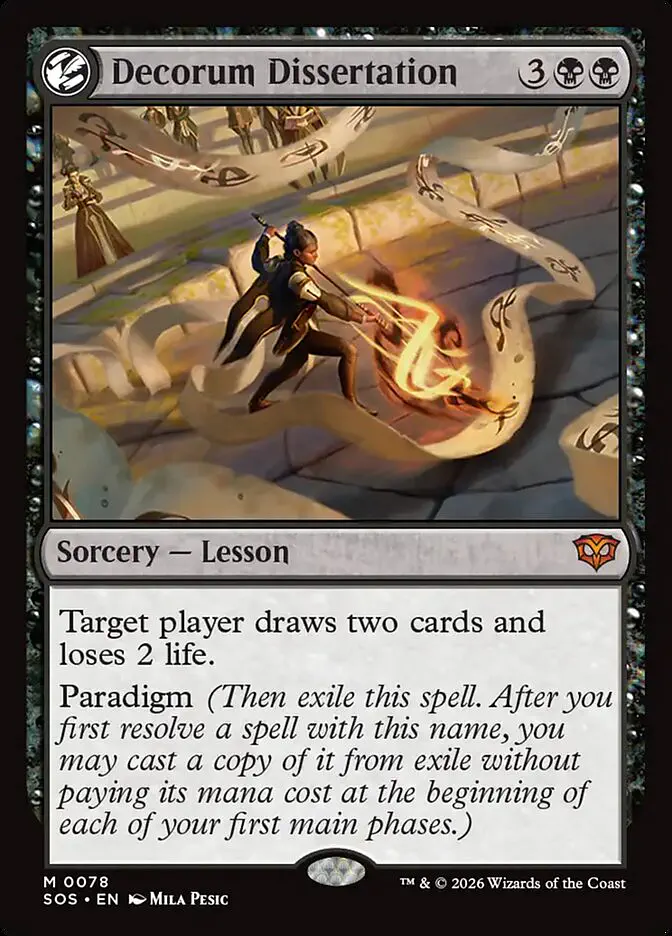
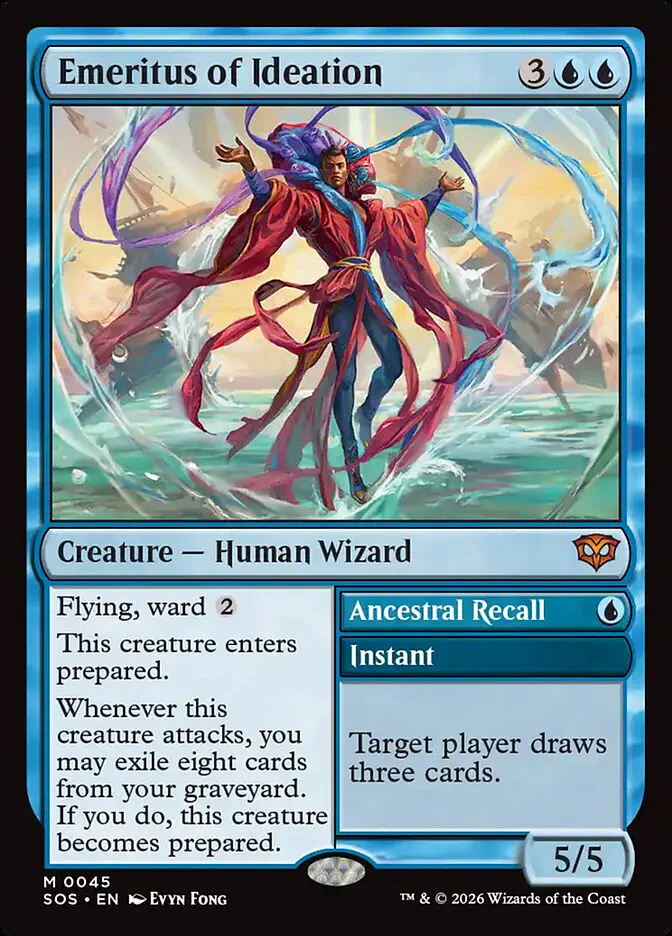
The two SOS cards that best align with the deck's logic are Decorum Dissertation and Emeritus of Ideation. Both can either provide card advantage to close out the combo or redirect this card advantage to the opponent to make them lose post-Doomsday Excruciator effect. Thus, they enhance the existing win condition in the deck.
However, both are cast at 5 mana, not exactly agile, and their entry doesn't produce a disruptive effect. To include them in the deck, you have to sacrifice either Duress, or Winternight Stories, or Deadly Cover-Up, or some removals. Therefore, in any case, much is lost. Different effects that cannot be recovered are given up, and sometimes the mana base needs to be rethought.
For these reasons, even though these cards follow the deck's logic, they might end up in the sideboard rather than the main deck, unless Badgermole Cub sees a potential departure, which would allow for a reduction in main deck removals without too much hesitation.
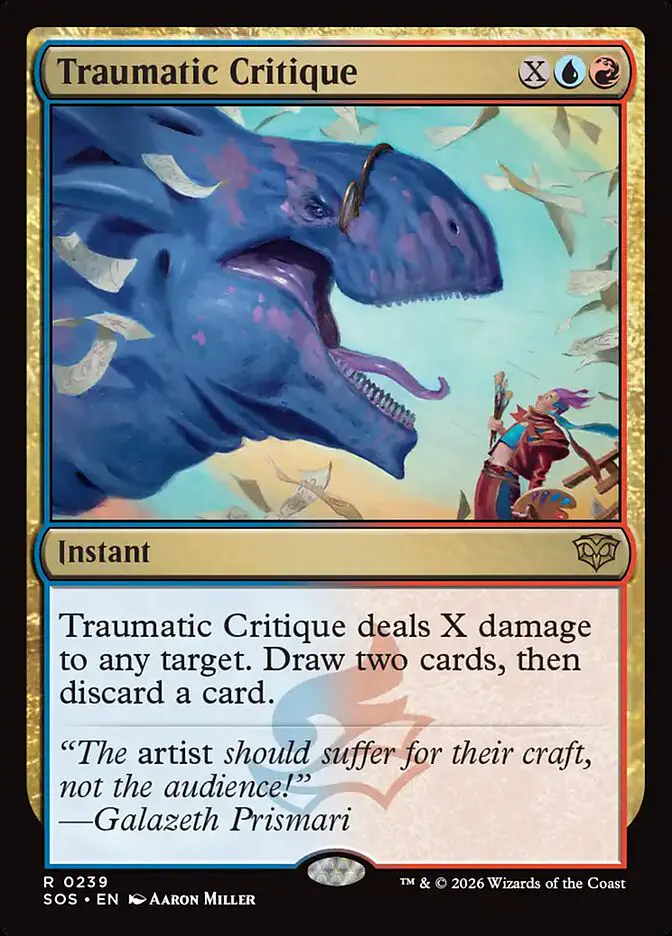
Moving on to Spellementals, Traumatic Critique seems an almost obligatory inclusion in place of Abandon Attachments. Spellementals don't care about Lessons: being able to draw before discarding, potentially even dealing damage, is a significant added value.
I'll stop at the remaining potential increments because they have a high degree of randomness, e.g., Impratical Joke.
I close this section with Bant Rhythm. This deck harbors a well-known toolbox mechanic made possible by Nature’s Rhythm. Thanks to this mechanic, the deck integrates some elements, even as single copies, to tutor for in response to a wide variety of game situations. It is never easy for a new creature to take a place in this arsenal and displace another.
I must say, however, that two Emeritus from SOS have hope. First of all, Emeritus of Abundance seems truly powerful to me. Its regrowth effect, even if performed only once, gives the deck a second recurring play in addition to Nature’s Rhythm's Harmonize. Redundancy is important.
Secondly, Emeritus of Truce can also be a choice, but given its various criticalities compared to the deck's logic (for example, its preparation condition, which presupposes a board state the deck never wants to have), I will discuss it in the next point of the column, among the new side cards.
3) Sideboard variations
We've reached the topic of sideboards. It must be said that the current construction of Standard sideboards can already count on a wide variety of resources. Moreover, sideboards follow even sudden changes in the metagame to manage it, and consequently, it is always very fleeting to discuss them.
That said, I'll connect to the immediately preceding point, picking up on the last sentence about Emeritus of Truce in Bant Rhythm. Well, tutoring "Swords to Plowshares" with Nature’s Rhythm can be very powerful, but the condition to satisfy to prepare the card presupposes that everything is going wrong for the deck, or that you are facing a deck that swarms as much as or more than yours.
There aren't many of them in the format, and all the ones that exist are found in Cub decks. If the stars align in a sporadic game, even MOMO White can create a board similar to a Cub deck by the time the Emeritus would be tutored. This condition would lead one to consider it a one-shot sideboard card, to be included and tutored only against those specific decks. The problem is understanding if, against those decks, a "Plowshares" effect is truly relevant.
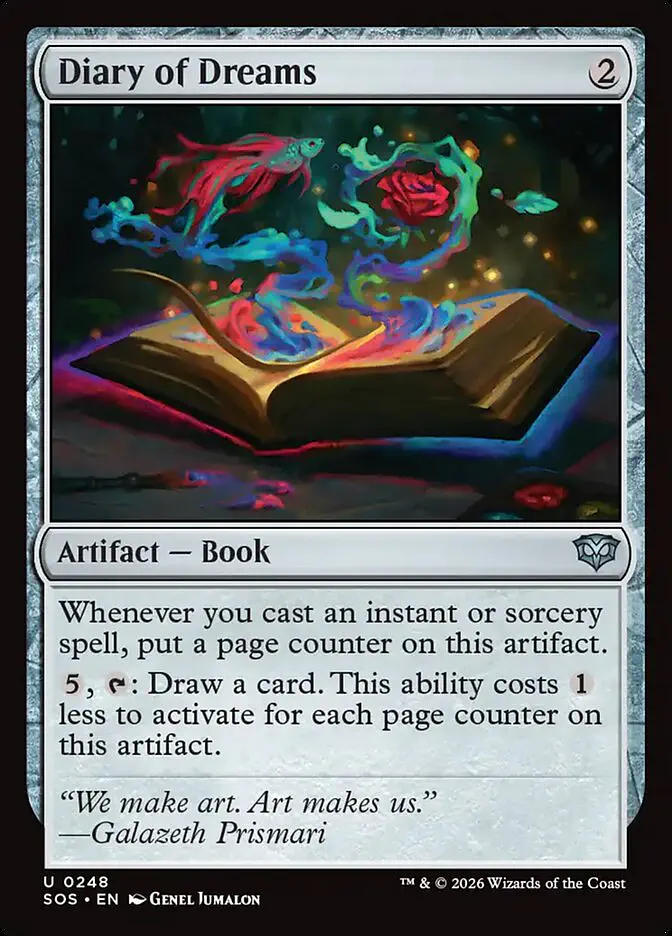
Another sideboard card I really like and that no one talks about is Diary of Dreams. It seems like a silly card, because for 2 mana we're not doing anything. However, in decks like Spellementals, Lessons, or Prowess, many spells are cast. In a mirror match of these archetypes, card advantage is often decisive, given that games tend towards attrition. A single copy of Diary of Dreams will cost us tempo when we play it, but within a few turns, it will start generating a free card per turn. It's a card that, in the long run, can reverse the momentum of the match.
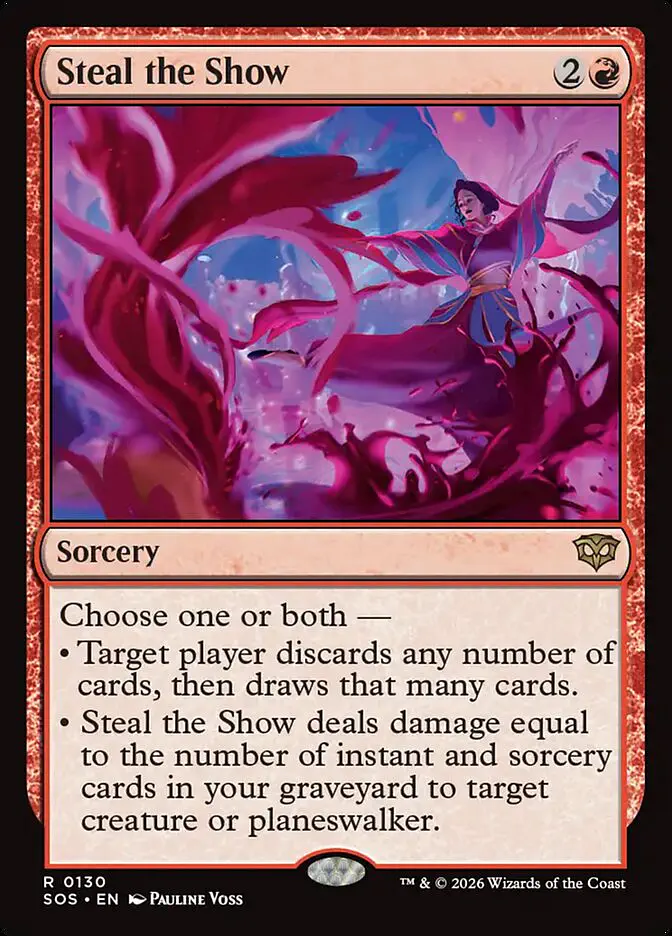
Finally, Steal the Show is an interesting resource in all those decks that want to discard and draw a lot, or quickly fill the graveyard. At a cost of three mana, therefore not negligible, it allows you to discard your entire hand and draw that many cards. In addition, it has a double mode that allows you to remove a creature or planeswalker with damage. Three mana is noticeable, but it remains a good sideboard option in specific matchups, for example Lessons against Spellementals.
4) Price update
Update to the Standard MOLE Index on format prices. The field distribution, compared across multiple meta-tracking databases over the past two weeks, yielded an analysis sample of 11 decks:
- Excruciator
- MonoG Landfall
- Lessons
- Midrange
- Prowess
- Spellementals
 Mobilize
- Momo
- Bounce
- Midrange
- Control
The new expansion slightly increased the observed points and greatly varied their quality, flattening the outliers. Furthermore, the continuous nuances of contribute to significantly lowering the cost of the format.
The arithmetic mean continues to fall, stopping at €329, while the resistant median drops to €338, approaching the arithmetic mean. The geometric mean is brought down to €316.56, with the lower outlier being Spellementals and the upper outlier being MonoG Landfall.
The cost of Standard continues its downward trend, despite inverse advertising from some non-specialized sources that, evidently, don't have time to look at the data.
The geometric mean of the other formats used for comparison is updated as follows:
- Vintage €31,288.42
- Legacy €4,043.26
- Modern €649.04
- Pioneer €328.75
- Pauper €77.29.
Taking all formats as a sample, Standard drops to the second most economical format. If the scope is limited to competitive formats only (Modern, Pioneer, and Standard), then Standard has been the most economical format in the last two weeks.
“See You Space Cowboy”
Francesco