

Spoiler season is over, and the complete gallery is online: and just like every time a new set comes out, the usual endless debate has started about which card is truly the strongest in HOB. Some swear that Wizard's Staff will become yet another Equipment that someone will break with a combo no one saw coming, some have already started breaking out in a cold sweat at the thought of seeing Settle the Wreckage on the other side of the table, and some have done nothing for weeks but repeat that Bilbo's Gambit is the best white instant to come out in a very long time. And then, of course, there are the usual "Commander" cards that are already creeping into competitive discussions as well.
HOB officially releases on August 14th and will be legal everywhere, Standard included—it is worth remembering that this is the first Tolkien-themed set to enter Standard and not just eternal formats. That being said, don't take this as a ranking carved in stone: without actual tournaments under our belt, we can only analyze based on efficiency, flexibility, and known interactions. But a few cards are definitely starting with a clear advantage over the others.
Wizard's Staff
Let's start with the one that, if I had to bet on it, has the highest ceiling in the entire set.

 , Equipment, gives prowess to the equipped creature and makes it trigger any triggered ability it has twice. Equipping a Wizard costs ; for everything else, you need three.
The most obvious combo stands out immediately: Slickshot Show-Off. The little bird already gets +2/+0 for each noncreature spell cast; with the Staff equipped, that trigger is duplicated along with prowess. Do the math: every noncreature spell is worth +6/+2. Just three spells and you have a 19/8 flying with haste that closes the game on its own.
That being said—and here I am going a bit against the grain compared to the hype going around—it is by no means a given that Wizard's Staff will make Izzet Prowess stronger than it already is. The deck wins perfectly fine even without permanents that, when drawn on their own, do absolutely nothing. And the sequence requires setup, leaving mana open at sorcery speed, and a target that stays alive after the opponent has had time to remove it.
Where the card convinces me most is outside of this single case: it doubles enter-the-battlefield, attack, sacrifice, and spell-casting triggers. Every Wizard that comes out from now on will have to be evaluated in relation to this Equipment. It is the classic piece that seems quiet for a couple of weeks, then someone finds the right interaction and suddenly it is banned everywhere.
Bilbo's Gambit
If the Staff has the highest ceiling, Bilbo's Gambit is probably the card with the best chance of ending up in maindecks starting from the very first competitive weekend.
 , instant: return target spell to its owner's hand. You can also promise a Treasure to the opponent—if you do, after it resolves, no one can cast spells for the rest of the turn.
Essentially, white gets a "soft" counterspell: it doesn't counter, but bounces and blocks immediate re-casting. Giving away a Treasure hurts, sure, but it is almost always an acceptable price if the goal is to save a threat, stop a combo, or keep that specific spell from resolving right then and there.
The beauty of it is its flexibility: it stops removal, planeswalkers, wraths, and creatures. You can even use it on your own spells to save them from an opponent's counter, though the tempo cost there is quite heavy. And because it technically doesn't "counter" anything, it even bypasses protections against spells that "cannot be countered"—a detail that in certain matchups is worth the game.
I see it fitting perfectly in Azorius Control, Jeskai Control, and white tempo decks that want to protect a threat without losing board presence. Of all the releases in HOB, this is the one that I think needs the least "deckbuilding effort" to be ready to compete.
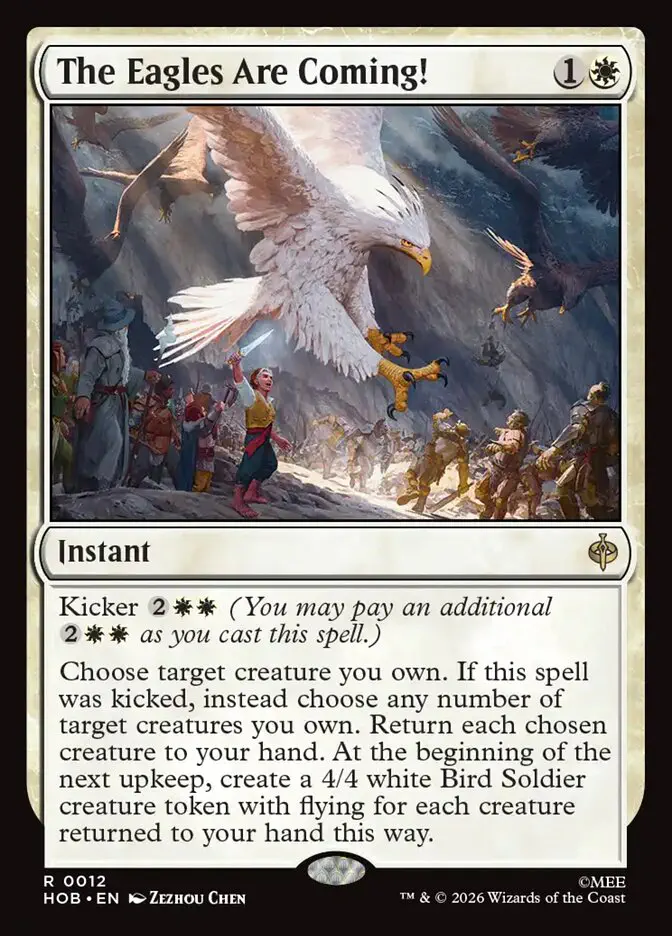
The Eagles Are Coming!
One of the most flexible spells in the set, and indeed there is a lot of talk about it even outside of technical circles.
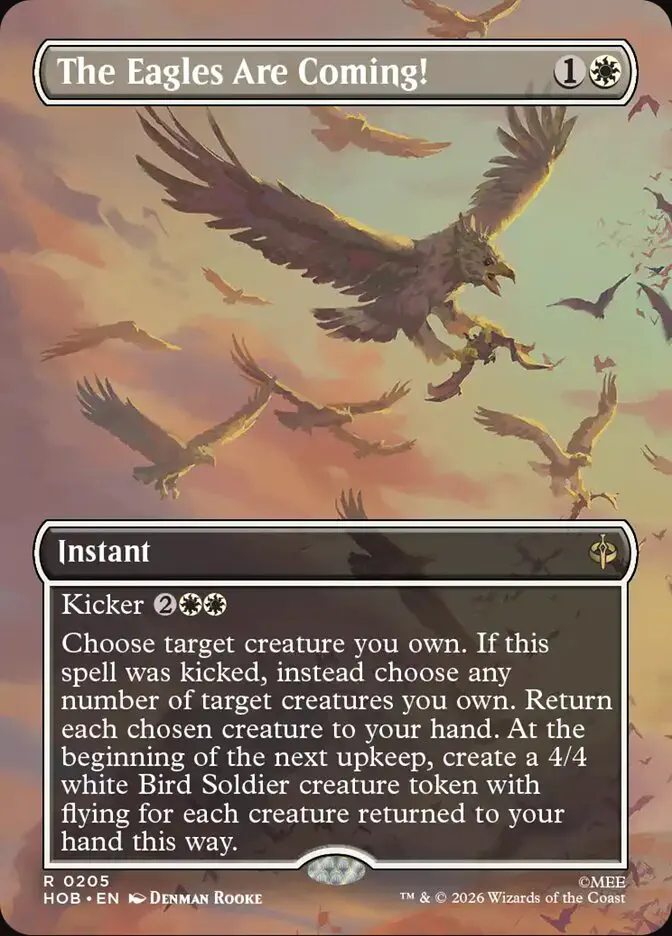
: return a creature you control to its owner's hand, and at the beginning of the next upkeep, you get a 4/4 white Bird Soldier creature token with flying. With a kicker of  , you do this to any number of creatures, getting a 4/4 for each one.
In the first turn or two, it protects against a removal spell, resets an ETB trigger, or turns a token destined to die into a massive flyer. In the late game, it becomes a way to save your entire board from a wrath and immediately restart with a threat on the field.
A neat little detail: even though a token ceases to exist after returning to your hand, the delayed trigger still counts it and produces the Bird Soldier anyway. Yes, it works with tokens too.
Six mana for the full kicker version is a lot, but you don't have to think of it only in that mode: even at two mana, it is a protection effect that leaves you with a respectable flying body in return. Expect to see it in White Tokens, blink decks, and generally anywhere that plays around ETBs.
The Sackville-Bagginses
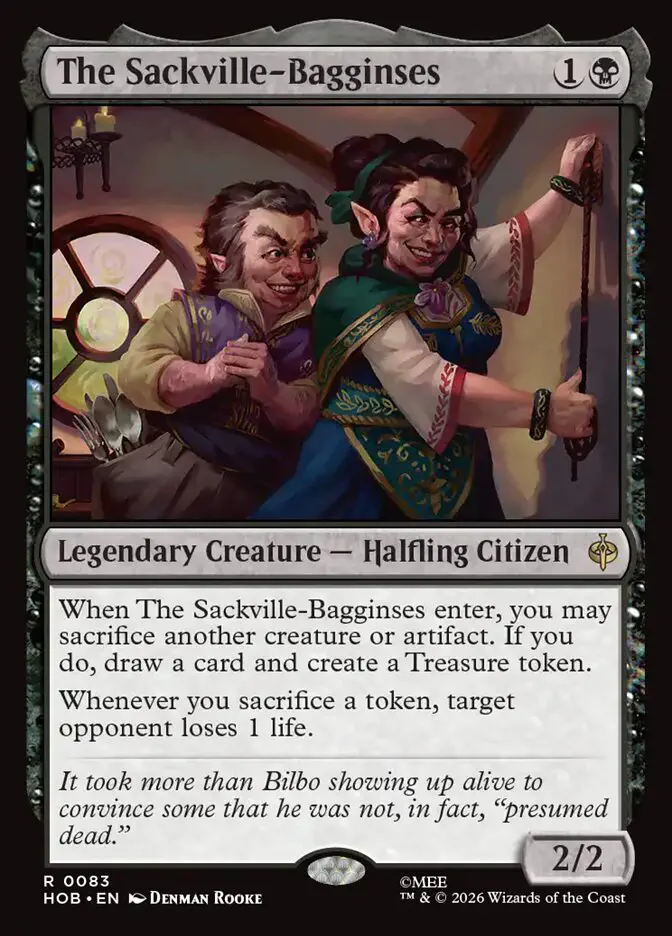
This one feels written specifically to end up in a sacrifice deck, and honestly, I don't think that is an accident.
Legendary 2/2 for  . When it enters, you can sacrifice another creature or an artifact to draw a card and create a Treasure. And whenever you sacrifice any token, target opponent loses 1 life.
The first part turns something that was going to die anyway (a token, a disposable artifact) into a card plus a mana resource, while still leaving a 2/2 body on the board. The second part turns Treasures, Food, Clues, and creature tokens into free damage—you don't even need a dedicated sacrifice outlet, just cracking a Treasure normally will still make your opponent lose 1 life.
In other words: in a list with plenty of Treasures, every time you spend mana, you are also playing a mini copy of Blood Artist. The two-mana black slots are highly competitive, but the immediate value this offers might be enough to earn it a spot anyway.
The Queen of Dale
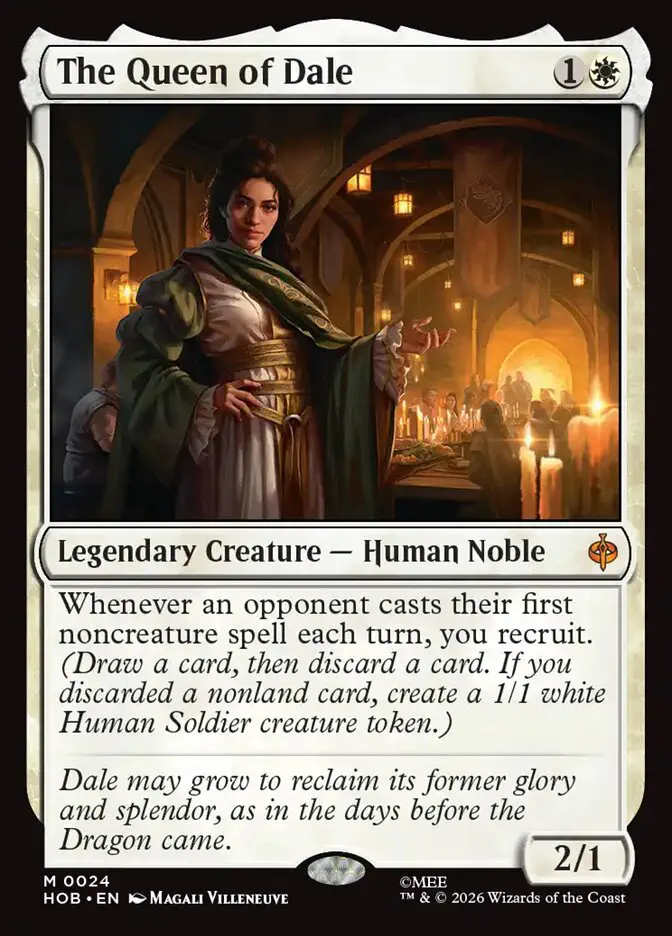
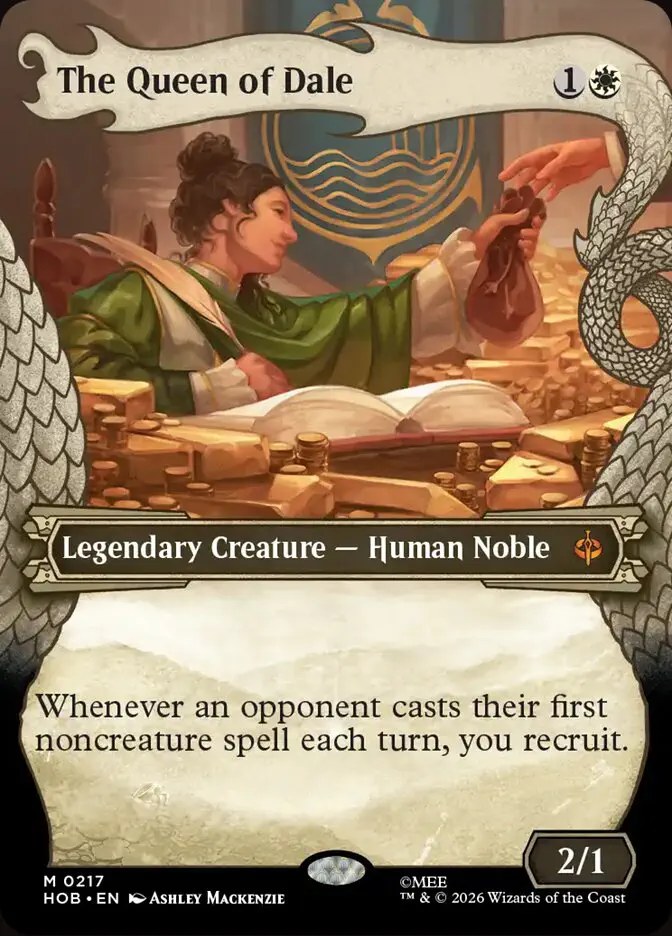
It looks harmless, but against certain decks, it becomes incredibly annoying very quickly.
, 2/1 legendary, recruit whenever an opponent casts their first noncreature spell of the turn. Recruit = draw a card, then discard a card; if you discard a nonland card, you also get a 1/1 Human Soldier creature token.
Against Izzet Prowess, Azorius Control, and generally against decks that live on instants and sorceries, this card generates free value, turn after turn, without you having to do anything. It filters your hand, fills the graveyard, and sometimes even adds a body.
The problem is that it is a 2/1: it dies to anything, and if it vanishes immediately, it has done nothing. But if it survives even a couple of turns, the opponent is forced to choose between continuing with their game plan or feeding you resources—and that is not a pleasant choice to make. In Commander, it scales even better, as it triggers on every player's turn, not just the one targeting you.
The Great Goblin
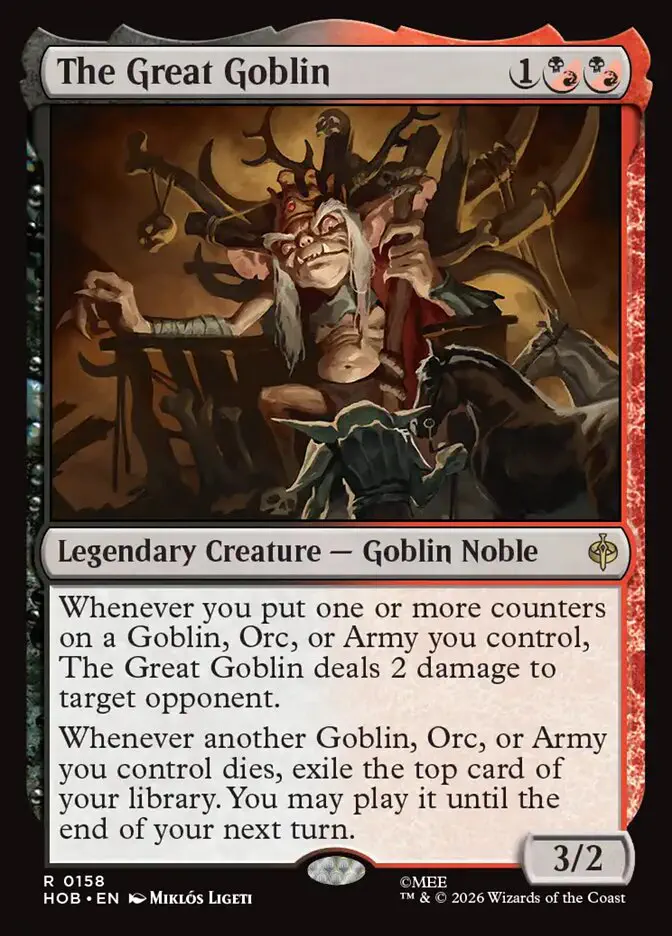
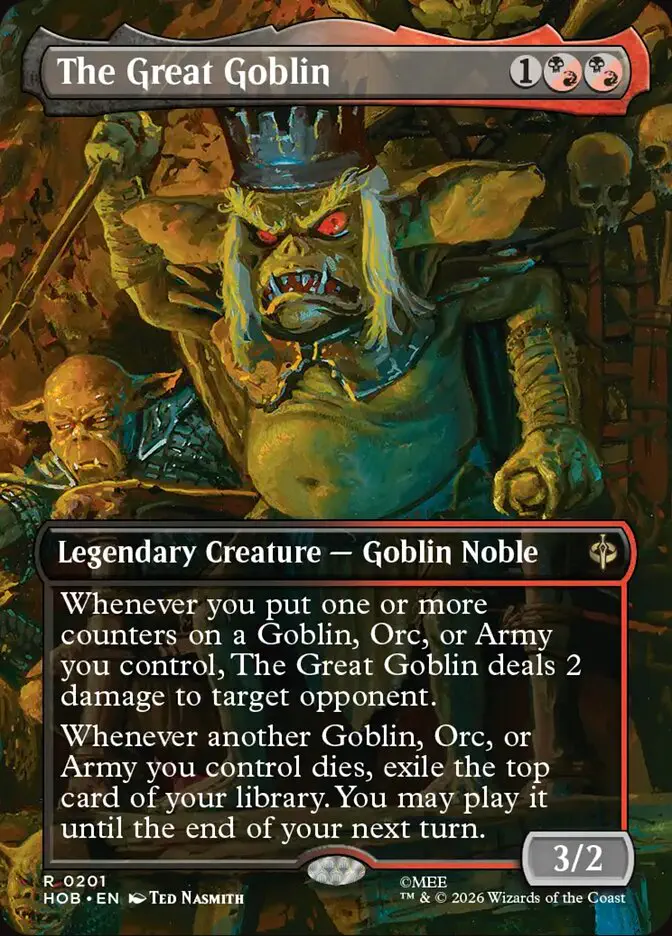
If amass is ever to become a playable archetype outside of Commander, this will likely be the engine.
 , 3/2 legendary. Whenever you put one or more +1/+1 counters on a Goblin, Orc, or Army, it deals 2 damage to target opponent. And when another Goblin, Orc, or Army you control dies, exile the top card of your library and you may play it until the end of your next turn.
The two abilities cover exactly the two classic problems of tribal decks: dealing damage without having to get past blockers, and not running out of resources after a board wipe. Amass puts counters on an Army and triggers the first ability; no matter how many counters are placed at once, the damage remains 2, but in a list that amasses multiple times a turn, the total adds up quickly.
The body is fragile and does nothing upon entering, let's be clear. But if it stays alive for even a single turn, the amount of damage and extra cards it generates is disproportionate to its cost.
Orcrist, Goblin-cleaver
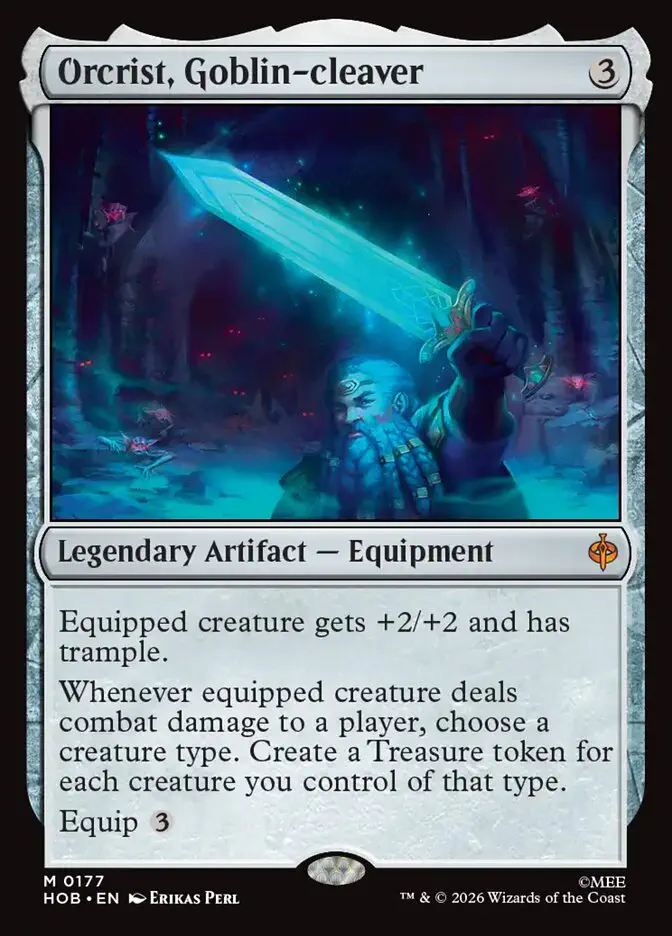
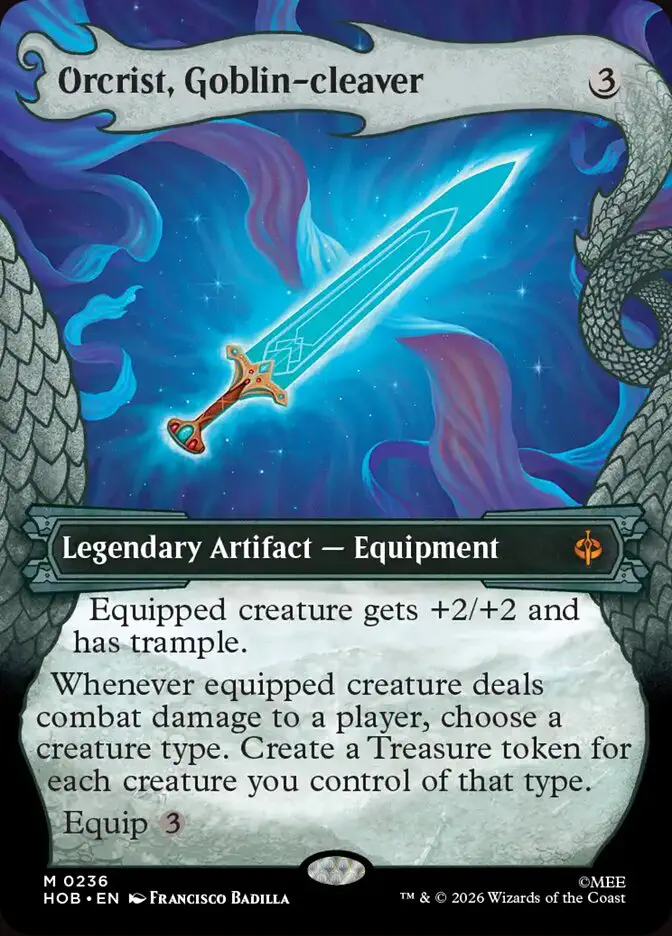
Let's move over to Commander, because the typal community has already gone wild over this one.
Orcrist, Goblin-cleaver generates Treasures repeatedly, and it is a weapon that is going straight into decks like Krenko, Mob Boss or The Unbeatable Squirrel Girl. The synergies with Treasure-oriented commanders—such as Vihaan, Goldwaker and Magda, Brazen Outlaw—are just as natural. With the right pieces on the board (Time Sieve, Aggravated Assault, to name a couple), it even becomes a combo enabler for extra turns or infinite combat phases, which is frankly a lot for a weapon designed to bring flavor to a goblin-slaying sword.
Bard, King of Dale
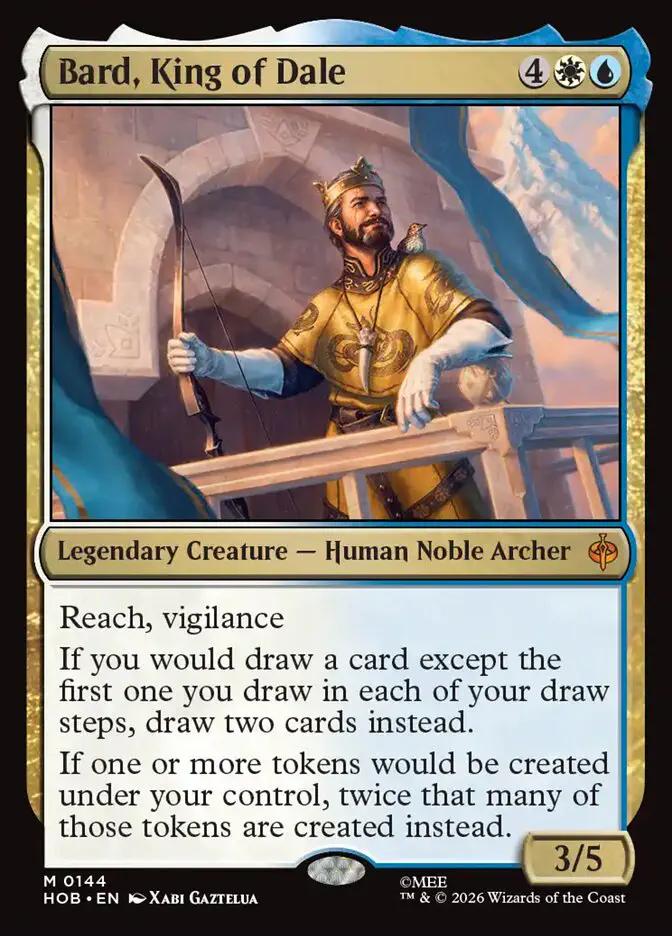
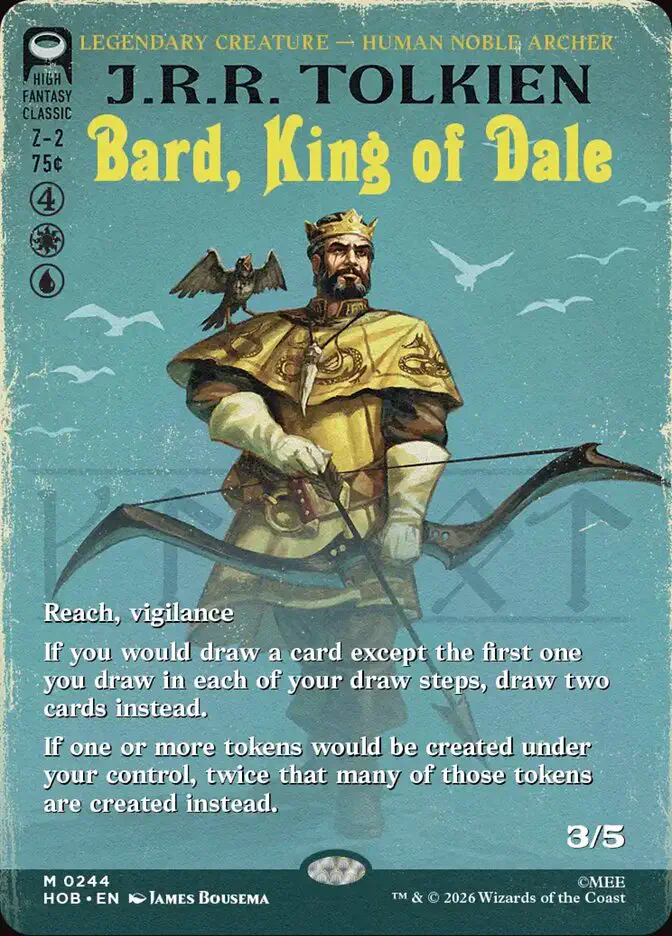
Another card being heavily discussed in Commander circles: it doubles drawing and token creation, plain and simple. Two of the strongest mechanics in the format, packed into a single Azorius card. It is not surprising at all to see it already flagged as a staple for next season's value-token decks—it is the kind of card that, if it survives a turn, flips the game state entirely on its own.
Settle the Wreckage
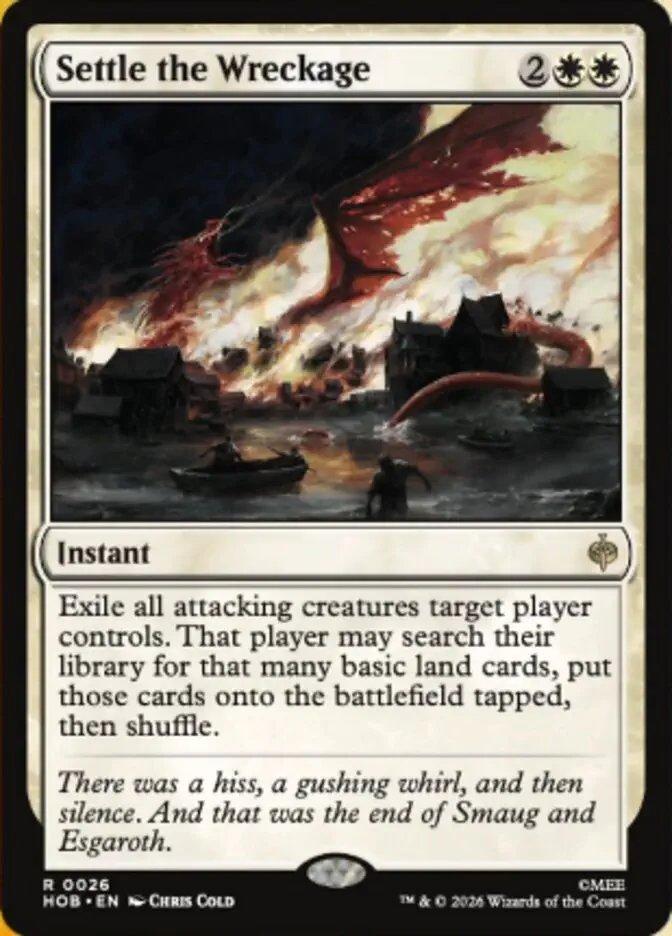
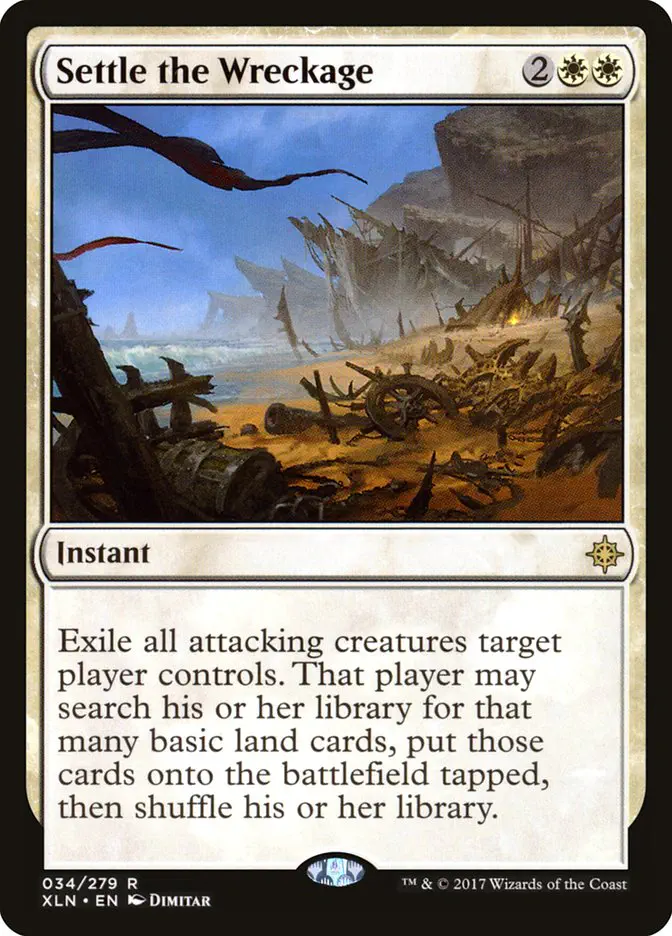
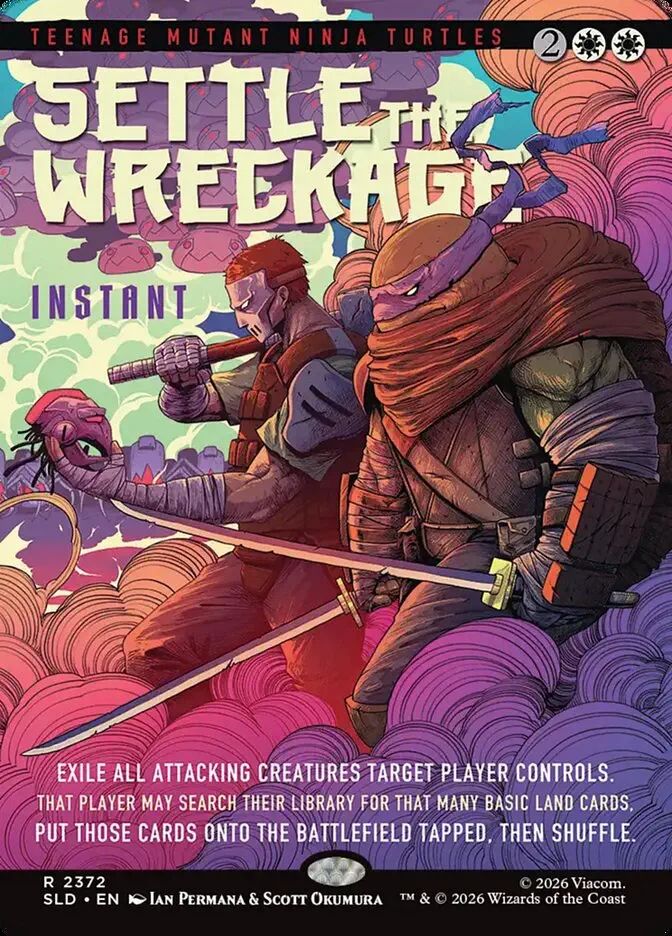
Among the reprints, this is the one that will truly change how Standard is played.
, instant: exile all attacking creatures target player controls. That player may search their library for that many basic land cards, put them onto the battlefield tapped, then shuffle.
Knowing that Settle the Wreckage is in the format already changes how you attack against an opponent with four white mana open. You no longer swing with everything lightheartedly, because a single instant can wipe your entire board without even letting your death triggers activate.
The gifted lands are not nothing, especially if you are playing against a basic-heavy deck. But when the effect saves you from lethal damage or exiles five creatures at once, the tempo gained is worth far more. Aggro decks, token decks, and anyone aiming for a single decisive swing had better play with respect—it won't necessarily be a four-of everywhere, but the mere fact that it is legal again is enough to make it a factor in everyone's game plans.
Smaug the Magnificent
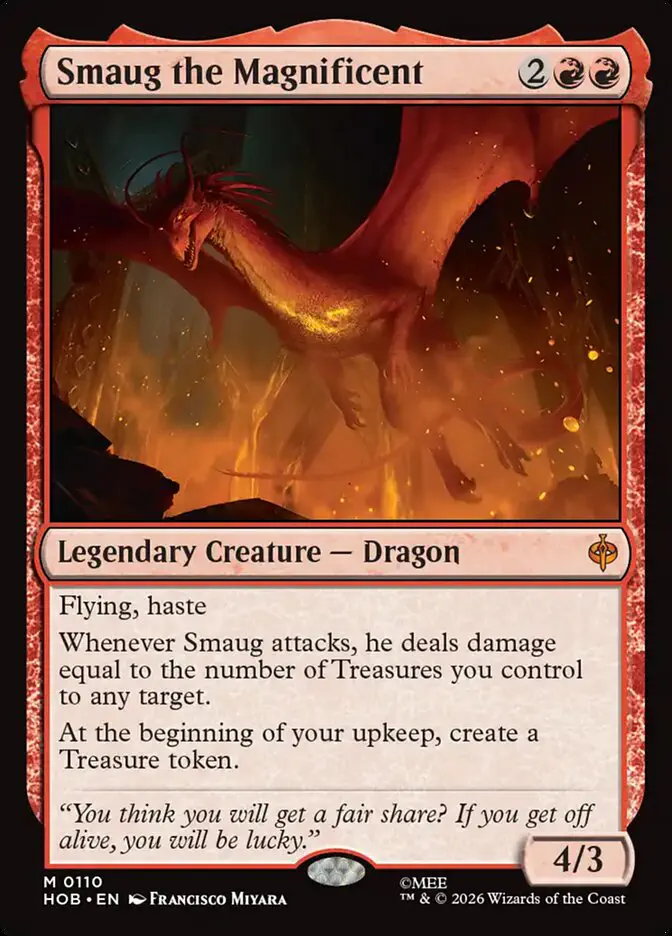
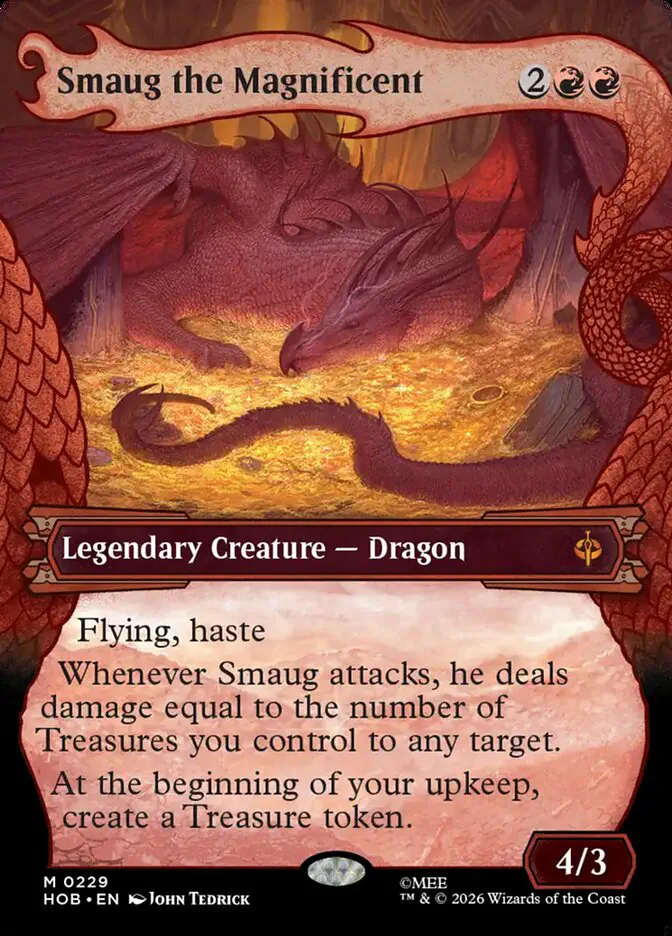
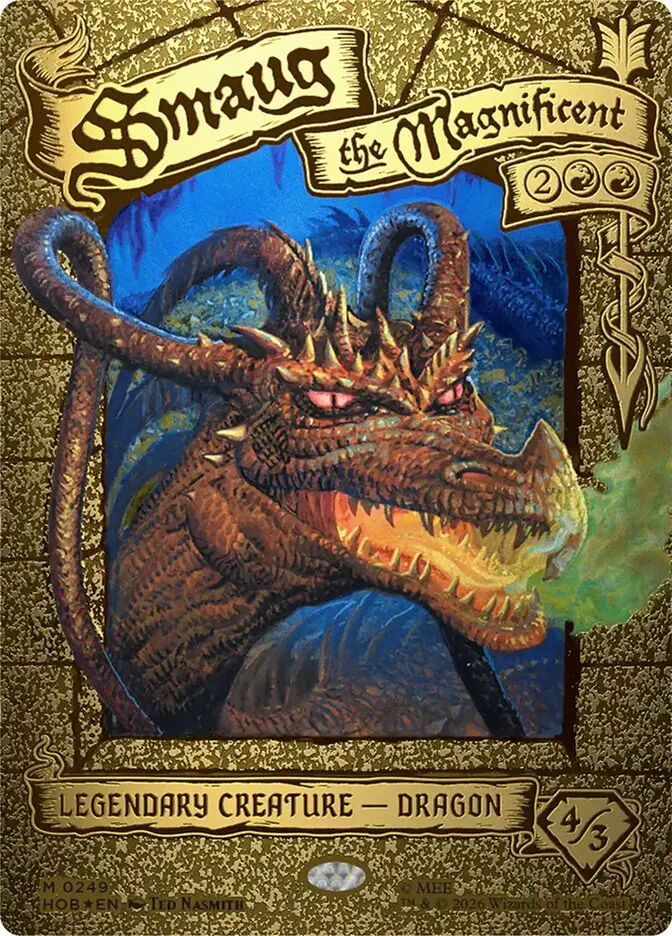
We couldn't skip this one, obviously: it is the cover star of the set, and it is also the chase card from a collector's standpoint—the Showcase version is already trading well over $150 on the secondary market.
Legendary 4/3 Dragon with flying and haste for  . When it attacks, it deals damage equal to the number of Treasures you control to any target. At the beginning of your upkeep, you get a free Treasure.
It attacks immediately on the turn it enters, which is already a great reason to play it. With two or three Treasures already on board, the first attack really hurts. But on its own, without support, it remains "just" a 4/3 flying with haste—efficient, but quite vulnerable to common removal, and the automatic Treasure generation starts on the next turn, not right away.
It needs to be played in a list built around it: in a Treasure shell, it acts as both a finisher and a removal spell, clearing a creature or a planeswalker while keeping the pressure on in the air.
Gleaming Splendor
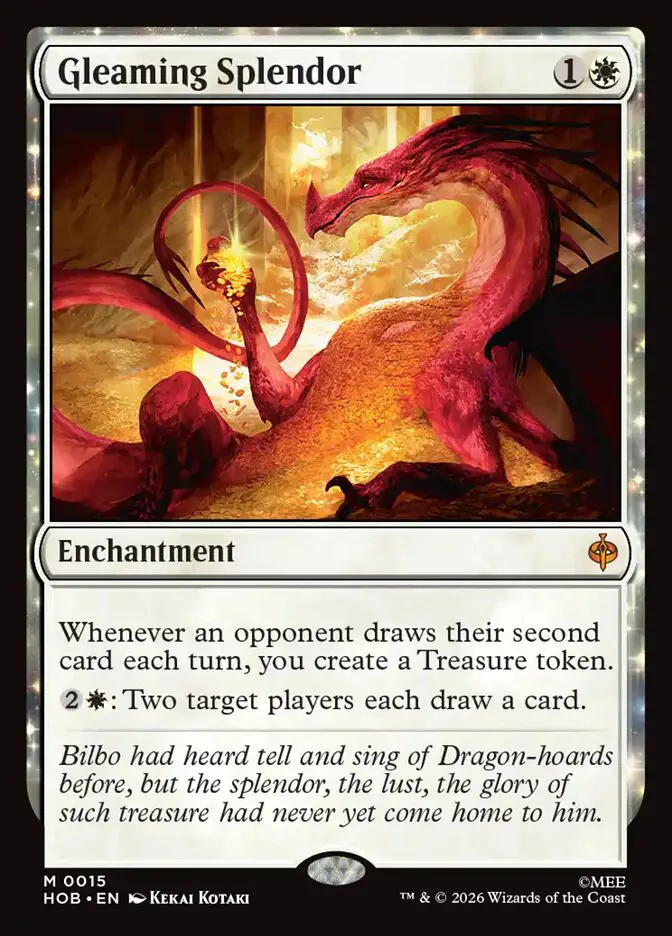
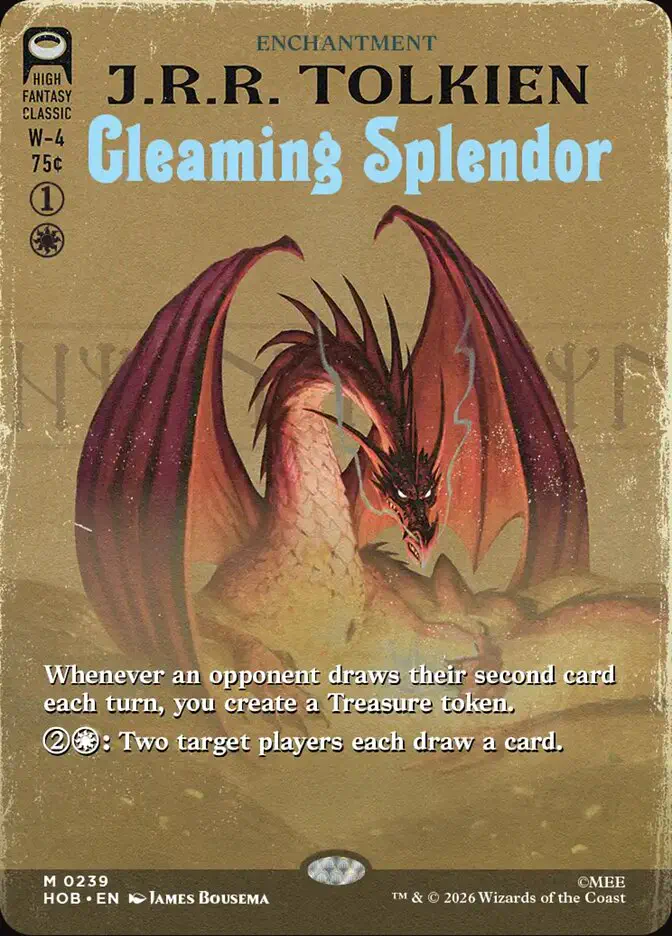
Mainly a Commander card, but the efficiency is such that it is well worth discussing.
, enchantment: whenever an opponent draws their second card each turn, you get a free Treasure. By paying , you can also make two target players draw a card.
At a Commander table, where drawing multiple cards per turn is the norm, this can become a monstrous mana engine—and with the activated ability, you can even trigger it yourself. In Standard, the story is quite different: many modern blue effects "add cards to hand" without technically drawing, so the card might do nothing. But against the right deck, it becomes a repeatable source of mana that is incredibly annoying to remove.
I don't see it as an immediate competitive staple, but in Commander, it looks poised to find its way into thousands of lists within a few weeks.
My Precious // Allure of Power
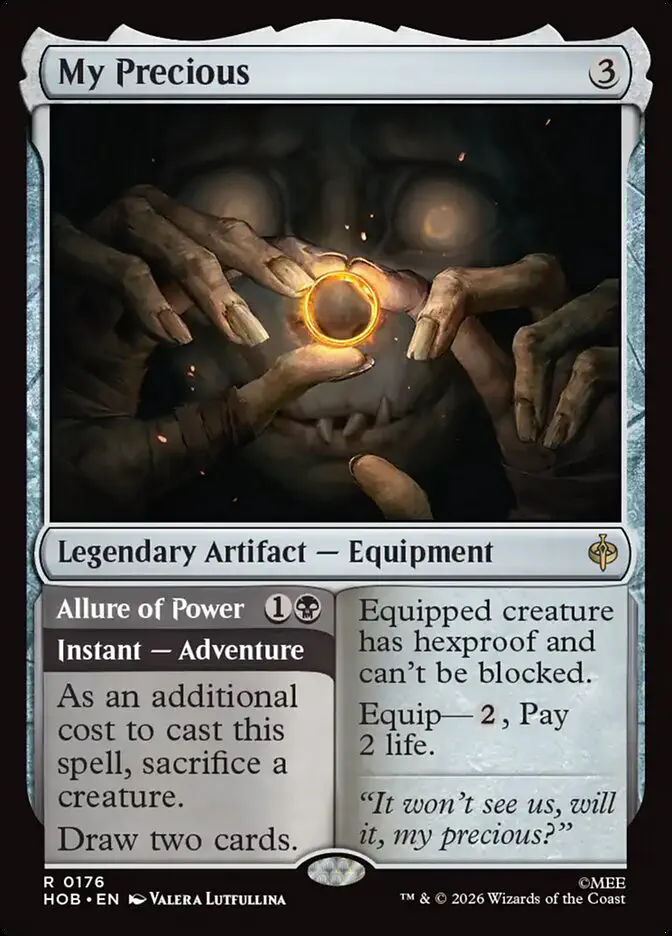
This is the classic card that goes somewhat unnoticed now, only to be found everywhere in a month.
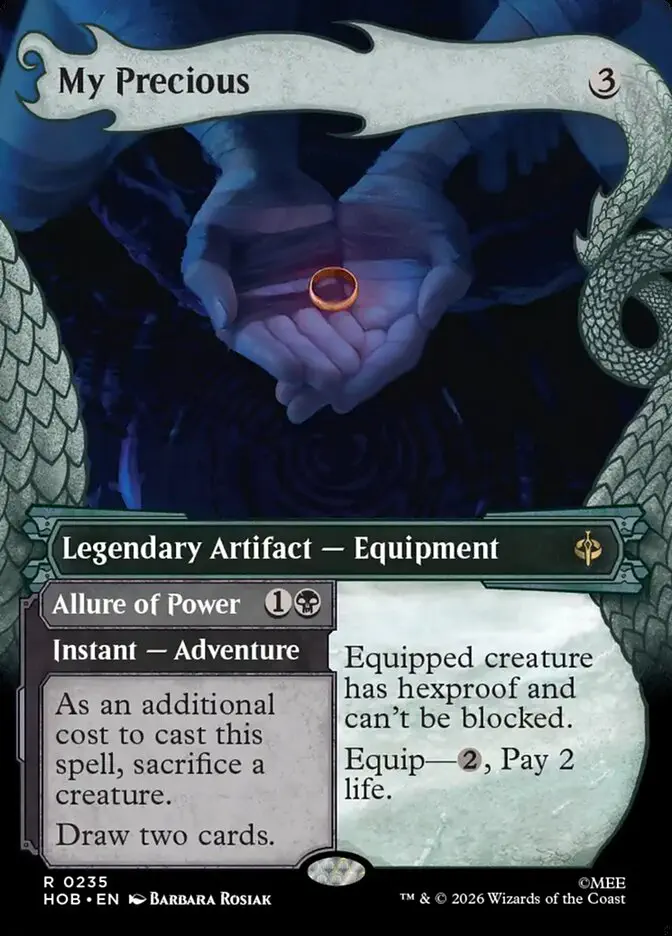
The Adventure, Allure of Power, costs : sacrifice a creature as an additional cost, draw two cards. Then you can cast My Precious from exile, a three-mana legendary Equipment that gives hexproof and "can't be blocked" to the equipped creature. Equip: and 2 life.
The first half on its own is already a solid piece for sacrifice decks: it turns a token or a dying creature into two cards without losing access to the Equipment. The second half makes a threat practically unstoppable in combat. The total cost is not trivial, but having two such different effects on the same card means you don't have to choose what to cut from your list.
I can see it fitting well in artifact decks, sacrifice strategies, or simply as a plan B to make your game-ending threat unblockable. It is not the most powerful card in the set, but it is among those that will most often end up at the center of interactions that no one predicted.
So, which one is truly the best?
If I had to bet on an immediate impact in Standard, I would say Bilbo's Gambit: it is cheap, flexible, and gives white a type of stack interaction that we rarely see.
However, Wizard's Staff remains the one with the highest and most dangerous potential—it will all depend on what creatures we have available and how quickly someone finds a list where it is not just a "win more" piece. If the right combo emerges, it will be the card we talk about for months.
For those who mainly play Commander, the perspective is different: Gleaming Splendor seems like the safest long-term bet, while Orcrist, Goblin-cleaver and Bard, King of Dale are already among the most sought-after cards for typal and value-token decks. The Sackville-Bagginses and My Precious remain the sleepers I would pick up before the price goes up.
Still, the real surprise, in my opinion, remains The Eagles Are Coming!. Protection, ETB value, token synergy, and the ability to rebuild the board after a wrath: there are just too many good things on a single card for it not to end up everywhere.
Compared to other recent releases, HOB seems to have fewer blatantly overpowered bombs, but several cards have the kind of flexibility that only reveals itself after weeks of playtesting. And in the end, those are almost always the ones that leave the deepest mark.
Alex